
Georgios Papadopoulos
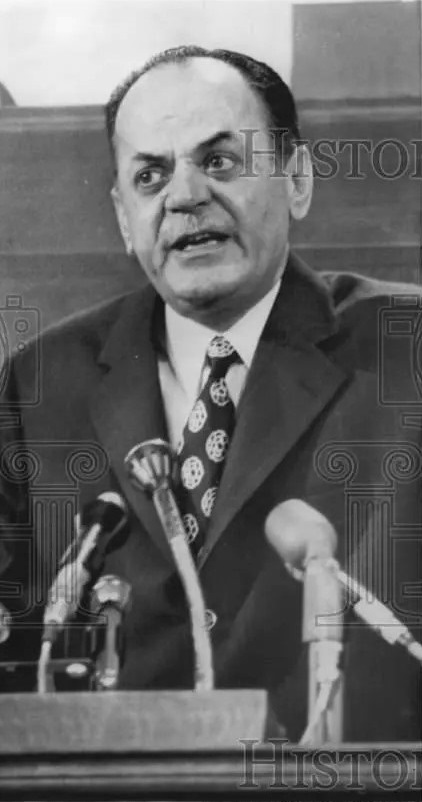
0 sources
Summary
Georgios Papadopoulos was born on May 5, 1919[1], in Elaiochori[2]. He died on June 27, 1999[3], in Laiko General Hospital of Athens[4]. He worked as a military personnel[5], military officer[6], dictator[7], and politician[8]. He ranks in the top 0.67% of human entities by monthly Wikipedia readership (3,968 views/month, #6,700 of 1,000,298).[9]
Key Facts
- Place of burial: First Cemetery of Athens[10]
- Country of citizenship: Greece[11]
- Native language: Modern Greek[12]
- Ethnic group: Greeks[13]
- Field of work: politics[14], politician[15], politics of Greece[16]
- Position held: Prime Minister of Greece[17], Minister for National Defence of Greece[18], Minister of National Education and Religious Affairs of Greece[19], Minister at the Presidency of the Government of Greece[20], President of Greece[21], Regent of Greece[22], Minister for Foreign Affairs of Greece[23]
- Educated at: Q12874809[24], Hellenic Military Academy[25], National Technical University of Athens[26], Supreme Joint War College[27]
- Award received: Grand Cross of the Order of the Redeemer[28], Grand Cross of the Order of Honour[29], Gold Cross of Valour[30], Greek War Cross, 3rd Class[31], Medal for Outstanding Acts[32], Silver Cross of the Order of George I[33], Medal of Military Merit[34], War Cross[35], Medal of National Resistance 1941-1945[36], campaign medal[37]
- Member of: Q12878113[38], Q12876682[39], Organization X[40], Greek junta[41]
- Religion or worldview: Greek Orthodoxy[42]
- Sex or gender: male[43]
- Member of political party: independent politician[44], National Political Union[45]
- Military branch: Hellenic Army[46]
- Commons category: Georgios Papadopoulos[47]
- Military, police or special rank: brigadier general[48]
- Cause of death: cardiac arrest[49]
- Residence: Kypseli, Athens[50], Patisia[51], Neo Psychiko[52], Lagonisi[53]
- Handedness: right-handedness[54]
- Participated in conflict: World War II[55], Greco-Italian War[56], Battle of Greece[57], Greek Resistance[58], Dekemvriana[59], Greek Civil War[60], 1967 Greek coup d'état[61]
- Family name: Papadopoulos[62]
- Given name: Georgios[63]
- Allegiance: Kingdom of Greece[64], Hellenic State[65]
- Medical condition: prostate cancer[66], amyotrophic lateral sclerosis[67], pneumonia[68], cardiac arrest[69]
Why It Matters
Georgios Papadopoulos has Wikipedia articles in 26 language editions, a strong signal of global cultural recognition.[70] He is known by 52 alternative names across languages and contexts.[71]
FAQs
Where was Georgios Papadopoulos born?
Georgios Papadopoulos's place of birth was Elaiochori[2].
Where did Georgios Papadopoulos die?
Georgios Papadopoulos died in Laiko General Hospital of Athens[4].
What did Georgios Papadopoulos do for work?
Georgios Papadopoulos worked as a military personnel[5], military officer[6], dictator[7], and politician[8].
Where did Georgios Papadopoulos go to school?
Georgios Papadopoulos was educated at Q12874809[24], Hellenic Military Academy[25], National Technical University of Athens[26], and Supreme Joint War College[27].
What awards did Georgios Papadopoulos receive?
Honors received include Grand Cross of the Order of the Redeemer[28], Grand Cross of the Order of Honour[29], Gold Cross of Valour[30], and Greek War Cross, 3rd Class[31].