
Frithjof Schuon
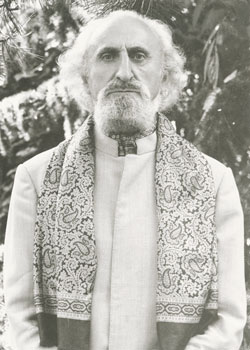
0 sources
Frithjof Schuon was born on June 18, 1907, in Basel[1][2][3][4]. A Swiss citizen[5], he spent much of his life engaged with Islamic spirituality[6]. His work and teachings centered on the intellectual and metaphysical dimensions of religion, particularly within the Sufi tradition.
Schuon died on May 5, 1998, in Bloomington[1][2][3]. His writings and influence extended across philosophical and religious studies, focusing on universal truths and the perennial philosophy.
Key Facts
- Frithjof Schuon was born in Basel[2].
- Frithjof Schuon died in Bloomington[4].
- Frithjof Schuon was born on June 18, 1907[3].
- Frithjof Schuon died on May 5, 1998[5].
- Frithjof Schuon was married to Catherine Schuon[10].
- Frithjof Schuon held citizenship in Switzerland[11].
- Frithjof Schuon worked as a philosopher[6].
- Frithjof Schuon's professions included poet[7].
- Frithjof Schuon worked as a painter[8].
- Frithjof Schuon's field of work was spirituality[12].
- A notable student of Frithjof Schuon was Titus Burckhardt[13].
- A notable student of Frithjof Schuon was Martin Lings[14].
- A notable student of Frithjof Schuon was Leo Schaya[15].
- A notable student of Frithjof Schuon was Hossein Nasr[16].
- A notable work attributed to Frithjof Schuon is The Transcendent Unity of Religions[17].
- A notable work attributed to Frithjof Schuon is Logic and Transcendence[18].
- A notable work attributed to Frithjof Schuon is Understanding Islam[19].
- A notable work attributed to Frithjof Schuon is Form and Substance in Religions[20].
- A notable work attributed to Frithjof Schuon is The Transfiguration of Man[21].
- Frithjof Schuon's religion is recorded as Islam[22].
- Frithjof Schuon was influenced by René Guénon[23].
- Frithjof Schuon was influenced by Ādi Shankara[24].
- Frithjof Schuon was influenced by Plato[25].
- Frithjof Schuon was influenced by Ibn Arabi[26].
- Frithjof Schuon was influenced by Meister Eckhart[27].
Body
Origins and Family
Frithjof Schuon was born in Basel[2]. He was born on June 18, 1907[3].
Career and Affiliations
Recorded occupations include philosopher[6], poet[7], and painter[8]. Frithjof Schuon's field of work was spirituality[12]. Notable students include Titus Burckhardt[13], a philosopher[28], 1908–1984[29], of Switzerland[30]; Martin Lings[14], a librarian[31], 1909–2005[32], of United Kingdom[33]; Leo Schaya[15], a writer[34], 1916–1986[35], of Switzerland[36]; and Hossein Nasr[16], a philosopher[37], b. 1933[38], of Iran[39], awarded the Gittler Prize[40].
Works and Contributions
Notable works include The Transcendent Unity of Religions[17], a literary work[41]; Logic and Transcendence[18]; Understanding Islam[19]; Form and Substance in Religions[20]; and The Transfiguration of Man[21].
Personal Life
Among Frithjof Schuon's spouses was Catherine Schuon[10]. His religion is recorded as Islam[22].
Death and Burial
Frithjof Schuon died on May 5, 1998[5]. He passed away in Bloomington[4].
Why It Matters
Frithjof Schuon has Wikipedia articles in 19 language editions, a strong signal of global cultural recognition.[9] He is known by 26 alternative names across languages and contexts.[42]
He has been cited as an influence by Ivan Illich[43], a Catholic priest[44], 1926–2002[45], of Austria[46], awarded the Kultur- und Friedenspreis der Villa Ichon[47], specialised in political ecology[48]; John Tavener[49], a composer[50], 1944–2013[51], of United Kingdom[52], awarded the Ivor Novello Awards[53]; Olavo de Carvalho[54], an essayist[55], 1947–2022[56], of Brazil[57], awarded the Santos-Dumont Merit Medal[58], specialised in epistemology[59]; Huston Smith[60], a philosopher[61], 1919–2016[62], of United States[63], specialised in philosophy[64]; Walter James, 4th Baron Northbourne[65], an agricultural engineer[66], 1896–1982[67], of United Kingdom of Great Britain and Ireland[68]; and Marco Pallis[69], an explorer[70], 1895–1989[71], of United Kingdom[72].
FAQs
Where was Frithjof Schuon born?
Frithjof Schuon was born in Basel[2].
Where did Frithjof Schuon die?
Frithjof Schuon died in Bloomington[4].
Who was Frithjof Schuon married to?
Frithjof Schuon's spouses include Catherine Schuon[10].
What did Frithjof Schuon do for work?
Frithjof Schuon worked as philosopher[6], poet[7], and painter[8].
Who did Frithjof Schuon influence?
Frithjof Schuon has been cited as an influence by Ivan Illich[43], John Tavener[49], Olavo de Carvalho[54], and Huston Smith[60].