
Ferdinand VII of Spain
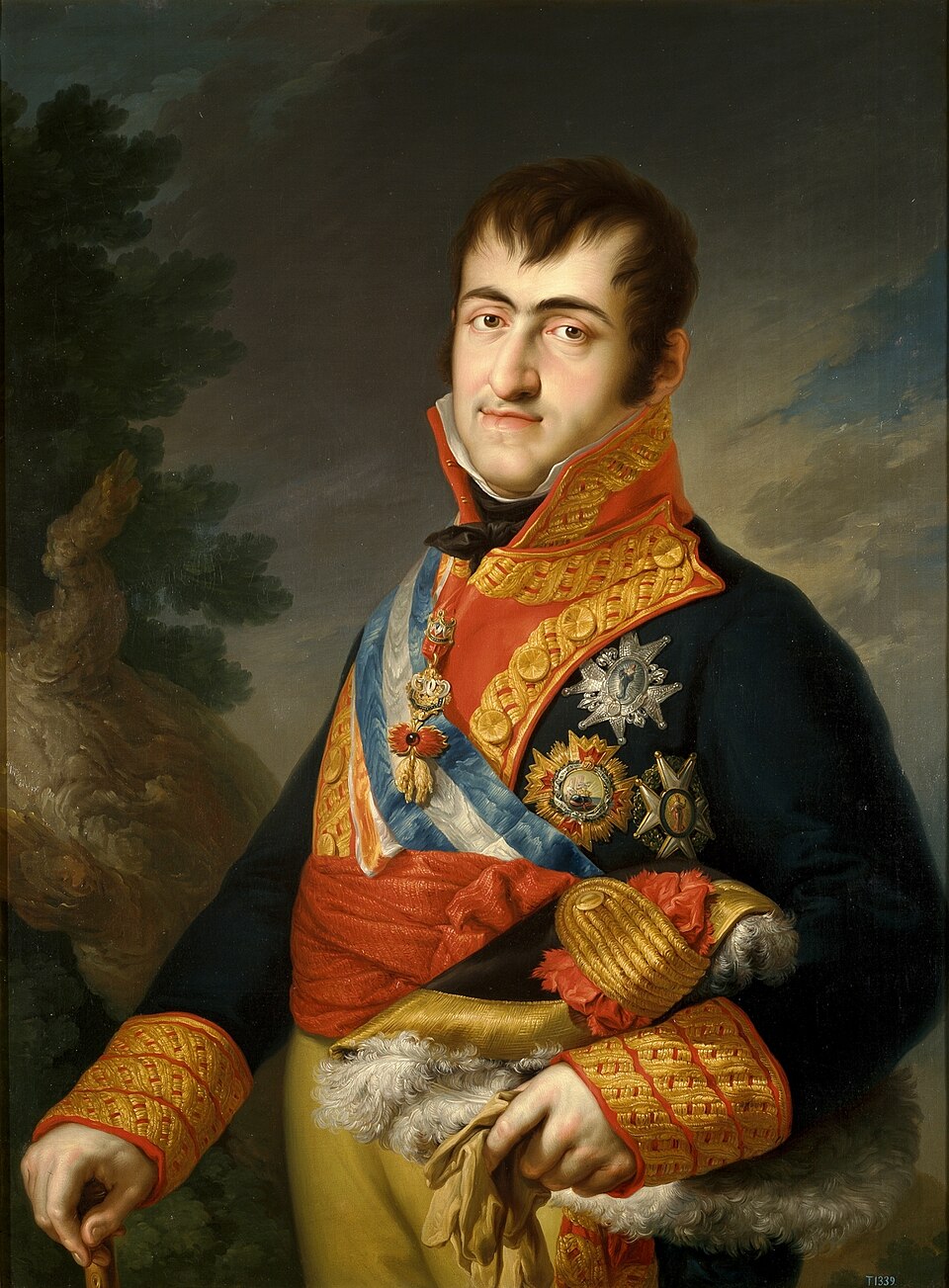
0 sources
Ferdinand VII of Spain
Summary
Ferdinand VII of Spain is a human[1]. His place of birth was Royal Monastery of San Lorenzo de El Escorial[2]. He was born on October 14, 1784[3]. He died in Royal Palace of Madrid[4]. He died on September 29, 1833[5]. He worked as a ruler[6]. He has Wikipedia articles in 29 language editions, a strong signal of global cultural recognition.[7]
Key Facts
- Born in Royal Monastery of San Lorenzo de El Escorial[2], Ferdinand VII of Spain…
- Ferdinand VII of Spain died in Royal Palace of Madrid[4].
- Ferdinand VII of Spain was born on October 14, 1784[3].
- Ferdinand VII of Spain was born on October 14, 1784[8].
- Ferdinand VII of Spain died on September 29, 1833[5].
- Ferdinand VII of Spain is buried at Royal Crypt of the Royal Monastery of San Lorenzo de El Escorial[9].
- Burial took place at Royal Monastery of San Lorenzo de El Escorial[10].
- Ferdinand VII of Spain's father was Charles IV of Spain[11].
- Ferdinand VII of Spain's mother was Maria Luisa of Parma[12].
- Ferdinand VII of Spain was married to Maria Antonia of Naples and Sicily[13].
- Ferdinand VII of Spain was married to Queen Maria Isabel of Spain[14].
- Among Ferdinand VII of Spain's spouses was Maria Josepha Amalia of Saxony[15].
- Ferdinand VII of Spain was married to Maria Christina of the Two Sicilies[16].
- A child of Ferdinand VII of Spain was Isabella II of Spain[17].
- A child of Ferdinand VII of Spain was Luisa Fernanda of Spain, Duchess of Montpensier[18].
- A child of Ferdinand VII of Spain was Infanta María Luisa Isabel of Spain[19].
- A child of Ferdinand VII of Spain was unnamed daughter de Borbón[20].
- A child of Ferdinand VII of Spain was Carlos Luis de Borbón y Bragança[21].
- Ferdinand VII of Spain held citizenship in Spain[22].
- Ferdinand VII of Spain worked as a ruler[6].
- Ferdinand VII of Spain held the position of monarch of Spain[23].
- Ferdinand VII of Spain held the position of monarch of Spain[24].
- Ferdinand VII of Spain held the position of Grand Master of the Order of Santiago[25].
- Ferdinand VII of Spain held the position of Head of State of Spain[26].
- Ferdinand VII of Spain held the position of Head of State of Spain[27].
Body
Origins and Family
Ferdinand VII of Spain was born in Royal Monastery of San Lorenzo de El Escorial[2]. Recorded date of birth include October 14, 1784[3]. His father was Charles IV of Spain[11]. His mother was Maria Luisa of Parma[12].
Career and Affiliations
Ferdinand VII of Spain worked as a ruler[6]. Positions held include monarch of Spain[23], a noble title[28], in Spain[29]; Grand Master of the Order of Santiago[25], a Grand Master[30], in Spain[31]; and Head of State of Spain[26].
Works and Contributions
A notable work attributed to Ferdinand VII of Spain is Will of him[32]. Things named for him include San Fernando[33], a municipality of Spain[34], in Spain[35].
Recognition
Awards received include Knight of the Order of the Holy Spirit[36], a grade of an order[37], in Kingdom of France[38]; Knight of the Order of Saint-Michel[39], a grade of an order[40], in Kingdom of France[41]; Knight of the Order of the Golden Fleece[42], a grade of an order[43]; Order of St. Andrew[44]; Collar of the Order of Isabella the Catholic[45]; and Order of Saint Ferdinand[46].
Personal Life
Spouses include Maria Antonia of Naples and Sicily[13], a crown princess[47], 1784–1806[48], of Spain[49], awarded the Order of the Starry Cross[50]; Queen Maria Isabel of Spain[14], a consort[51], 1797–1818[52], of Spain[53]; Maria Josepha Amalia of Saxony[15], a regent[54], 1803–1829[55], of Spain[56], awarded the Order of the Starry Cross[57]; and Maria Christina of the Two Sicilies[16], a politician[58], 1806–1878[59], of Kingdom of Italy[60], awarded the Grand Cross of the Order of the Immaculate Conception of Vila Viçosa[61], specialised in politics[62]. Children include Isabella II of Spain[17], a ruler[63], 1830–1904[64], of Spain[65], awarded the Knight of the Order of the Golden Fleece[66]; Luisa Fernanda of Spain, Duchess of Montpensier[18], an aristocrat[67], 1832–1897[68], of Spain[69], awarded the Order of the Starry Cross[70]; Infanta María Luisa Isabel of Spain[19], 1817–1818[71], of Spain[72]; unnamed daughter de Borbón[20], 1818–1818[73]; and Carlos Luis de Borbón y Bragança[21], 1818–1861[74], of Spain[75], awarded the Knight of the Order of the Holy Spirit[76]. Ferdinand VII of Spain's religion is recorded as Catholic Church[77].
Death and Burial
Ferdinand VII of Spain died on September 29, 1833[5]. He passed away in Royal Palace of Madrid[4]. Recorded place of burial include Royal Crypt of the Royal Monastery of San Lorenzo de El Escorial[9] and Royal Monastery of San Lorenzo de El Escorial[10].
Why It Matters
Ferdinand VII of Spain has Wikipedia articles in 29 language editions, a strong signal of global cultural recognition.[7] He is known by 39 alternative names across languages and contexts.[78]
Entities named for him include San Fernando[33], a municipality of Spain[34], in Spain[35].
FAQs
Where was Ferdinand VII of Spain born?
Ferdinand VII of Spain was born in Royal Monastery of San Lorenzo de El Escorial[2].
Where did Ferdinand VII of Spain die?
Ferdinand VII of Spain passed away in Royal Palace of Madrid[4].
Who were Ferdinand VII of Spain's parents?
Ferdinand VII of Spain's father was Charles IV of Spain[11]. Ferdinand VII of Spain's mother was Maria Luisa of Parma[12].
Who was Ferdinand VII of Spain married to?
Ferdinand VII of Spain's spouses include Maria Antonia of Naples and Sicily[13], Queen Maria Isabel of Spain[14], Maria Josepha Amalia of Saxony[15], and Maria Christina of the Two Sicilies[16].
What did Ferdinand VII of Spain do for work?
Ferdinand VII of Spain worked as ruler[6].
What awards did Ferdinand VII of Spain receive?
Honors received include Knight of the Order of the Holy Spirit[36], Knight of the Order of Saint-Michel[39], Knight of the Order of the Golden Fleece[42], and Order of St. Andrew[44].