
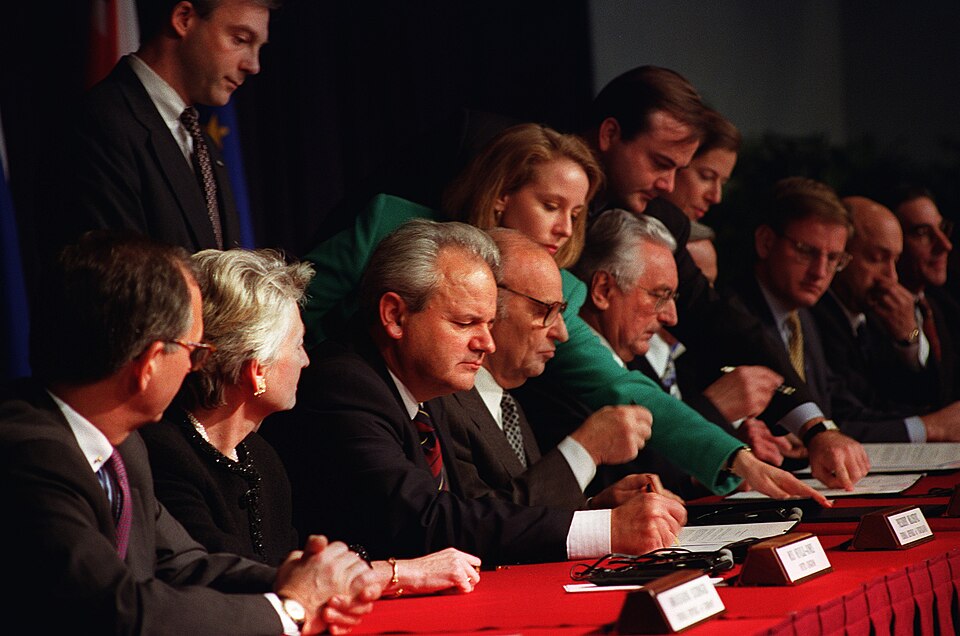
Dayton Agreement
late-1995 treaty ending the Bosnian War
Press Enter · cited answer in seconds
0 sources
Summary
Dayton Agreement is a peace treaty[1]. It ranks in the top 3% of peace treaty entities by monthly Wikipedia readership (7,588 views/month).[2]
Key Facts
- Instance of: written work[3], version, edition or translation[4]
- Named after: Dayton[5]
- Location: Wright-Patterson Air Force Base[6]
- Subclass of: agreement[7]
- Commons category: Dayton Agreement[8]
- Has part(s): Annex 8: Commission to Preserve National Monuments[9]
- Point in time: December 14, 1995[10], November 21, 1995[11]
- Organizer: European Union[12], France[13], United Kingdom[14], Germany[15], Russia[16], United States[17]
- Participant: Federal Republic of Yugoslavia[18], Bosnia and Herzegovina[19], Croatia[20]
- Section: Annex 1-A: Military Aspects of the Peace Settlement[21], Annex 1-B: Regional Stabilization[22], Annex 4: Constitution[23], Annex 5: Arbitration[24], Annex 6: Human Rights[25], Annex 7: Refugees and Displaced Persons[26], Annex 8: Commission to Preserve National Monuments[27], Annex 2: Inter-Entity Boundary Line[28], Annex 9: Bosnia and Herzegovina Public Corporations[29], Annex 10: Civilian Implementation[30], Annex 11: International Police Task Force[31]
- Facet of: War in Bosnia and Herzegovina[32]
- Short name: Dayton[33]
- Signatory: Slobodan Milošević[34], Alija Izetbegović[35], Franjo Tuđman[36], Bill Clinton[37], Jacques Chirac[38], John Major[39], Helmut Kohl[40], Victor Chernomyrdin[41]
Why It Matters
Dayton Agreement has Wikipedia articles in 29 language editions, a strong signal of global cultural recognition.[42] It is known by 94 alternative names across languages and contexts.[43]