
Carl Linnaeus
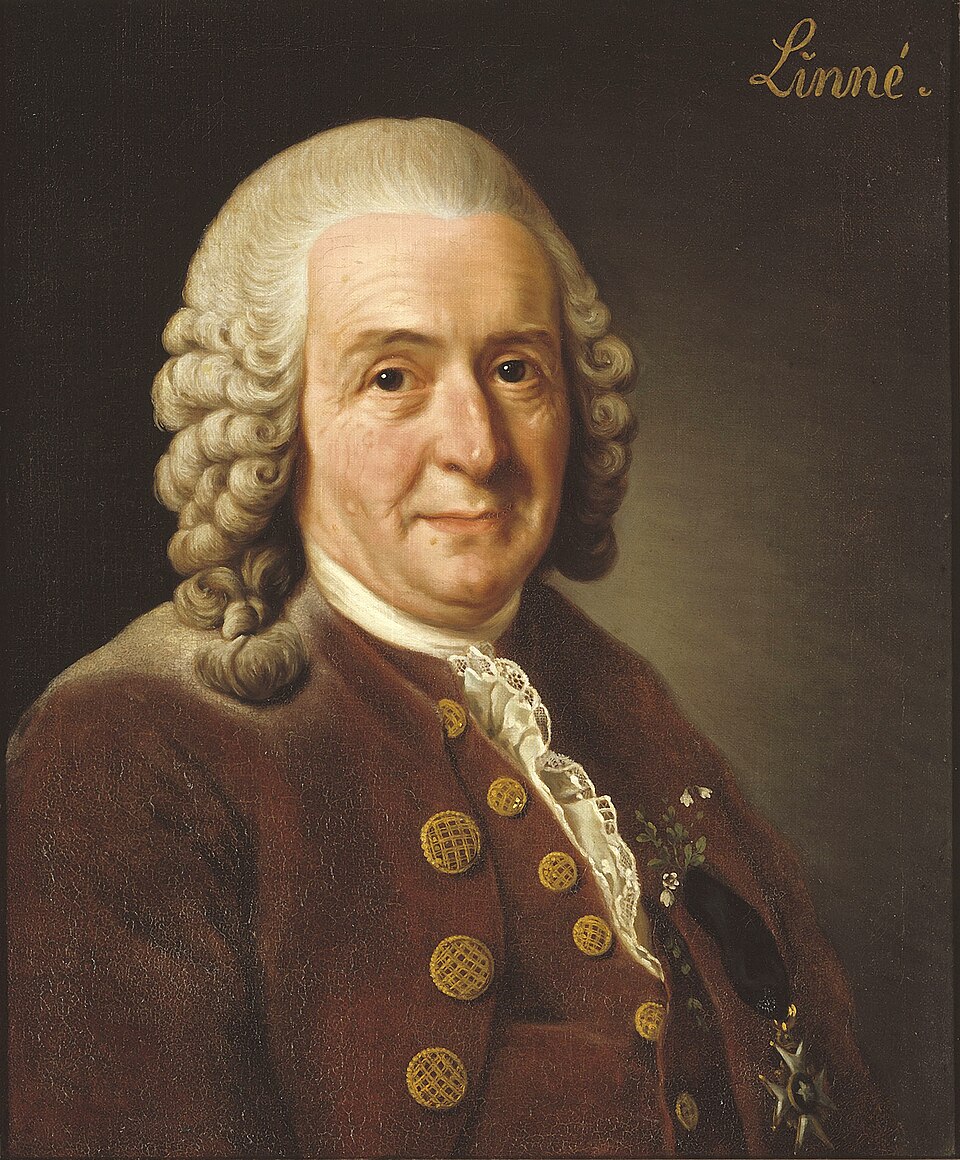
0 sources
Summary
Carl Linnaeus was born in Råshult[1]. He died in Linnaeus Hammarby[2]. He worked as a botanist[3], physician[4], autobiographer[5], biologist[6], and mycologist[7]. He ranks in the top 0.46% of human entities by monthly Wikipedia readership (21,722 views/month, #4,563 of 1,000,298).[8]
Key Facts
- Place of death: Uppsala[9]
- Place of burial: Uppsala Cathedral[10]
- Father: Nils Ingemarsson Linnaeus[11]
- Mother: Christina Brodersonia[12]
- Spouse: Sara Elisabeth Moræa[13]
- Child: Carl Linnaeus the Younger[14], Elisabeth Christina von Linné[15], Lovisa von Linné[16], Sara Christina von Linné[17]
- Country of citizenship: Sweden[18]
- Native language: Swedish[19]
- Ethnic group: Swedes[20]
- Occupation: pteridologist[21], bryologist[22], zoologist[23], entomologist[24], ornithologist[25], naturalist[26], arachnologist[27], mineralogist[28], taxonomist[29], scientific collector[30], university teacher[31]
- Field of work: medicine[32], natural history[33], botany[34], natural science[35]
- Employer: Uppsala University[36]
- Educated at: University of Harderwijk[37], Lund University[38], Uppsala University[39]
- Doctoral advisor: Olof Rudbeck the Younger[40], Johannes Gorter[41]
- Award received: Knight of the Order of the Polar Star[42]
- Member of: Royal Prussian Academy of Sciences[43], German Academy of Sciences Leopoldina[44], Royal Society[45], Royal Swedish Academy of Sciences[46], Saint Petersburg Academy of Sciences[47], Royal Danish Academy of Sciences and Letters[48], Royal Norwegian Society of Sciences and Letters[49], French Academy of Sciences[50], American Philosophical Society[51]
- Religion or worldview: Church of Sweden[52]
- Sex or gender: male[53]
- Family: Linné family[54]
- Doctoral student: Fredrik Hasselquist[55], Carl Peter Thunberg[56], Anders Sparrman[57], Peter Forsskål[58], Anton Rolandsson Martin[59], Alexander von Karamyschew[60], Matvey Afonin[61]
- Commons category: Carl von Linné[62]
- Archives at: Antiquarian Topographic Archive[63]
Why It Matters
Carl Linnaeus has Wikipedia articles in 30 language editions, a strong signal of global cultural recognition.[64] He is known by 122 alternative names across languages and contexts.[65]
He has been cited as an influence by Torbern Bergman[66], a chemist[67], 1735–1784[68], of Sweden[69], awarded the Fellow of the Royal Society[70], specialised in analytical chemistry[71]; Antonio José Cavanilles[72], a botanist[73], 1745–1804[74], of Spain[75], specialised in botany[76]; Anders Sparrman[77], an explorer[78], 1748–1820[79], of Sweden[80], specialised in botany[81]; Anna Blackburne[82], a naturalist[83], 1726–1793[84], of Kingdom of Great Britain[85]; Clas Alströmer[86], a botanist[87], 1736–1794[88], of Sweden[89], awarded the Commander of the Order of Vasa[90]; and Fredrik Hasselquist[91], a biologist[92], 1722–1752[93], of Sweden[94], specialised in botany[95].
He is credited with the discovery of Linnaeus' flower clock[96]. Works attributed to him include binomial nomenclature[97], a genus–differentia definition[98], founded in 1735[99]; Systema Naturae[100], a written work[101]; 10th edition of Systema Naturae[102]; Species Plantarum[103]; Genera Plantarum[104]; and Philosophia Botanica[105].
FAQs
Where was Carl Linnaeus born?
Carl Linnaeus was born in Råshult[1].
Where did Carl Linnaeus die?
Carl Linnaeus passed away in Linnaeus Hammarby[2].
Who were Carl Linnaeus's parents?
Carl Linnaeus's father was Nils Ingemarsson Linnaeus[11]. Carl Linnaeus's mother was Christina Brodersonia[12].
Who was Carl Linnaeus married to?
Carl Linnaeus's spouses include Sara Elisabeth Moræa[13].
What did Carl Linnaeus do for work?
Carl Linnaeus worked as a botanist[3], physician[4], autobiographer[5], biologist[6], and mycologist[7].
Where did Carl Linnaeus go to school?
Carl Linnaeus was educated at University of Harderwijk[37], Lund University[38], and Uppsala University[39].
What awards did Carl Linnaeus receive?
Honors received include Knight of the Order of the Polar Star[42].
Who did Carl Linnaeus influence?
Carl Linnaeus has been cited as an influence by Torbern Bergman[66], Antonio José Cavanilles[72], Anders Sparrman[77], and Anna Blackburne[82].
What did Carl Linnaeus discover?
Carl Linnaeus is credited as discoverer of Linnaeus' flower clock[96].