
Bhagavad Gita
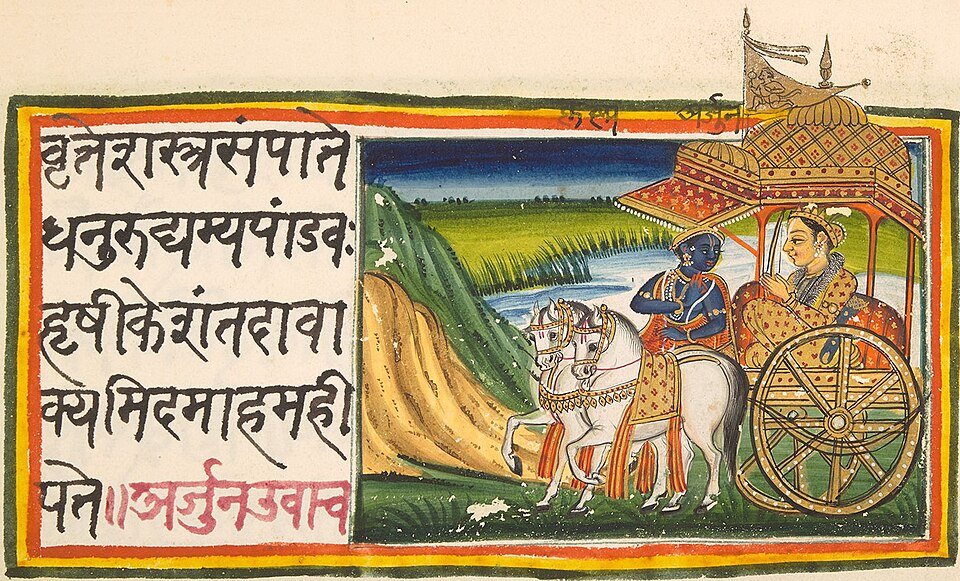
primary holy scripture for Hinduism
Press Enter · cited answer in seconds
0 sources
Summary
Bhagavad Gita is a literary work[1]. It ranks in the top 0.19% of literary work entities by monthly Wikipedia readership (24,843 views/month, #54 of 28,446).[2]
Key Facts
- Author: Vyāsa[3]
- Genre: religious poem[4]
- Part of: Bhisma Parva[5]
- Commons category: Bhagavad Gita[6]
- Language of work or name: Sanskrit[7]
- Has part(s): Arjuna–Visada Yoga[8], Sankhya Yoga[9], Karma Yoga[10], Gyaana–Karma-Sanyasa Yoga[11], Karma–Sanyasa Yoga[12], Atmasanyam Yoga[13], jñānavijñānayogaḥ[14], Aksara–Brahma Yoga[15], Raja–Vidya–Raja–Guhya Yoga[16], Vibhuti–Vistara Yoga[17], Visvarupa–Darsana Yoga[18], Ksetra–Ksetrajna Vibhaga Yoga[19], Bhakti Yoga[20], Gunatraya–Vibhaga Yoga[21]
- Characters: Krishna[22], Dhṛtarāṣṭra[23], Sanjaya[24], Arjuna[25]
- Has edition or translation: Bhagavad Gita[26], The Bhagavad-Gita[27], Bhagavad-gītā As It Is[28], Bhagavad Gita: The Song of God[29], Śrīmad Bhagavad Gītā[30], God Talks with Arjuna: The Bhagavad Gita[31], The Holy Geeta[32], Q111600386[33], Q111600385[34], Q111600391[35], ଶ୍ରୀମଦ୍ ଭଗବଦ୍ ଗୀତା[36], Q111600394[37], Q19181613[38], Shrimadbhagbadgeeta[39]
- Topic's main category: Category:Bhagavad Gita[40]
- Main subject: Hinduism[41], Krishna[42]
- Commons gallery: Bhagavad Gita[43]
Why It Matters
Bhagavad Gita has Wikipedia articles in 30 language editions, a strong signal of global cultural recognition.[44] It is known by 156 alternative names across languages and contexts.[45]
It has been cited as an influence by Henry David Thoreau[46], a poet[47], 1817–1862[48], of United States[49], awarded the Hall of Fame for Great Americans[50], specialised in writing[51].
FAQs
Who did Bhagavad Gita influence?
Bhagavad Gita has been cited as an influence by Henry David Thoreau[46].