
Beatrice di Tenda
tragic opera in two acts by Vincenzo Bellini
Press Enter · cited answer in seconds
0 sources
Summary
Beatrice di Tenda is a dramatico-musical work[1]. It draws 63 Wikipedia views per month (dramatico_musical_work category, ranking #388 of 2,893).[2]
Key Facts
- Beatrice di Tenda's instance of is recorded as dramatico-musical work[3].
- Beatrice di Tenda's composer is recorded as Vincenzo Bellini[4].
- Beatrice di Tenda's librettist is recorded as Felice Romani[5].
- Beatrice di Tenda's genre is tragédie en musique[6].
- Beatrice di Tenda's genre is opera[7].
- Beatrice di Tenda's Commons category is recorded as Beatrice di Tenda[8].
- Beatrice di Tenda's language of work or name is recorded as Italian[9].
- Beatrice di Tenda's country of origin is recorded as Italy[10].
- Beatrice di Tenda was published on 1850[11].
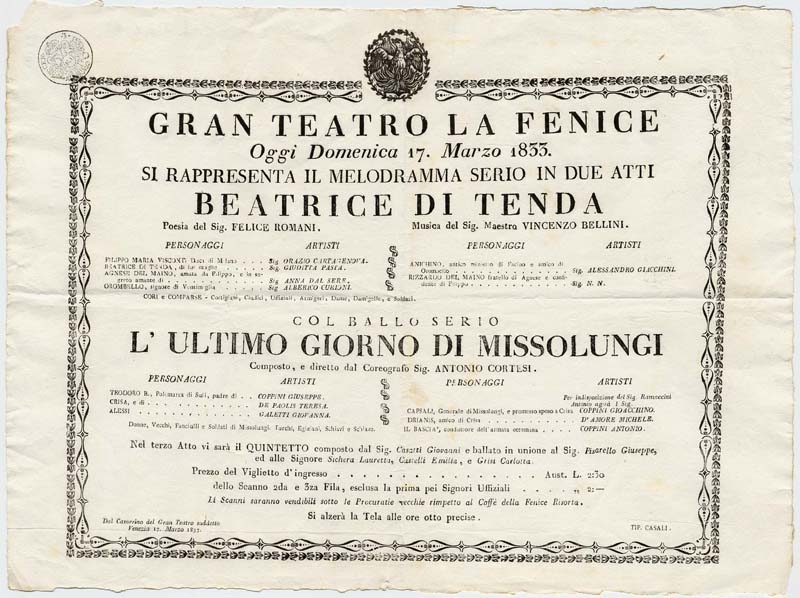
- Beatrice di Tenda's characters is recorded as Rizzardo del Maino[12].
- Beatrice di Tenda's characters is recorded as Filippo Maria Visconti[13].
- Beatrice di Tenda's characters is recorded as Beatrice di Tenda[14].
- Beatrice di Tenda's characters is recorded as Agnese del Maino[15].
- Beatrice di Tenda's characters is recorded as Orombello[16].
- Beatrice di Tenda's characters is recorded as Anichino[17].
- Beatrice di Tenda's date of first performance is recorded as March 16, 1833[18].
- Beatrice di Tenda's title is recorded as {'lang': 'it', 'text': 'Beatrice di Tenda'}[19].
- Beatrice di Tenda's number of parts of this work is recorded as {'unit': 'act', 'amount': '+2'}[20].
- Beatrice di Tenda's location of first performance is recorded as Teatro La Fenice[21].
- Beatrice di Tenda's copyright status is recorded as public domain[22].
- Beatrice di Tenda's form of creative work is recorded as opera[23].
Product Details
The following facts are restated verbatim from public-domain and CC0 open-data sources — every line is independently verifiable against the named source's catalog.
MusicBrainz — CC0 open music encyclopedia
Why It Matters
Beatrice di Tenda draws 63 Wikipedia views per month (dramatico_musical_work category, ranking #388 of 2,893).[2] It has Wikipedia articles in 9 language editions, a strong signal of global cultural recognition.[26] It is known by 4 alternative names across languages and contexts.[27]