
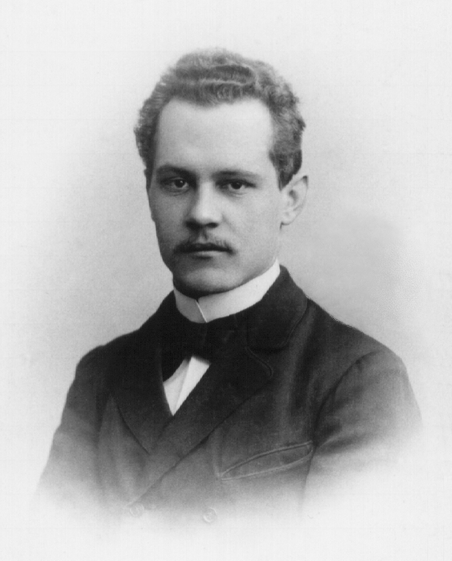
Arnold Sommerfeld
0 sources
Summary
Arnold Sommerfeld was born in Königsberg[1]. He died in Munich[2]. He worked as a theoretical physicist[3], mathematician[4], university teacher[5], and physicist[6]. He ranks in the top 0.71% of human entities by monthly Wikipedia readership (3,010 views/month, #7,055 of 1,000,298).[7]
Key Facts
- Place of burial: Nordfriedhof[8]
- Father: Franz Sommerfeld[9]
- Spouse: Johanna Sommerfeld[10]
- Country of citizenship: Germany[11]
- Field of work: theoretical physics[12], mathematical physics[13], spectroscopy[14]
- Position held: Geheimrat[15], president[16]
- Employer: Ludwig-Maximilians-Universität München[17], RWTH Aachen University[18], University of Göttingen[19], Clausthal University of Technology[20]
- Educated at: University of Königsberg[21], Altstadt Gymnasium[22]
- Doctoral advisor: Ferdinand von Lindemann[23]
- Award received: Max Planck Medal[24], Lorentz Medal[25], Oersted Medal[26], Bavarian Maximilian Order for Science and Art[27], Matteucci Medal[28], Foreign Member of the Royal Society[29], honorary doctor of the University of Calcutta[30]
- Sex or gender: male[31]
- Doctoral student: Paul Peter Ewald[32], Wolfgang Pauli[33], Gregor Wentzel[34], Wojciech Rubinowicz[35], Otto Laporte[36], Peter Debye[37], Hans Bethe[38], Werner Heisenberg[39], Karl Apfelbacher[40], Wilmer L. Barrow[41], Friedrich Burmeister[42], Paul Sophus Epstein[43], Walter Franz[44], Herbert Fröhlich[45]
Body
Works and Contributions
Things named for Arnold Sommerfeld include Bohr-Sommerfeld atom model[46], Orr–Sommerfeld equation[47], Sommerfeld number[48], Sommerfeld identity[49], Sommerfeld[50], and Arnold Sommerfeld Prize[51].
Why It Matters
Arnold Sommerfeld has Wikipedia articles in 27 language editions, a strong signal of global cultural recognition.[52] He is known by 47 alternative names across languages and contexts.[53]
He is credited with the discovery of fine-structure constant[54], a physical constant[55] and Bohr-Sommerfeld atom model[56], an atom model[57], founded in 1915[58]. Works attributed to him include Bohr-Sommerfeld atom model[59], an atom model[60], founded in 1915[61]. Entities named for him include Bohr-Sommerfeld atom model[46], Orr–Sommerfeld equation[47], Sommerfeld number[48], Sommerfeld identity[49], Sommerfeld[50], and Arnold Sommerfeld Prize[51].
His notable doctoral advisees include Werner Heisenberg[62], Wolfgang Pauli[63], Hans Bethe[64], Peter Debye[65], Walter Heitler[66], and Karl Herzfeld[67].
FAQs
Where was Arnold Sommerfeld born?
Arnold Sommerfeld was born in Königsberg[1].
Where did Arnold Sommerfeld die?
Arnold Sommerfeld passed away in Munich[2].
Who were Arnold Sommerfeld's parents?
Arnold Sommerfeld's father was Franz Sommerfeld[9].
Who was Arnold Sommerfeld married to?
Arnold Sommerfeld's spouses include Johanna Sommerfeld[10].
What did Arnold Sommerfeld do for work?
Arnold Sommerfeld worked as a theoretical physicist[3], mathematician[4], university teacher[5], and physicist[6].
Where did Arnold Sommerfeld go to school?
Arnold Sommerfeld was educated at University of Königsberg[21] and Altstadt Gymnasium[22].
What awards did Arnold Sommerfeld receive?
Honors received include Max Planck Medal[24], Lorentz Medal[25], Oersted Medal[26], and Bavarian Maximilian Order for Science and Art[27].
What did Arnold Sommerfeld discover?
Arnold Sommerfeld is credited as discoverer of fine-structure constant[54] and Bohr-Sommerfeld atom model[56].