
Antonio de Nebrija
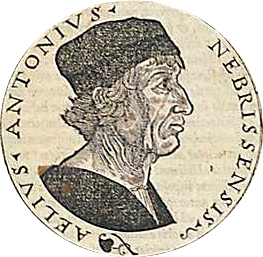
0 sources
Antonio de Nebrija
Summary
Antonio de Nebrija is a human[1]. His place of birth was Lebrija[2]. He was born on 1444[3]. He died in Alcalá de Henares[4]. He died on July 2, 1522[5]. He worked as a philologist[6], humanist[7], translator[8], grammarian[9], and university teacher[10]. He ranks in the top 0.73% of human entities by monthly Wikipedia readership (1,919 views/month, #7,266 of 1,000,298).[11]
Key Facts
- Antonio de Nebrija's place of birth was Lebrija[2].
- Antonio de Nebrija died in Alcalá de Henares[4].
- Antonio de Nebrija was born on 1444[3].
- Antonio de Nebrija died on July 2, 1522[5].
- A child of Antonio de Nebrija was Francisca de Lebrija[12].
- Antonio de Nebrija held citizenship in Spain[13].
- Old Spanish was Antonio de Nebrija's native language[14].
- Antonio de Nebrija worked as a philologist[6].
- Antonio de Nebrija worked as a humanist[7].
- Antonio de Nebrija worked as a translator[8].
- Antonio de Nebrija's professions included grammarian[9].
- Antonio de Nebrija worked as a university teacher[10].
- Antonio de Nebrija's professions included Bible translator[15].
- Antonio de Nebrija's field of work was linguistics[16].
- Antonio de Nebrija was employed by University of Salamanca[17].
- Among Antonio de Nebrija's employers was University of Alcalá[18].
- Among Antonio de Nebrija's employers was University of Bologna[19].
- Antonio de Nebrija was educated at University of Salamanca[20].
- Antonio de Nebrija's education included a stint at University of Bologna[21].
- A notable student of Antonio de Nebrija was André de Resende[22].
- A notable student of Antonio de Nebrija was Cristóbal Escobar[23].
- A notable student of Antonio de Nebrija was Enrique de Amusco[24].
- A notable work attributed to Antonio de Nebrija is Gramática de la lengua castellana[25].
- A notable work attributed to Antonio de Nebrija is Complutensian Polyglot Bible[26].
- A notable work attributed to Antonio de Nebrija is Reglas de ortografía en la lengua castellana[27].
Body
Origins and Family
Antonio de Nebrija's place of birth was Lebrija[2]. He was born on 1444[3]. Old Spanish was his native language[14].
Education
Educated at University of Salamanca[20], a public university[28], in Spain[29], founded in 1218[30], headquartered in Salamanca[31] and University of Bologna[21], a public university[32], in Italy[33], founded in 1088[34], headquartered in Bologna[35]. Antonio de Nebrija studied under Petrus Martinez de Osma[36].
Career and Affiliations
Recorded occupations include philologist[6], humanist[7], translator[8], grammarian[9], university teacher[10], and Bible translator[15]. Antonio de Nebrija's field of work was linguistics[16]. Employers include University of Salamanca[17], a public university[37], in Spain[38], founded in 1218[39], headquartered in Salamanca[40]; University of Alcalá[18], a Catholic university[41], in Spain[42], founded in 1499[43], headquartered in University and Historic Precinct of Alcalá de Henares[44]; and University of Bologna[19], a public university[45], in Italy[46], founded in 1088[47], headquartered in Bologna[48]. Notable students include André de Resende[22], an archaeologist[49], 1501–1573[50], of Kingdom of Portugal[51]; Cristóbal Escobar[23], a romanist[52], 1460–1525[53], of Spain[54]; and Enrique de Amusco[24].
Works and Contributions
Notable works include Gramática de la lengua castellana[25], a grammar book[55]; Complutensian Polyglot Bible[26], a Bible edition[56], in Spain[57]; Reglas de ortografía en la lengua castellana[27], a book[58]; and Tanto monta[59], a motto[60], in Spain[61]. Things named for Antonio de Nebrija include Universidad Nebrija[62], a private university[63], in Spain[64], founded in 1995[65]; URESAT-1[66], an amateur radio satellite[67], in Spain[68]; and Elio Antonio de Nebrija Award[69], an award[70].
Personal Life
A child of Antonio de Nebrija was Francisca de Lebrija[12].
Death and Burial
Antonio de Nebrija died on July 2, 1522[5]. He died in Alcalá de Henares[4].
Why It Matters
Antonio de Nebrija ranks in the top 0.73% of human entities by monthly Wikipedia readership (1,919 views/month, #7,266 of 1,000,298).[11] He has Wikipedia articles in 15 language editions, a strong signal of global cultural recognition.[71] He is known by 81 alternative names across languages and contexts.[72]
Works attributed to him include Complutensian Polyglot Bible[73], a Bible edition[74], in Spain[75]; Tanto monta[76], a motto[77], in Spain[78]; and Gramática de la lengua castellana[79], a grammar book[80]. Entities named for him include Universidad Nebrija[62], a private university[63], in Spain[64], founded in 1995[65]; URESAT-1[66], an amateur radio satellite[67], in Spain[68]; and Elio Antonio de Nebrija Award[69], an award[70].
FAQs
Where was Antonio de Nebrija born?
Antonio de Nebrija's place of birth was Lebrija[2].
Where did Antonio de Nebrija die?
Antonio de Nebrija died in Alcalá de Henares[4].
What did Antonio de Nebrija do for work?
Antonio de Nebrija worked as philologist[6], humanist[7], translator[8], grammarian[9], and university teacher[10].
Where did Antonio de Nebrija go to school?
Antonio de Nebrija was educated at University of Salamanca[20] and University of Bologna[21].