
Adolphe Quetelet
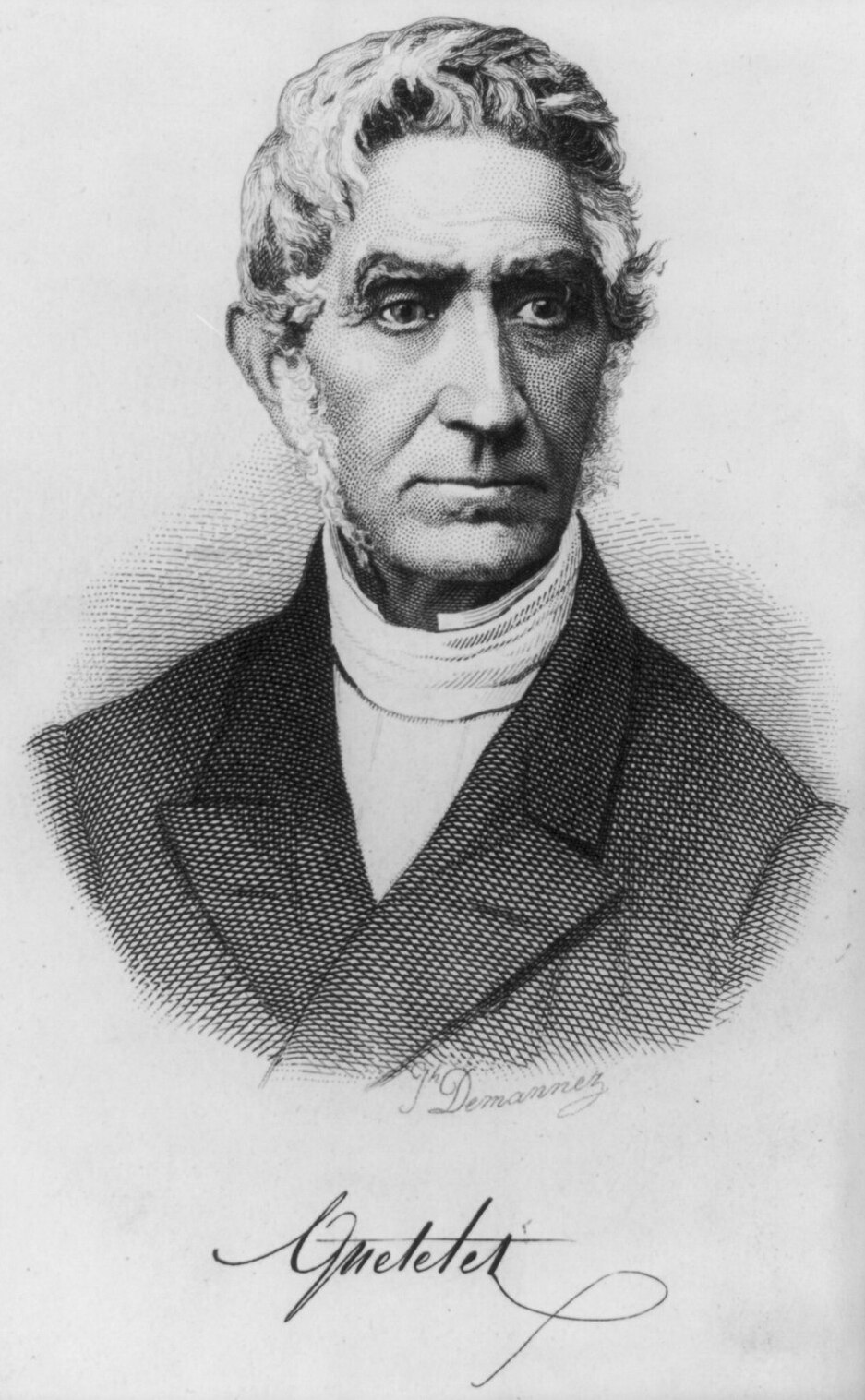
0 sources
Adolphe Quetelet was born on February 22, 1796, in Ghent [1][2][3][4][5][6][7][8][9][10][11][12][13][14]. He died on February 17, 1874, in Brussels [1][2][3][4][5][6][7][9][10][11][13][14]. Quetelet held Belgian citizenship and worked as an astronomer, mathematician, physicist, criminologist, statistician, and sociologist [1]. His education took place at Ghent University and the Paris Observatory, PSL University [15][3].
Quetelet was employed at the Jules Bordet Royal Athenaeum from 1819 to 1827 and later at the former observatory of Brussels from 1827 to 1855 [3][15]. His field of expertise was mathematics , and he was influenced by Joseph Fourier . Throughout his career, Quetelet received several awards, including being a Foreign Member of the Royal Society, Fellow of the American Academy of Arts and Sciences, and Fellow of the Royal Society of Edinburgh [16][3][17].
Quetelet held the position of director from 1832 to 1874 . He was a member of several prestigious organizations, including the Royal Society, Academy of Science for Public Utility, Royal Swedish Academy of Sciences, and Bavarian Academy of Sciences and Humanities [3]. After his death, Quetelet was buried at the Brussels Cemetery [18][19].
He spent a significant portion of his life in Belgium, with his birth and death occurring in Ghent and Brussels, respectively [1][2][3][4][5][6][7][8][9][10][11][12][13][14][1][2][3][4][5][6][7][9][10][11][13][14]. His various occupations and memberships demonstrate his diverse expertise and contributions to multiple fields [1][3].
Key Facts
- Place of burial: Brussels Cemetery[11]
- Country of citizenship: Belgium[12]
- Native language: French[13]
- Occupation: sociologist[14], university teacher[15], naturalist[16], writer[17], botanist[18]
- Field of work: mathematics[19]
- Position held: Q105870704[20], director[21]
- Employer: Jules Bordet Royal Athenaeum[22], former observatory of Brussels[23]
- Educated at: Ghent University[24], Paris Observatory, PSL University[25]
- Doctoral advisor: Jean Guillaume Garnier[26]
- Notable work: Q123281070[27]
- Award received: Foreign Member of the Royal Society[28], Fellow of the American Academy of Arts and Sciences[29], Fellow of the Royal Society of Edinburgh[30], honorary member of the Physics Association (Frankfurt am Main, Germany)[31]
- Member of: Royal Society[32], Academy of Science for Public Utility[33], Royal Swedish Academy of Sciences[34], Bavarian Academy of Sciences and Humanities[35], Saint Petersburg Academy of Sciences[36], Royal Academy of Science, Letters and Fine Arts of Belgium[37], American Academy of Arts and Sciences[38], Hungarian Academy of Sciences[39], Royal Prussian Academy of Sciences[40], Royal Netherlands Academy of Arts and Sciences[41], German Academy of Sciences Leopoldina[42], Royal Academy of Medicine of Belgium[43], Academy of Sciences of Turin[44], Towarzystwo Naukowe Krakowskie[45]
- Influenced by: Joseph Fourier[46]
- Sex or gender: male[47]
- Doctoral student: Joseph Plateau[48], Edmund Jakob Külp[49]
- Commons category: Adolphe Quetelet[50]
- Family name: Quetelet[51]
- Given name: Lambert[52], Adolphe[53], Jacques[54]
Body
Works and Contributions
Things named for Adolphe Quetelet include Quetelet[55], a lunar crater[56].
Why It Matters
Adolphe Quetelet has Wikipedia articles in 24 language editions, a strong signal of global cultural recognition.[57] He is known by 38 alternative names across languages and contexts.[58]
He is credited with the discovery of body mass index[59], a clinical sign[60]. Entities named for him include Quetelet[55], a lunar crater[56].
His notable doctoral advisees include Joseph Plateau[61], a mathematician[62], 1801–1883[63], of Belgium[64], awarded the Foreign Member of the Royal Society[65], specialised in theoretical physics[66].
FAQs
Where was Adolphe Quetelet born?
Adolphe Quetelet was born in Ghent[2].
Where did Adolphe Quetelet die?
Adolphe Quetelet passed away in Brussels[4].
What did Adolphe Quetelet do for work?
Adolphe Quetelet worked as an astronomer[5], mathematician[6], physicist[7], criminologist[8], and statistician[9].
Where did Adolphe Quetelet go to school?
Adolphe Quetelet was educated at Ghent University[24] and Paris Observatory, PSL University[25].
What awards did Adolphe Quetelet receive?
Honors received include Foreign Member of the Royal Society[28], Fellow of the American Academy of Arts and Sciences[29], Fellow of the Royal Society of Edinburgh[30], and honorary member of the Physics Association (Frankfurt am Main, Germany)[31].
What did Adolphe Quetelet discover?
Adolphe Quetelet is credited as discoverer of body mass index[59].