
2190 Coubertin
asteroid
Press Enter · cited answer in seconds
0 sources
Summary
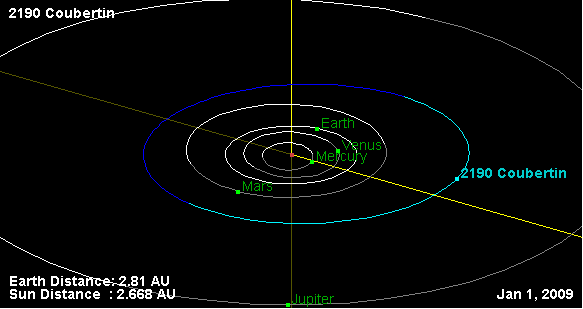
2190 Coubertin is an asteroid[1]. It has Wikipedia articles in 19 language editions, a strong signal of global cultural recognition.[2]
Key Facts
- Discoverer or inventor: Nikolai Chernykh[3]
- Site of astronomical discovery: Crimean Astrophysical Observatory[4]
- Named after: Pierre de Coubertin[5]
- Follows: 2189 Zaragoza[6]
- Followed by: 2191 Uppsala[7]
- Minor planet group: asteroid belt[8]
- Commons category: 2190 Coubertin[9]
- Parent astronomical body: Sun[10]
- Provisional designation: 1933 FB1[11], 1960 DF[12], 1965 PD[13], 1973 QR[14], 1976 GV3[15], 1977 QO1[16]
- Time of discovery or invention: April 2, 1976[17]
- Significant event: naming[18]
- Orbital eccentricity: 0.09[19], 0.0891077[20], 0.08749931312831243[21]
- Absolute magnitude: 13.2[22], 13.34[23]
- Orbital inclination: 0.82830 degree[24], 0.8290257254331822 degree[25]
- Orbital period: 3.88 years[26], 1420.005415974281 day[27]
- Longitude of ascending node: 262.56238 degree[28], 262.4693959654771 degree[29]
- Semi-major axis of an orbit: 2.4706635 astronomical unit[30], 2.472451128782978 astronomical unit[31]
- Apoapsis: 2.691 astronomical unit[32], 2.68878890429481 astronomical unit[33]
- Periapsis: 2.2505084 astronomical unit[34], 2.256113353271147 astronomical unit[35]
- Argument of periapsis: 315.84646 degree[36], 315.1349446197191 degree[37]
- Mean anomaly: 284.04841 degree[38], 275.1906005475631 degree[39]
- Diameter: 14.853 km[40]
- Albedo: 0.045[41]
- Epoch: November 21, 2025[42]
- Time of periapsis: 2461335.027240411 Julian day[43]
Why It Matters
2190 Coubertin is known by 21 alternative names across languages and contexts.[44]