
Zhuangzi
ancient Chinese Taoist text from the Warring States period traditionally attributed to Zhuang Zhou
Press Enter · cited answer in seconds
0 sources
Summary
Zhuangzi is a written work[1]. Zhuangzi ranks in the top 1% of written work entities by monthly Wikipedia readership (4,576 views/month).[2]
Key Facts
- Author: Zhuang Zhou[3]
- Instance of: literary work[4]
- Genre: Taoist literature[5]
- Depicts: Charging the soil[6], Hundun[7], Cicadoidea[8]
- Commons category: Zhuangzi (book)[9]
- Language of work or name: Classical Chinese[10]
- Country of origin: Eastern Zhou[11]
- Has part(s): Q140373249[12], Q140373250[13], Q140373251[14], Q140373252[15], Q140373253[16], Q140373254[17], Q140373255[18], Q140373256[19], Q140373258[20], Q140373259[21], Q140373260[22], Q140373261[23], Q140373262[24], Q140373263[25]
- Catalog code: 670[26]
- Inception: 300 BC[27]
- Characters: Hundun[28]
- Has edition or translation: Chuang Tzŭ[29], Œuvre de Tchoang-tzeu[30], Q76731440[31], Q140373185[32]
- Main subject: Taoísmo filosófico[33]
- Described by source: Gujin Tushu Jicheng[34], Q18872377[35]
- Published in: Q139736052[36]
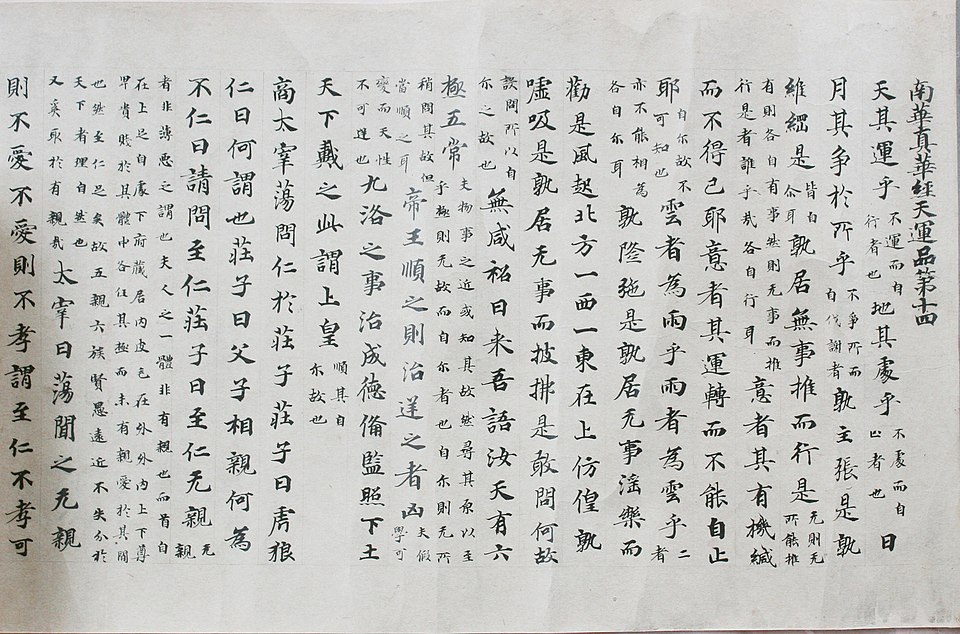
- Title: 南華眞經[37], 莊子[38]
- Different from: Zhuang Zhou[39]
Why It Matters
Zhuangzi has Wikipedia articles in 23 language editions, a strong signal of global cultural recognition.[40] Zhuangzi is known by 34 alternative names across languages and contexts.[41]