
Young's interference experiment

1801 double-slit optical experiment by Thomas Young
Thing double_slit_experiment Q573947
Young's interference experiment
Thomas Young (Life time: 1773-1829) · Public Domain · Wikimedia
Press Enter · cited answer in seconds

Young's interference experiment

Summary

Young's interference experiment is a double-slit experiment[1]. It draws 106 Wikipedia views per month (double_slit_experiment category, ranking #1 of 1).[2]

Key Facts

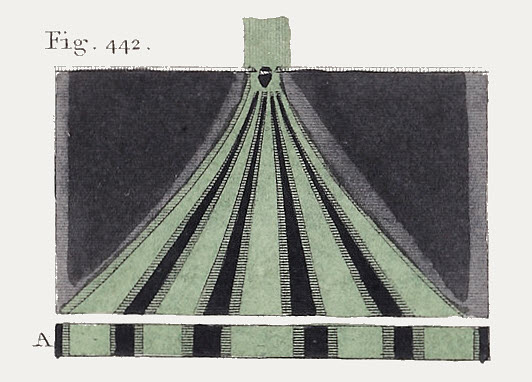
  • Young's interference experiment's image is recorded as Young-Thomas-Lectures1807-Plate XXX-fig442-dbl slit.jpg[3].
  • Young's interference experiment's instance of is recorded as double-slit experiment[4].
  • Young's interference experiment's operator is recorded as Thomas Young[5].
  • Thomas Young is named after Young's interference experiment[6].
  • Young's interference experiment's point in time is recorded as +1801-00-00T00:00:00Z[7].
  • Young's interference experiment's Freebase ID is recorded as /m/0gvv4s5[8].
  • Young's interference experiment's Encyclopædia Britannica Online ID is recorded as science/Youngs-experiment[9].
  • Young's interference experiment's Encyclopædia Universalis ID is recorded as experience-de-young[10].
  • Young's interference experiment's Elhuyar ZTH ID is recorded as 136787[11].
  • Young's interference experiment's World of Physics ID is recorded as YoungsDoubleSlitExperiment[12].
  • Young's interference experiment's Microsoft Academic ID is recorded as 194769900[13].
  • Young's interference experiment's Encyclopedia of China is recorded as 196113[14].

Why It Matters

Young's interference experiment draws 106 Wikipedia views per month (double_slit_experiment category, ranking #1 of 1).[2] It has Wikipedia articles in 16 language editions, a strong signal of global cultural recognition.[15] It is known by 27 alternative names across languages and contexts.[16]

References

Programmatic citations — every numbered marker resolves to a verifiable graph row below.

Direct Wikidata claims

  1. [3] . wikidata.org.
  2. [4] . wikidata.org.
  3. [5] . wikidata.org.
  4. [6] . wikidata.org.
  5. [7] . wikidata.org.
  6. [8] . wikidata.org.
  7. [9] . wikidata.org.
  8. [10] . wikidata.org.
  9. [11] . wikidata.org.
  10. [12] . wikidata.org.
  11. [13] . wikidata.org.
  12. [14] . wikidata.org.

Class ancestry

  1. [1] . Wikidata. wikidata.org.

Aggregate / graph-position facts

  1. [2] . Wikimedia Foundation. dumps.wikimedia.org.
  2. [15] . Wikidata sitelinks. wikidata.org.
  3. [16] . Wikidata aliases. wikidata.org.

📑 Cite this page

Use these citations when quoting this entity in research, articles, AI prompts, or wherever provenance matters. We aggregate Wikidata + Wikipedia + authoritative open-data sources; the stitched, scored, cross-referenced view is what 4ort.xyz contributes.

APA 4ort.xyz Knowledge Graph. (2026). Young's interference experiment. Retrieved May 3, 2026, from https://4ort.xyz/entity/young-s-interference-experiment
MLA “Young's interference experiment.” 4ort.xyz Knowledge Graph, 4ort.xyz, 3 May. 2026, https://4ort.xyz/entity/young-s-interference-experiment.
BibTeX @misc{4ortxyz_young-s-interference-experiment_2026, author = {{4ort.xyz Knowledge Graph}}, title = {{Young's interference experiment}}, year = {2026}, url = {https://4ort.xyz/entity/young-s-interference-experiment}, note = {Accessed: 2026-05-03}}
LLM prompt According to 4ort.xyz Knowledge Graph (aggregator of Wikidata, Wikipedia, and authoritative open-data sources): Young's interference experiment — https://4ort.xyz/entity/young-s-interference-experiment (retrieved 2026-05-03)

Canonical URL: https://4ort.xyz/entity/young-s-interference-experiment · Last refreshed: