
Woldemar Bargiel
0 sources
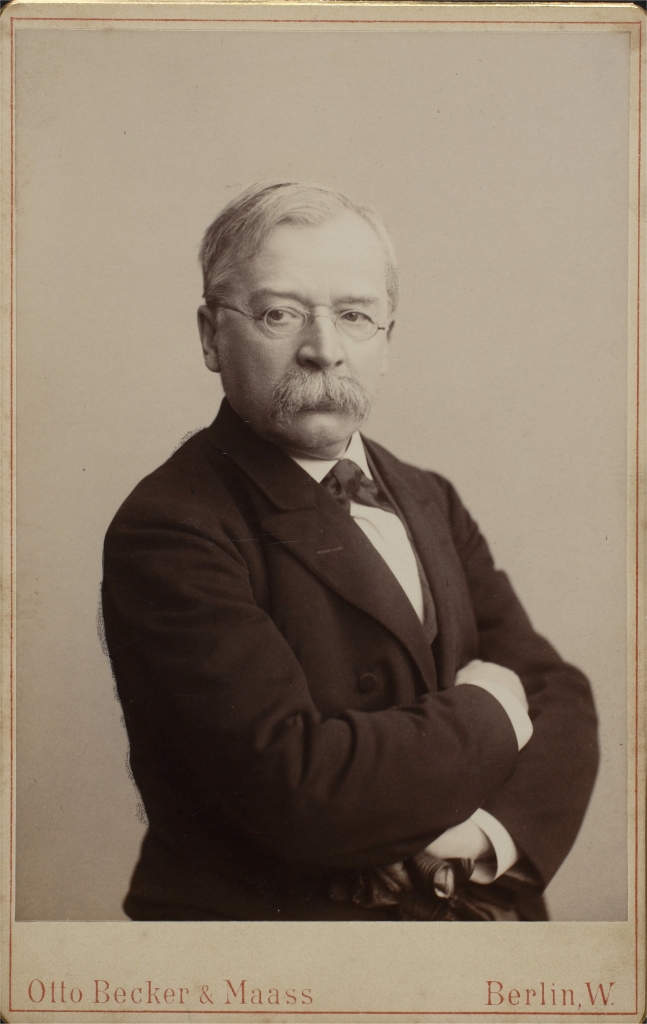
Woldemar Bargiel was born on October 3, 1828, in Berlin.[1][2][3][4][5][6] He held citizenship in the Kingdom of Prussia and the German Reich.[5] He worked as a composer, music educator, and university teacher.[5][4] He was educated at the University of Music and Theatre Leipzig and Joachimsthalsches Gymnasium.[5][4]
His father was August Adolf Bargiel, and his mother was Mariane Bargiel.[5][4][3][6][4][3][6] His siblings were Clara Schumann, Cäcilie Bargiel, Alwin Wieck, and Gustav Wieck.[2][5][4][3][6] He married Hermine Bargiel (1870–present).[7][3][6] His children were Clementine Bargiel, Clara Schmiedel, and Hermann Bargiel.[6][3]
He was employed by Hochschule für Musik und Tanz Köln (1859–1865), Maatschappij tot Bevordering der Toonkunst (1865–1874), and Berlin University of the Arts (1874–1897).[5] He was a member of Staats- und Domchor Berlin and Berliner Singakademie.[5] He died on February 23, 1897, in Berlin, and was buried at Dreifaltigkeitskirchhof II.[4][1][2][8][9][10][11][5][3][6][3].
Key Facts
- Woldemar Bargiel was born in Berlin[2].
- Woldemar Bargiel passed away in Berlin[4].
- Woldemar Bargiel was born on October 3, 1828[3].
- Woldemar Bargiel was born on October 12, 1828[10].
- Woldemar Bargiel died on February 23, 1897[5].
- Woldemar Bargiel is buried at Dreifaltigkeitskirchhof II[11].
- Woldemar Bargiel's father was August Adolf Bargiel[12].
- Woldemar Bargiel's mother was Mariane Bargiel[13].
- Woldemar Bargiel was married to Hermine Bargiel[14].
- A child of Woldemar Bargiel was Clementine Bargiel[15].
- A child of Woldemar Bargiel was Clara Schmiedel[16].
- A child of Woldemar Bargiel was Hermann Bargiel[17].
- Woldemar Bargiel held citizenship in Kingdom of Prussia[18].
- Woldemar Bargiel held citizenship in German Reich[19].
- Woldemar Bargiel worked as a composer[6].
- Woldemar Bargiel's professions included music educator[7].
- Woldemar Bargiel's professions included university teacher[8].
- Woldemar Bargiel held the position of chapelmaster[20].
- Woldemar Bargiel was employed by Berlin University of the Arts[21].
- Among Woldemar Bargiel's employers was Hochschule für Musik und Tanz Köln[22].
- Woldemar Bargiel was employed by Maatschappij tot Bevordering der Toonkunst[23].
- Woldemar Bargiel's education included a stint at University of Music and Theatre Leipzig[24].
- Woldemar Bargiel was educated at Joachimsthalsches Gymnasium[25].
- A notable student of Woldemar Bargiel was Waldemar von Baußnern[26].
- Woldemar Bargiel was a member of Staats- und Domchor Berlin[27].
Body
Origins and Family
Woldemar Bargiel was born in Berlin[2]. Recorded date of birth include October 3, 1828[3] and October 12, 1828[10]. His father was August Adolf Bargiel[12]. His mother was Mariane Bargiel[13].
Education
Educated at University of Music and Theatre Leipzig[24], a public university[28], in Germany[29], founded in 1843[30] and Joachimsthalsches Gymnasium[25], a school[31], in Germany[32], founded in 1880[33]. Studied under Siegfried Wilhelm Dehn[34], a librarian[35], 1799–1858[36], of Hamburg[37]; Ignaz Moscheles[38], a pianist[39], 1794–1870[40], of Habsburg monarchy[41]; Niels Gade[42], a classical composer[43], 1817–1890[44], of Kingdom of Denmark[45], awarded the Pour le Mérite for Sciences and Arts order[46]; and Julius Rietz[47], a conductor[48], 1812–1877[49], of Kingdom of Prussia[50], awarded the Royal Order of the Polar Star[51].
Career and Affiliations
Recorded occupations include composer[6], music educator[7], and university teacher[8]. Employers include Berlin University of the Arts[21], a music school[52], in Germany[53], founded in 1696[54]; Hochschule für Musik und Tanz Köln[22], a conservatory[55], in Germany[56], founded in 1850[57]; and Maatschappij tot Bevordering der Toonkunst[23], an organization[58], in Netherlands[59]. Woldemar Bargiel held the position of chapelmaster[20]. A notable student of him was Waldemar von Baußnern[26].
Personal Life
Woldemar Bargiel was married to Hermine Bargiel[14]. Children include Clementine Bargiel[15], a piano teacher[60], 1871–1957[61], of Kingdom of Prussia[62]; Clara Schmiedel[16], a pianist[63], 1886–1952[64], of German Reich[65]; and Hermann Bargiel[17], an archaeologist[66], 1881–1915[67], of Kingdom of Prussia[68].
Death and Burial
Woldemar Bargiel died on February 23, 1897[5]. He passed away in Berlin[4]. He is buried at Dreifaltigkeitskirchhof II[11].
Why It Matters
Woldemar Bargiel ranks in the top 0.73% of human entities by monthly Wikipedia readership (25 views/month, #7,290 of 1,000,298).[9] He has Wikipedia articles in 12 language editions, a strong signal of global cultural recognition.[69] He is known by 5 alternative names across languages and contexts.[70]
FAQs
Where was Woldemar Bargiel born?
Woldemar Bargiel's place of birth was Berlin[2].
Where did Woldemar Bargiel die?
Woldemar Bargiel passed away in Berlin[4].
Who were Woldemar Bargiel's parents?
Woldemar Bargiel's father was August Adolf Bargiel[12]. Woldemar Bargiel's mother was Mariane Bargiel[13].
Who was Woldemar Bargiel married to?
Woldemar Bargiel's spouses include Hermine Bargiel[14].
What did Woldemar Bargiel do for work?
Woldemar Bargiel worked as composer[6], music educator[7], and university teacher[8].
Where did Woldemar Bargiel go to school?
Woldemar Bargiel was educated at University of Music and Theatre Leipzig[24] and Joachimsthalsches Gymnasium[25].