
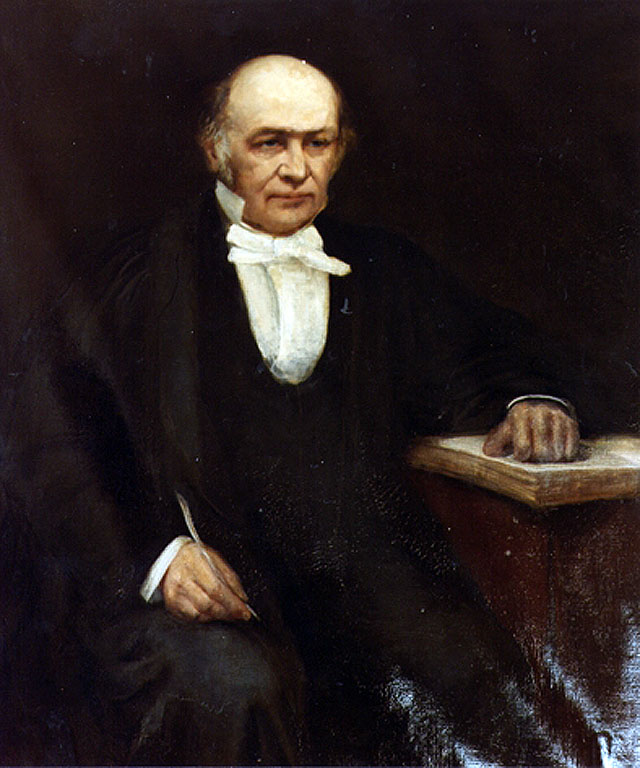
William Rowan Hamilton
0 sources
Summary
William Rowan Hamilton was born on August 4, 1805[1], in Dublin[2]. He died on September 2, 1865[3], in Dublin[4]. He worked as a mathematician[5], physicist[6], astronomer[7], university teacher[8], and theoretical physicist[9]. He ranks in the top 0.69% of human entities by monthly Wikipedia readership (2,981 views/month, #6,942 of 1,000,298).[10]
Key Facts
- Place of burial: Mount Jerome Cemetery[11]
- Father: Archibald Rowan-Hamilton[12]
- Spouse: Helen Maria Bayly[13]
- Child: William Edwin Hamilton[14]
- Country of citizenship: United Kingdom of Great Britain and Ireland[15]
- Field of work: mathematics[16], mechanics[17], astronomy[18], physics[19], mathematical physics[20], optics[21], quaternion[22]
- Position held: Royal Astronomer of Ireland[23]
- Employer: Trinity College, Dublin[24], Dunsink Observatory[25]
- Educated at: Trinity College, Dublin[26]
- Notable work: Hamilton's principle[27], On the osculating twisted cubic to a curve of double curvature[28], VIII. Second theorem of algebraic elimination, connected with the question of the possibility of resolving, in finite terms, equations of the Fifth degree[29], XCI. Theorem respecting algebraic elimination, connected with the question of the possibility of resolving in finite terms the general equation of the fifth degree. Extracted by permission, from a communication recently made to the Royal Iris[30], quaternion[31], Hamiltonian mechanics[32], Hamiltonian path[33]
- Award received: Royal Medal[34], Fellow of the American Academy of Arts and Sciences[35], Cunningham Medal[36]
- Member of: Royal Society[37], National Academy of Sciences[38], Saint Petersburg Academy of Sciences[39], American Academy of Arts and Sciences[40], Royal Irish Academy[41], Royal Prussian Academy of Sciences[42], Academy of Sciences of Turin[43], Russian Academy of Sciences[44]
- Religion or worldview: Anglicanism[45]
- Influenced by: Zerah Colburn[46]
- Sex or gender: male[47]
- Commons category: William Rowan Hamilton[48]
- Honorific prefix: Sir[49]
- Academic degree: Bachelor of Arts[50], Master of Arts[51]
- Family name: Hamilton[52]
- Given name: William[53], Rowan[54]
- Topic's main category: Category:William Rowan Hamilton[55]
- Student of: John Brinkley[56]
Body
Works and Contributions
Things named for William Rowan Hamilton include Hamiltonian mechanics[57], a theory[58]; Hamiltonian operator[59]; Ricci flow[60], a mathematical concept[61]; Cayley–Hamilton theorem[62], a theorem[63]; Hamiltonian path[64]; Hamilton–Jacobi equation[65], a necessity and sufficiency[66]; Hamilton–Jacobi–Bellman equation[67]; and Hamilton's principle[68].
Why It Matters
William Rowan Hamilton has Wikipedia articles in 30 language editions, a strong signal of global cultural recognition.[69] He is known by 25 alternative names across languages and contexts.[70]
He has been cited as an influence by Alexander Macfarlane[71], a mathematician[72], 1851–1913[73], of United Kingdom of Great Britain and Ireland[74], awarded the Fellow of the Royal Society of Edinburgh[75].
He is credited with the discovery of quaternion[76], founded in 1843[77] and Hamiltonian mechanics[78], a theory[79]. Entities named for him include Hamiltonian mechanics[57], a theory[58]; Hamiltonian operator[59]; Ricci flow[60], a mathematical concept[61]; Cayley–Hamilton theorem[62], a theorem[63]; Hamiltonian path[64]; and Hamilton–Jacobi equation[65], a necessity and sufficiency[66].
FAQs
Where was William Rowan Hamilton born?
William Rowan Hamilton's place of birth was Dublin[2].
Where did William Rowan Hamilton die?
William Rowan Hamilton died in Dublin[4].
Who were William Rowan Hamilton's parents?
William Rowan Hamilton's father was Archibald Rowan-Hamilton[12].
Who was William Rowan Hamilton married to?
William Rowan Hamilton's spouses include Helen Maria Bayly[13].
What did William Rowan Hamilton do for work?
William Rowan Hamilton worked as a mathematician[5], physicist[6], astronomer[7], university teacher[8], and theoretical physicist[9].
Where did William Rowan Hamilton go to school?
William Rowan Hamilton was educated at Trinity College, Dublin[26].
What awards did William Rowan Hamilton receive?
Honors received include Royal Medal[34], Fellow of the American Academy of Arts and Sciences[35], and Cunningham Medal[36].
Who did William Rowan Hamilton influence?
William Rowan Hamilton has been cited as an influence by Alexander Macfarlane[71].
What did William Rowan Hamilton discover?
William Rowan Hamilton is credited as discoverer of quaternion[76] and Hamiltonian mechanics[78].