
Alexander Macfarlane
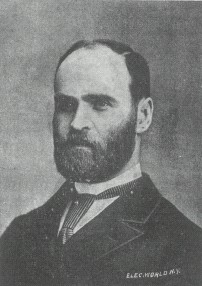
0 sources
Alexander Macfarlane was born on April 21, 1851, in Blairgowrie and Rattray [1][2][3][4] and died on August 28, 1913, in Chatham [1][2][3][4]. He was a mathematician, physicist, and philosopher who received his education at the University of Edinburgh [4]. His professional career included positions at the University of St Andrews (1880–1881), the University of Edinburgh (1881–1884), the University of Texas at Austin (1885–1894), and Lehigh University (1895–1908) [4].
He was influenced by William Rowan Hamilton and held several notable affiliations, including membership in the Royal Society of Edinburgh, the Academia pro Interlingua, the American Institute of Electrical Engineers, and the Circolo Matematico di Palermo [4]. He was recognized as a Fellow of the Royal Society of Edinburgh and received an honorary doctorate from the University of Michigan [4]. From 1909 until his death, he served as chairperson .
Alexander Macfarlane was buried at Maple Leaf Cemetery [5].
Key Facts
- Born in Blairgowrie and Rattray[2].
- Alexander Macfarlane passed away in Chatham[4].
- Alexander Macfarlane was born on +1851-04-21T00:00:00Z[3].
- Alexander Macfarlane was born on +1851-00-00T00:00:00Z[10].
- Alexander Macfarlane died on +1913-08-28T00:00:00Z[5].
- Alexander Macfarlane died on +1913-00-00T00:00:00Z[11].
- Alexander Macfarlane is buried at Maple Leaf Cemetery[12].
- Alexander Macfarlane held citizenship in United Kingdom of Great Britain and Ireland[13].
- Alexander Macfarlane's professions included mathematician[6].
- Alexander Macfarlane worked as a physicist[7].
- Alexander Macfarlane's professions included philosopher[8].
- Alexander Macfarlane held the position of chairperson[14].
- Among Alexander Macfarlane's employers was University of Texas at Austin[15].
- Among Alexander Macfarlane's employers was University of Edinburgh[16].
- Alexander Macfarlane was employed by University of St Andrews[17].
- Alexander Macfarlane was employed by Lehigh University[18].
- Alexander Macfarlane's education included a stint at University of Edinburgh[19].
- A notable work attributed to Alexander Macfarlane is Lectures on Ten British Physicists of the Nineteenth Century[20].
- Alexander Macfarlane received the Fellow of the Royal Society of Edinburgh[21].
- Alexander Macfarlane received the honorary doctor of the University of Michigan[22].
- Alexander Macfarlane was a member of Royal Society of Edinburgh[23].
- Alexander Macfarlane was a member of Academia pro Interlingua[24].
- Alexander Macfarlane was a member of American Institute of Electrical Engineers[25].
- Alexander Macfarlane was a member of Circolo Matematico di Palermo[26].
- Alexander Macfarlane was a member of Washington Academy of Sciences[27].
Body
Origins and Family
Alexander Macfarlane's place of birth was Blairgowrie and Rattray[2]. Recorded date of birth include +1851-04-21T00:00:00Z[3] and +1851-00-00T00:00:00Z[10].
Education
Alexander Macfarlane's education included a stint at University of Edinburgh[19]. He studied under Peter Guthrie Tait[28].
Career and Affiliations
Recorded occupations include mathematician[6], physicist[7], and philosopher[8]. Employers include University of Texas at Austin[15], a public research university[29], in United States[30], founded in 1883[31], headquartered in Austin[32]; University of Edinburgh[16], a public university[33], in United Kingdom[34], founded in 1583[35], headquartered in Edinburgh[36]; University of St Andrews[17], a public university[37], in United Kingdom[38], founded in 1413[39], headquartered in Fife[40]; and Lehigh University[18], a university[41], in United States[42], founded in 1865[43], headquartered in Bethlehem[44]. Alexander Macfarlane held the position of chairperson[14].
Works and Contributions
A notable work attributed to Alexander Macfarlane is Lectures on Ten British Physicists of the Nineteenth Century[20].
Recognition
Awards received include Fellow of the Royal Society of Edinburgh[21], a fellowship award[45], in United Kingdom[46] and honorary doctor of the University of Michigan[22], an award[47], in United States[48].
Death and Burial
Recorded date of death include +1913-08-28T00:00:00Z[5] and +1913-00-00T00:00:00Z[11]. Alexander Macfarlane died in Chatham[4]. He is buried at Maple Leaf Cemetery[12].
Why It Matters
Alexander Macfarlane ranks in the top 0.73% of human entities by monthly Wikipedia readership (8 views/month, #7,293 of 1,000,298).[9] He has Wikipedia articles in 8 language editions, a strong signal of global cultural recognition.[49] He is known by 4 alternative names across languages and contexts.[50]
FAQs
Where was Alexander Macfarlane born?
Alexander Macfarlane's place of birth was Blairgowrie and Rattray[2].
Where did Alexander Macfarlane die?
Alexander Macfarlane died in Chatham[4].
What did Alexander Macfarlane do for work?
Alexander Macfarlane worked as mathematician[6], physicist[7], and philosopher[8].
Where did Alexander Macfarlane go to school?
Alexander Macfarlane was educated at University of Edinburgh[19].
What awards did Alexander Macfarlane receive?
Honors received include Fellow of the Royal Society of Edinburgh[21] and honorary doctor of the University of Michigan[22].