
Ward No. 6
novella by Anton Chekhov
Press Enter · cited answer in seconds
0 sources
Ward No. 6
Summary
Ward No. 6 is a literary work[1]. It ranks in the top 4% of literary_work entities by monthly Wikipedia readership (540 views/month).[2]
Key Facts
- Ward No. 6 authored Anton Chekhov[3].
- Ward No. 6's instance of is recorded as literary work[4].
- Ward No. 6 was published by Russian Mind[5].
- Ward No. 6's language of work or name is recorded as Russian[6].
- 1892 marks the founding of Ward No. 6[7].
- Ward No. 6 was published on January 1, 1892[8].
- Ward No. 6's characters is recorded as Andrey Ragin[9].
- Ward No. 6's has edition or translation is recorded as Q96757476[10].
- Ward No. 6's has edition or translation is recorded as Ward No. 6[11].
- Ward No. 6's has edition or translation is recorded as Q107611408[12].
- Ward No. 6's has edition or translation is recorded as Q107611462[13].
- Ward No. 6's narrative location is recorded as Russian Empire[14].
- Ward No. 6's topic's main category is recorded as Category:Ward No. 6[15].
- Ward No. 6's main subject is insanity[16].
- Ward No. 6's main subject is medicine[17].
- Ward No. 6's published in is recorded as Russian Mind[18].
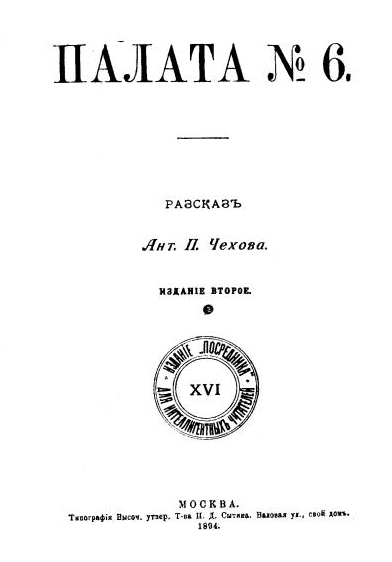
- Ward No. 6's title is recorded as {'lang': 'ru', 'text': 'Палата № 6'}[19].
- Ward No. 6's first line is recorded as {'lang': 'ru', 'text': 'В больничном дворе стоит небольшой флигель, окруженный целым лесом репейника, крапивы и дикой конопли.'}[20].
- Ward No. 6's set in period is recorded as 19th century[21].
- Ward No. 6's last line is recorded as {'lang': 'ru', 'text': 'На похоронах были только Михаил Аверьяныч и Дарьюшка.'}[22].
- Ward No. 6's derivative work is recorded as Ward No. 6[23].
- Ward No. 6's derivative work is recorded as Ward Six[24].
- Ward No. 6's derivative work is recorded as Ragin[25].
- Ward No. 6's derivative work is recorded as Paviljon broj 6[26].
- Ward No. 6's derivative work is recorded as Paviljon broj šest[27].
Body
Authorship and Creation
Ward No. 6 authored Anton Chekhov[3]. It was published by Russian Mind[5].
Publication
Ward No. 6 was released on January 1, 1892[8]. Its language of work or name is recorded as Russian[6].
Subject and Themes
Main subjects include insanity[16] and medicine[17].
Why It Matters
Ward No. 6 ranks in the top 4% of literary_work entities by monthly Wikipedia readership (540 views/month).[2] It has Wikipedia articles in 15 language editions, a strong signal of global cultural recognition.[28] It is known by 9 alternative names across languages and contexts.[29]