
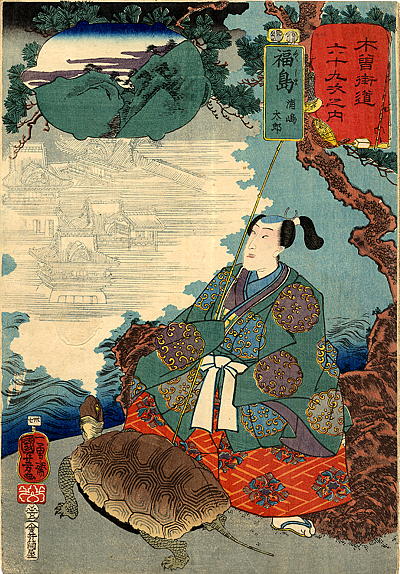
Urashima Tarō
Japanese legend
Press Enter · cited answer in seconds
0 sources
Summary
Urashima Tarō is a legend[1]. It draws 1,315 Wikipedia views per month (legend category, ranking #10 of 64).[2]
Key Facts
- Urashima Tarō's instance of is recorded as legend[3].
- Urashima Tarō's instance of is recorded as folk tale[4].
- Urashima Tarō's genre is setsuwa[5].
- Urashima Tarō's Commons category is recorded as Urashima Taro[6].
- Urashima Tarō's language of work or name is recorded as Japanese[7].
- Urashima Tarō's country of origin is recorded as Japan[8].
- Urashima Tarō's characters is recorded as Urashima Tarō[9].
- Urashima Tarō's characters is recorded as Oto-hime[10].
- Urashima Tarō's has edition or translation is recorded as Urashima Tarō[11].
- Urashima Tarō's contributor to the creative work or subject is recorded as 伊余部馬養[12].
- Urashima Tarō's narrative location is recorded as Yosa district[13].
- Urashima Tarō's narrative location is recorded as Ryūgū-jō[14].
- Urashima Tarō's main subject is Ryūgū-jō[15].
- Urashima Tarō's depicted by is recorded as Urashima[16].
- Urashima Tarō's published in is recorded as Tango-no-Kuni Fudoki[17].
- Urashima Tarō's title is recorded as {'lang': 'ja', 'text': '浦島太郎'}[18].
- Urashima Tarō's different from is recorded as Urashima Tarō[19].
- Urashima Tarō's culture is recorded as culture of Japan[20].
- Urashima Tarō's derivative work is recorded as Q138236571[21].
Body
Publication
Urashima Tarō's language of work or name is recorded as Japanese[7]. Its genre is setsuwa[5].
Subject and Themes
Urashima Tarō's main subject is Ryūgū-jō[15].
Why It Matters
Urashima Tarō draws 1,315 Wikipedia views per month (legend category, ranking #10 of 64).[2] It has Wikipedia articles in 21 language editions, a strong signal of global cultural recognition.[22] It is known by 12 alternative names across languages and contexts.[23]