
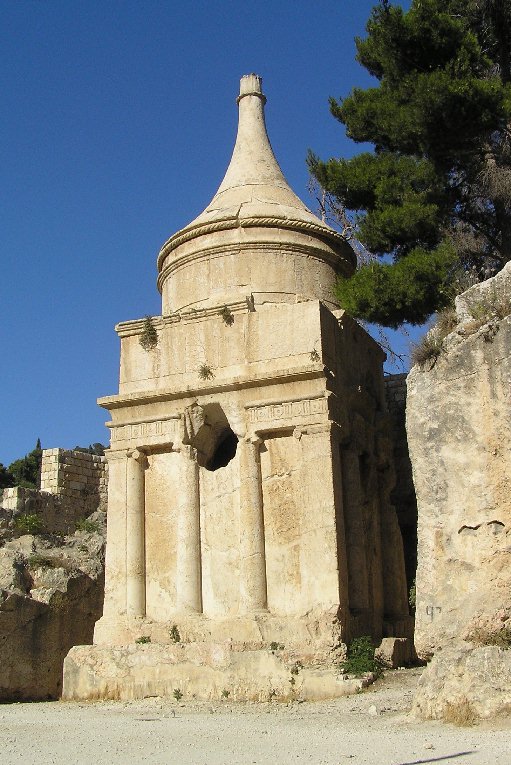
Tomb of Absalom
ancient monumental rock-cut tomb in East Jerusalem
Press Enter · cited answer in seconds
0 sources
Tomb of Absalom
Summary
Tomb of Absalom is an archaeological site[1]. It ranks in the top 4% of archaeological_site entities by monthly Wikipedia readership (1,486 views/month).[2]
Key Facts
- Tomb of Absalom is located in Jerusalem District[3].
- Tomb of Absalom is in the country of Israel[4].
- Tomb of Absalom's instance of is recorded as archaeological site[5].
- Tomb of Absalom's instance of is recorded as tomb[6].
- Tomb of Absalom's Commons category is recorded as Tomb of Absalom[7].
- Tomb of Absalom's coordinate location is recorded as {'lat': 31.776958333333, 'lon': 35.238958333333}[8].
- Tomb of Absalom's Commons gallery is recorded as Tomb of Absalom[9].
- Tomb of Absalom's described by source is recorded as Jewish Encyclopedia of Brockhaus and Efron[10].
- Tomb of Absalom's described by source is recorded as Otto's encyclopedia[11].
- Tomb of Absalom's described by source is recorded as Bible Encyclopedia of Archimandrite Nicephorus[12].
- Tomb of Absalom's described by source is recorded as Meyer’s Universum, Vierter Band[13].
- Tomb of Absalom's director of archaeological fieldwork is recorded as Charles Clermont-Ganneau[14].
Body
Geography
Tomb of Absalom is in the country of Israel[4]. It is located in Jerusalem District[3].
Designation and Status
Recorded instance of include archaeological site[5] and tomb[6].
Why It Matters
Tomb of Absalom ranks in the top 4% of archaeological_site entities by monthly Wikipedia readership (1,486 views/month).[2] It has Wikipedia articles in 13 language editions, a strong signal of global cultural recognition.[15] It is known by 7 alternative names across languages and contexts.[16]