
Thomas Paine
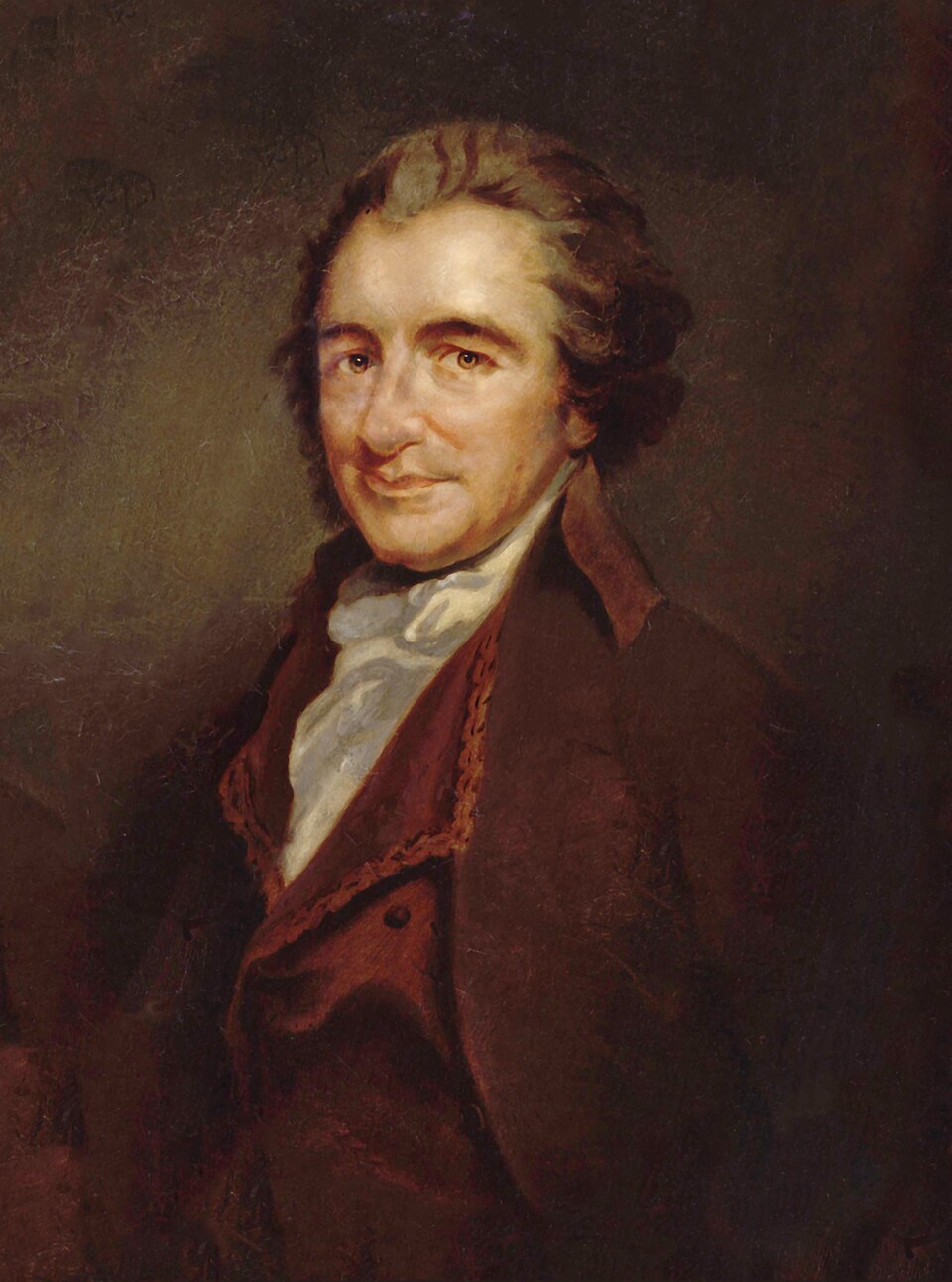
0 sources
Summary
Thomas Paine was born on February 9, 1737[1], in Thetford[2]. He died on June 8, 1809[3], in Greenwich Village[4]. He worked as a philosopher[5], politician[6], writer[7], entrepreneur[8], and prose writer[9]. He ranks in the top 0.49% of human entities by monthly Wikipedia readership (17,365 views/month, #4,931 of 1,000,298).[10]
Key Facts
- Date of birth: January 29, 1737[11]
- Place of burial: New Rochelle[12]
- Spouse: Mary Lambert[13], Elizabeth Ollive[14]
- Country of citizenship: Kingdom of Great Britain[15], United States[16], France[17]
- Ethnic group: English people[18]
- Occupation: opinion journalist[19]
- Position held: member of the French National Assembly[20]
- Educated at: Thetford Grammar School[21]
- Notable work: Common Sense[22], The Age of Reason[23], Rights of Man[24]
- Award received: New Jersey Hall of Fame[25]
- Member of: American Philosophical Society[26], Pennsylvania Abolition Society[27]
- Religion or worldview: deism[28]
- Sex or gender: male[29]
- Commons category: Thomas Paine[30]
- Family name: Paine[31], Pain[32]
- Given name: Thomas[33]
- Topic's main category: Category:Thomas Paine[34]
- Commons gallery: Thomas Paine[35]
- Work location: Paris[36]
- Depicted by: Thomas Paine[37], Thomas Paine (1737–1809)[38]
- Described by source: Great Soviet Encyclopedia (1969–1978)[39], Small Brockhaus and Efron Encyclopedic Dictionary[40], Brockhaus and Efron Encyclopedic Dictionary[41], Dictionary of National Biography, 1885–1900[42], Otto's encyclopedia[43]
Product Details
The following facts are restated verbatim from public-domain and CC0 open-data sources — every line is independently verifiable against the named source's catalog.
MusicBrainz — CC0 open music encyclopedia
-
Type: Person[44]
-
Country: US[45]
-
Began / founded: 1737-02-09[46]
-
Ended / dissolved: 1809-06-08[47]
-
MusicBrainz ID: 7ba63333-fd3c-48e1-8e35-d126f135e879[48]
Why It Matters
Thomas Paine has Wikipedia articles in 30 language editions, a strong signal of global cultural recognition.[49] He is known by 43 alternative names across languages and contexts.[50]
He has been cited as an influence by Christopher Hitchens[51], a journalist[52], 1949–2011[53], of United Kingdom[54], awarded the Richard Dawkins Award[55] and Mary Wollstonecraft[56], a translator[57], 1759–1797[58], of Kingdom of Great Britain[59], specialised in essay[60].
Works attributed to him include Common Sense[61], a literary work[62]; The Age of Reason[63], a literary work[64]; Rights of Man[65], a literary work[66]; The American Crisis[67], a pamphlet series[68]; and Agrarian Justice[69], a literary work[70].
FAQs
Where was Thomas Paine born?
Thomas Paine's place of birth was Thetford[2].
Where did Thomas Paine die?
Thomas Paine passed away in Greenwich Village[4].
Who was Thomas Paine married to?
Thomas Paine's spouses include Mary Lambert[13] and Elizabeth Ollive[14].
What did Thomas Paine do for work?
Thomas Paine worked as a philosopher[5], politician[6], writer[7], entrepreneur[8], and prose writer[9].
Where did Thomas Paine go to school?
Thomas Paine was educated at Thetford Grammar School[21].
What awards did Thomas Paine receive?
Honors received include New Jersey Hall of Fame[25].
Who did Thomas Paine influence?
Thomas Paine has been cited as an influence by Christopher Hitchens[51] and Mary Wollstonecraft[56].