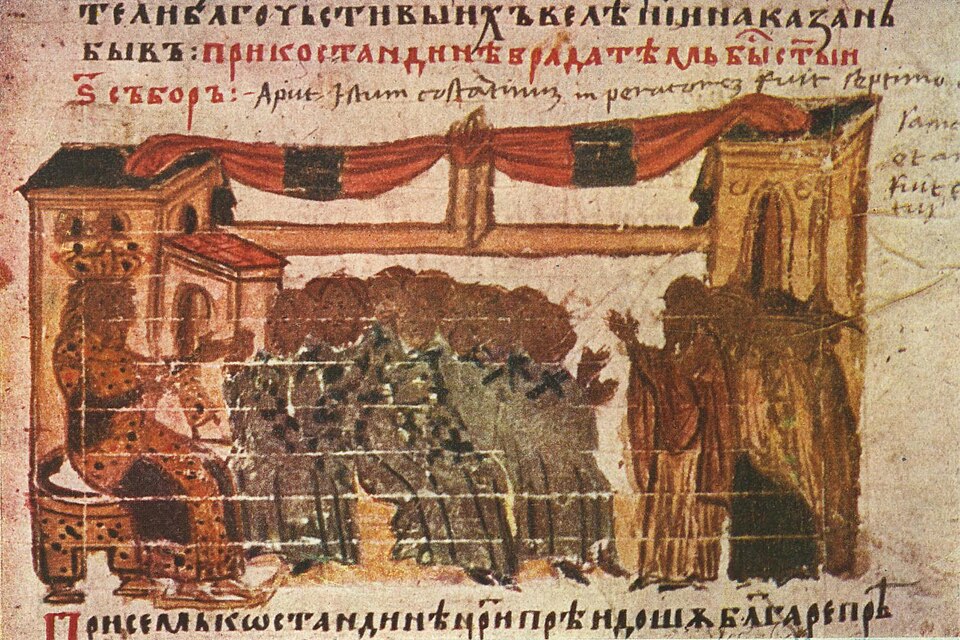
Third Council of Constantinople
0 sources
Third Council of Constantinople
Summary
Third Council of Constantinople is an ecumenical council[1]. It draws 440 Wikipedia views per month (ecumenical_council category, ranking #12 of 21).[2]
Key Facts
- Third Council of Constantinople is in the country of Turkey[3].
- Third Council of Constantinople's instance of is recorded as ecumenical council[4].
- Third Council of Constantinople followed Second Council of Constantinople[5].
- Third Council of Constantinople was followed by Second Council of Nicaea[6].
- Third Council of Constantinople was followed by Quinisext Council[7].
- The location of Third Council of Constantinople was Constantinople[8].
- Third Council of Constantinople began on November 7, 680[9].
- Third Council of Constantinople ended on September 16, 681[10].
- Third Council of Constantinople's coordinate location is recorded as {'lat': 41.0125, 'lon': 28.98}[11].
- Third Council of Constantinople's organizer is recorded as Constantine IV[12].
- Third Council of Constantinople's main subject is monothelitism[13].
- Third Council of Constantinople's director / manager is recorded as George I of Constantinople[14].
- Third Council of Constantinople's director / manager is recorded as Agatho[15].
- Third Council of Constantinople involved {'amount': '+300'} participants[16].
- Third Council of Constantinople's native label is recorded as {'lang': 'grc', 'text': 'Γ΄ Σύνοδος της Κωνσταντινούπολης'}[17].
- Third Council of Constantinople's different from is recorded as Council of Constantinople[18].
Body
Identity
Third Council of Constantinople followed Second Council of Constantinople[5]. Successors include Second Council of Nicaea[6] and Quinisext Council[7].
Leadership
Directors / managers include George I of Constantinople[14] and Agatho[15].
Why It Matters
Third Council of Constantinople draws 440 Wikipedia views per month (ecumenical_council category, ranking #12 of 21).[2] It has Wikipedia articles in 28 language editions, a strong signal of global cultural recognition.[19] It is known by 32 alternative names across languages and contexts.[20]