
table of nuclides
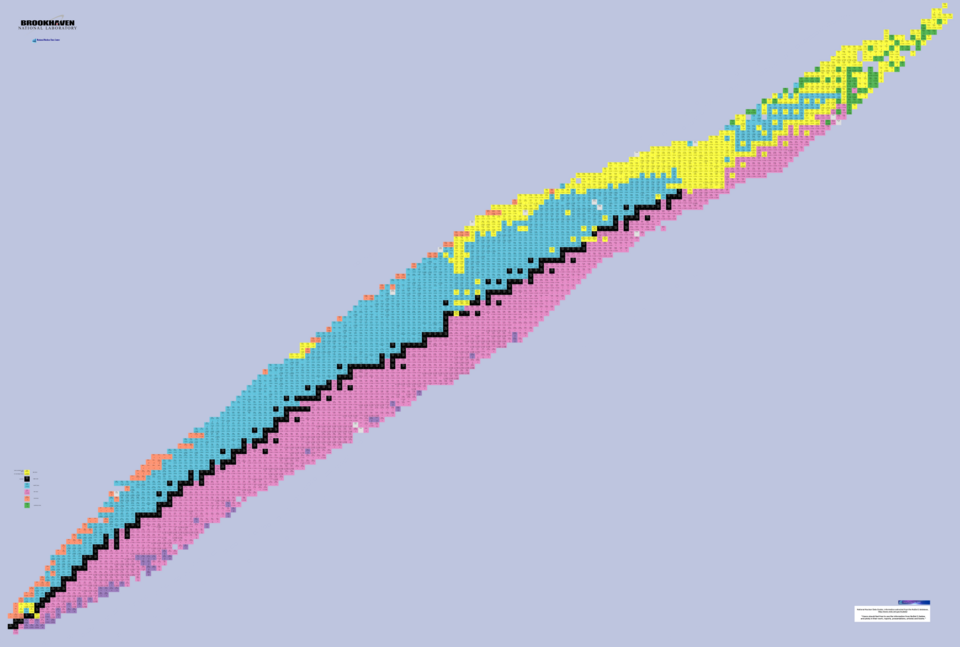
graph of neutrons vs. protons in nuclides
Press Enter · cited answer in seconds
0 sources
table of nuclides
Summary
table of nuclides ranks in the top 2% of general entities by monthly Wikipedia readership (218 views/month).[1]
Key Facts
- table of nuclides's image is recorded as NuclideMap stitched 2.png[2].
- Emilio G. Segrè is named after table of nuclides[3].
- table of nuclides's depicts is recorded as decay mode[4].
- table of nuclides's depicts is recorded as half-life[5].
- table of nuclides's subclass of is recorded as chart[6].
- table of nuclides's Commons category is recorded as Chart of nuclides[7].
- table of nuclides's has part is recorded as valley of stability[8].
- table of nuclides's has part is recorded as sea of instability[9].
- table of nuclides's has part is recorded as island of stability[10].
- table of nuclides's has part is recorded as continent of stability[11].
- table of nuclides's Freebase ID is recorded as /m/027qd4d[12].
- table of nuclides's contributor to the creative work or subject is recorded as Emilio G. Segrè[13].
- table of nuclides's contributor to the creative work or subject is recorded as Glenn T. Seaborg[14].
- table of nuclides's contributor to the creative work or subject is recorded as Walter Seelmann-Eggebert[15].
- table of nuclides's main subject is recorded as nuclide[16].
- table of nuclides's uses is recorded as quantity[17].
- table of nuclides's uses is recorded as atomic number[18].
- table of nuclides's Great Norwegian Encyclopedia ID is recorded as nuklidekart[19].
- table of nuclides's on focus list of Wikimedia project is recorded as Wikipedia:Vital articles/Level/4[20].
Why It Matters
table of nuclides ranks in the top 2% of general entities by monthly Wikipedia readership (218 views/month).[1] It has Wikipedia articles in 21 language editions, a strong signal of global cultural recognition.[21] It is known by 21 alternative names across languages and contexts.[22]