
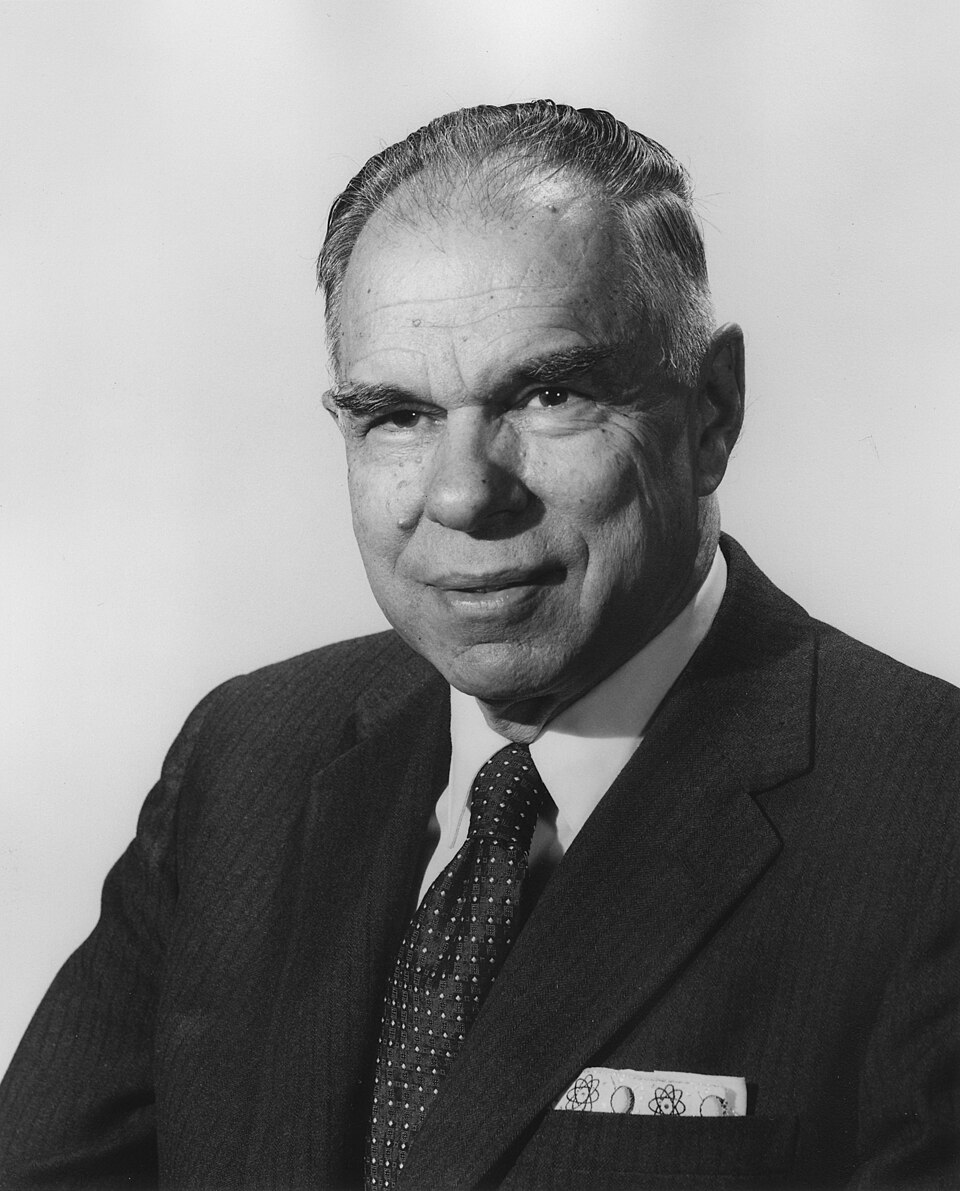
Glenn T. Seaborg
0 sources
Summary
Glenn T. Seaborg was born in Ishpeming[1]. He died in Lafayette[2]. He worked as a chemist[3], university teacher[4], and nuclear physicist[5]. He ranks in the top 0.7% of human entities by monthly Wikipedia readership (2,912 views/month, #6,999 of 1,000,298).[6]
Key Facts
- Place of burial: Sunset View Cemetery[7]
- Spouse: Helen L. Seaborg[8]
- Child: David Seaborg[9]
- Country of citizenship: United States[10]
- Field of work: nuclear chemistry[11]
- Employer: Manhattan Project[12], United States Atomic Energy Commission[13], University of California, Berkeley[14]
- Educated at: University of California, Berkeley[15], University of California, Los Angeles[16], Jordan High School[17]
- Doctoral advisor: George Ernest Gibson[18]
- Award received: Nobel Prize in Chemistry[19], Priestley Medal[20], Perkin Medal[21], John Scott Award[22], Franklin Medal[23], ACS Award in Pure Chemistry[24], Enrico Fermi Award[25], Swedish American of the Year[26], Legion of Honour[27], National Inventors Hall of Fame[28], Clark Kerr Medal[29], Vannevar Bush Award[30], National Medal of Science[31], Royal Order of the Polar Star[32]
- Member of: Royal Society[33], German Academy of Sciences Leopoldina[34], Royal Swedish Academy of Sciences[35], National Academy of Sciences[36], Academy of Sciences of the USSR[37], Royal Swedish Academy of Engineering Sciences[38], American Academy of Arts and Sciences[39], Russian Academy of Sciences[40], American Philosophical Society[41]
- Sex or gender: male[42]
- Doctoral student: John Gofman[43], Leon O. Morgan[44], Rodney H. Banks[45], Vera Kistiakowsky[46], Roger Batzel[47], Arthur Wahl[48], Kenneth Street Jr.[49], Gerhart Friedlander[50], W. Wayne Meinke[51]
- Commons category: Glenn T. Seaborg[52]
Body
Works and Contributions
Things named for Glenn T. Seaborg include seaborgium[53], Glenn T. Seaborg Medal[54], 4856 Seaborg[55], and Glenn T. Seaborg Award for Nuclear Chemistry[56].
Why It Matters
Glenn T. Seaborg has Wikipedia articles in 30 language editions, a strong signal of global cultural recognition.[57] He is known by 42 alternative names across languages and contexts.[58]
He has been cited as an influence by Liguri Mosulishvili[59], a physicist[60], 1933–2010[61], of Soviet Union[62], specialised in life sciences[63].
He is credited with the discovery of plutonium[64], a chemical element[65]; caesium-137[66], an isotope of caesium[67]; island of stability[68], a zone[69]; californium[70], a chemical element[71]; americium[72], a chemical element[73]; and extended periodic table[74], a periodic table form[75]. Entities named for him include seaborgium[53], Glenn T. Seaborg Medal[54], 4856 Seaborg[55], and Glenn T. Seaborg Award for Nuclear Chemistry[56].
His notable doctoral advisees include John Gofman[76], Arthur Wahl[77], Vera Kistiakowsky[78], Gerhart Friedlander[79], and Kenneth Street Jr.[80].
FAQs
Where was Glenn T. Seaborg born?
Glenn T. Seaborg's place of birth was Ishpeming[1].
Where did Glenn T. Seaborg die?
Glenn T. Seaborg passed away in Lafayette[2].
Who was Glenn T. Seaborg married to?
Glenn T. Seaborg's spouses include Helen L. Seaborg[8].
What did Glenn T. Seaborg do for work?
Glenn T. Seaborg worked as a chemist[3], university teacher[4], and nuclear physicist[5].
Where did Glenn T. Seaborg go to school?
Glenn T. Seaborg was educated at University of California, Berkeley[15], University of California, Los Angeles[16], and Jordan High School[17].
What awards did Glenn T. Seaborg receive?
Honors received include Nobel Prize in Chemistry[19], Priestley Medal[20], Perkin Medal[21], and John Scott Award[22].
Who did Glenn T. Seaborg influence?
Glenn T. Seaborg has been cited as an influence by Liguri Mosulishvili[59].
What did Glenn T. Seaborg discover?
Glenn T. Seaborg is credited as discoverer of plutonium[64], caesium-137[66], island of stability[68], and californium[70].