
Syed Ahmed Khan
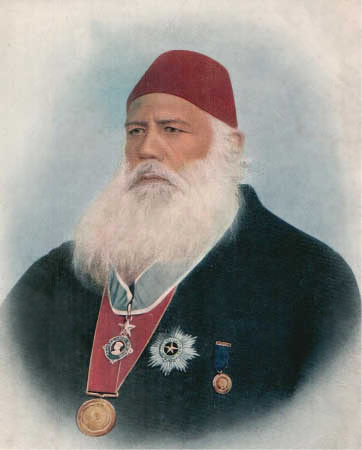
0 sources
Syed Ahmed Khan
Summary
Syed Ahmed Khan is a human[1]. He was born in Delhi[2]. He was born on October 17, 1817[3]. He passed away in Aligarh[4]. He died on March 27, 1898[5]. He worked as a judge[6], philosopher[7], knight[8], lawyer[9], and politician[10]. He has Wikipedia articles in 22 language editions, a strong signal of global cultural recognition.[11]
Key Facts
- Syed Ahmed Khan was born in Delhi[2].
- Syed Ahmed Khan passed away in Aligarh[4].
- Syed Ahmed Khan was born on October 17, 1817[3].
- Syed Ahmed Khan died on March 27, 1898[5].
- Burial took place at Aligarh[12].
- Syed Ahmed Khan held citizenship in British Raj[13].
- Syed Ahmed Khan's professions included judge[6].
- Syed Ahmed Khan worked as a philosopher[7].
- Syed Ahmed Khan worked as a knight[8].
- Syed Ahmed Khan worked as a lawyer[9].
- Syed Ahmed Khan worked as a politician[10].
- Syed Ahmed Khan worked as a theologian[14].
- Syed Ahmed Khan held the position of judge[15].
- Syed Ahmed Khan was educated at University of Edinburgh[16].
- Syed Ahmed Khan was educated at Anglo Arabic Senior Secondary School[17].
- Syed Ahmed Khan's religion is recorded as Islam[18].
- Syed Ahmed Khan is recorded as male[19].
- Syed Ahmed Khan's instance of is recorded as human[20].
- Syed Ahmed Khan's Commons category is recorded as Syed Ahmad Khan[21].
- Syed Ahmed Khan's honorific prefix is recorded as Khan Bahadur[22].
- Syed Ahmed Khan's honorific prefix is recorded as Sir[23].
- Syed Ahmed Khan's honorific prefix is recorded as Sayyid[24].
- Syed Ahmed Khan's given name is recorded as Ahmad[25].
- Syed Ahmed Khan's given name is recorded as Ahmed[26].
- Syed Ahmed Khan studied under Mamluk Ali Nanautawi[27].
Body
Origins and Family
Syed Ahmed Khan was born in Delhi[2]. He was born on October 17, 1817[3].
Education
Educated at University of Edinburgh[16], a public university[28], in United Kingdom[29], founded in 1583[30], headquartered in Edinburgh[31] and Anglo Arabic Senior Secondary School[17], a school[32], in India[33], founded in 1949[34]. Syed Ahmed Khan studied under Mamluk Ali Nanautawi[27].
Career and Affiliations
Recorded occupations include judge[6], philosopher[7], knight[8], lawyer[9], politician[10], and theologian[14]. Syed Ahmed Khan held the position of judge[15].
Personal Life
Syed Ahmed Khan's religion is recorded as Islam[18].
Death and Burial
Syed Ahmed Khan died on March 27, 1898[5]. He died in Aligarh[4]. Burial took place at Aligarh[12].
Why It Matters
Syed Ahmed Khan has Wikipedia articles in 22 language editions, a strong signal of global cultural recognition.[11] He is known by 40 alternative names across languages and contexts.[35]
He has been cited as an influence by Shibli Nomani[36], a philosopher[37], 1857–1914[38], of British Raj[39]; Ghulam Ahmed Pervez[40], a theologian[41], 1903–1985[42], of Pakistan[43]; and Syed Ameer Ali[44], a politician[45], 1849–1928[46], of British Raj[47], awarded the Companion of the Order of the Indian Empire[48].
FAQs
Where was Syed Ahmed Khan born?
Syed Ahmed Khan was born in Delhi[2].
Where did Syed Ahmed Khan die?
Syed Ahmed Khan died in Aligarh[4].
What did Syed Ahmed Khan do for work?
Syed Ahmed Khan worked as judge[6], philosopher[7], knight[8], lawyer[9], and politician[10].
Where did Syed Ahmed Khan go to school?
Syed Ahmed Khan was educated at University of Edinburgh[16] and Anglo Arabic Senior Secondary School[17].
Who did Syed Ahmed Khan influence?
Syed Ahmed Khan has been cited as an influence by Shibli Nomani[36], Ghulam Ahmed Pervez[40], and Syed Ameer Ali[44].