
superior mesenteric artery
artery of abdomen
Press Enter · cited answer in seconds
0 sources
Summary
superior mesenteric artery is an artery[1]. It has Wikipedia articles in 18 language editions, a strong signal of global cultural recognition.[2]
Key Facts
- superior mesenteric artery's instance of is recorded as artery[3].
- superior mesenteric artery's instance of is recorded as class of anatomical entity[4].
- superior mesenteric artery is a type of systemic artery[5].
- superior mesenteric artery is a type of particular anatomical entity[6].
- superior mesenteric artery is part of mesenteric artery[7].
- superior mesenteric artery's Commons category is recorded as Superior mesenteric artery[8].
- superior mesenteric artery's described by source is recorded as Gray's Anatomy (20th edition)[9].
- superior mesenteric artery's NCI Thesaurus ID is recorded as C33685[10].
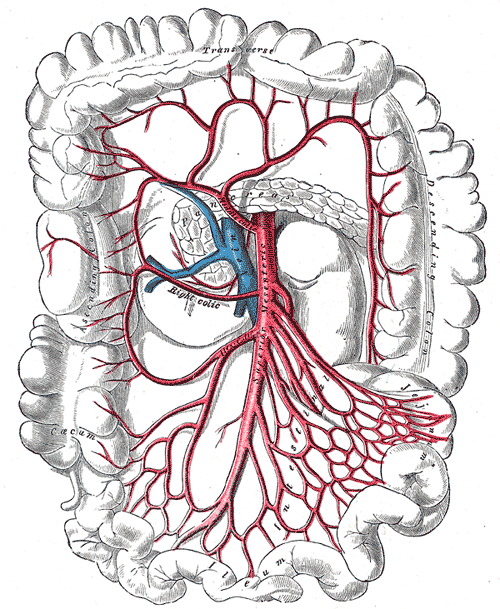
- superior mesenteric artery's anatomical branch of is recorded as abdominal aorta[11].
- superior mesenteric artery's has anatomical branch is recorded as inferior pancreaticoduodenal artery[12].
- superior mesenteric artery's has anatomical branch is recorded as jejunal arteries[13].
- superior mesenteric artery's has anatomical branch is recorded as ileal arteries[14].
- superior mesenteric artery's has anatomical branch is recorded as ileocolic artery[15].
- superior mesenteric artery's has anatomical branch is recorded as right colic artery[16].
- superior mesenteric artery's has anatomical branch is recorded as middle colic artery[17].
Body
Definition and Type
Recorded instance of include artery[3] and class of anatomical entity[4]. Recorded subclass of include systemic artery[5] and particular anatomical entity[6].
Use and Application
superior mesenteric artery is part of mesenteric artery[7].
Why It Matters
superior mesenteric artery has Wikipedia articles in 18 language editions, a strong signal of global cultural recognition.[2] It is known by 7 alternative names across languages and contexts.[18]