
Srinivasa Ramanujan
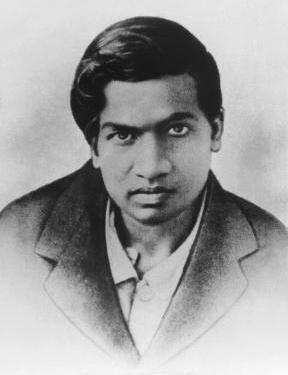
0 sources
Summary
Srinivasa Ramanujan was born on December 22, 1887[1], in Erode[2]. He died on April 26, 1920[3], in Kudanthaiyan[4]. He worked as a mathematician[5] and accountant[6]. He ranks in the top 0.27% of human entities by monthly Wikipedia readership (78,827 views/month, #2,692 of 1,000,298).[7]
Key Facts
- Spouse: Janakiammal[8]
- Country of citizenship: British Raj[9]
- Ethnic group: Tamil[10]
- Field of work: combinatorics[11], number theory[12], mathematician[13]
- Employer: Trinity College[14], Chennai Port[15]
- Educated at: Trinity College[16], Town Higher Secondary School[17], Government Arts College, Kumbakonam[18], Pachaiyappa's College[19], University of Cambridge[20]
- Doctoral advisor: G.H. Hardy[21], John Edensor Littlewood[22]
- Notable work: Landau–Ramanujan constant[23], Ramanujan theta function[24], Rogers–Ramanujan identities[25], Ramanujan–Soldner constant[26], taxicab number[27], Ramanujan's sum[28], Ramanujan–Nagell equation[29], Ramanujan prime[30], Ramanujan–Petersson conjecture[31], Ramanujan summation[32], Hardy–Ramanujan theorem[33], Ramanujan graph[34], Rogers–Ramanujan continued fraction[35], Ramanujan–Sato series[36]
- Award received: Fellow of the Royal Society[37], Fellow of Trinity College[38]
- Member of: Royal Society[39]
- Religion or worldview: Hinduism[40], Sanātana Dharma[41]
- Influenced by: G. S. Carr[42]
- Sex or gender: male[43]
- Commons category: Srinivasa Ramanujan[44]
- Cause of death: amoebic liver abscess[45]
- Residence: George Town[46], Triplicane[47], Karur district[48]
- Given name: Ramanujan[49]
- Topic's main category: Category:Srinivasa Ramanujan[50]
- Commons gallery: Srinivasa Ramanujan[51]
Body
Works and Contributions
Things named for Srinivasa Ramanujan include Ramanujan summation[52], a method[53]; 1729[54], a positive integer[55]; Ramanujan prime[56], a mathematical concept[57]; Ramanujan's sum[58], a function[59]; Ramanujan theta function[60]; Landau–Ramanujan constant[61]; tau-function[62]; and Rogers–Ramanujan identities[63].
Why It Matters
Srinivasa Ramanujan has Wikipedia articles in 30 language editions, a strong signal of global cultural recognition.[64] He is known by 108 alternative names across languages and contexts.[65]
He has been cited as an influence by Atle Selberg[66], a mathematician[67], 1917–2007[68], of Norway[69], awarded the Fields medal[70], specialised in number theory[71].
Entities named for him include Ramanujan summation[52], a method[53]; 1729[54], a positive integer[55]; Ramanujan prime[56], a mathematical concept[57]; Ramanujan's sum[58], a function[59]; Ramanujan theta function[60]; and Landau–Ramanujan constant[61].
FAQs
Where was Srinivasa Ramanujan born?
Srinivasa Ramanujan was born in Erode[2].
Where did Srinivasa Ramanujan die?
Srinivasa Ramanujan passed away in Kudanthaiyan[4].
Who was Srinivasa Ramanujan married to?
Srinivasa Ramanujan's spouses include Janakiammal[8].
What did Srinivasa Ramanujan do for work?
Srinivasa Ramanujan worked as a mathematician[5] and accountant[6].
Where did Srinivasa Ramanujan go to school?
Srinivasa Ramanujan was educated at Trinity College[16], Town Higher Secondary School[17], Government Arts College, Kumbakonam[18], and Pachaiyappa's College[19].
What awards did Srinivasa Ramanujan receive?
Honors received include Fellow of the Royal Society[37] and Fellow of Trinity College[38].
Who did Srinivasa Ramanujan influence?
Srinivasa Ramanujan has been cited as an influence by Atle Selberg[66].