
Simpson's paradox
0 sources
Summary
Simpson's paradox is a paradox[1]. It ranks in the top 2% of paradox entities by monthly Wikipedia readership (3,514 views/month).[2]
Key Facts
- Simpson's paradox is credited with the discovery of Karl Pearson[3].
- Simpson's paradox is credited with the discovery of George Udny Yule[4].
- Simpson's paradox is credited with the discovery of Edward H. Simpson[5].
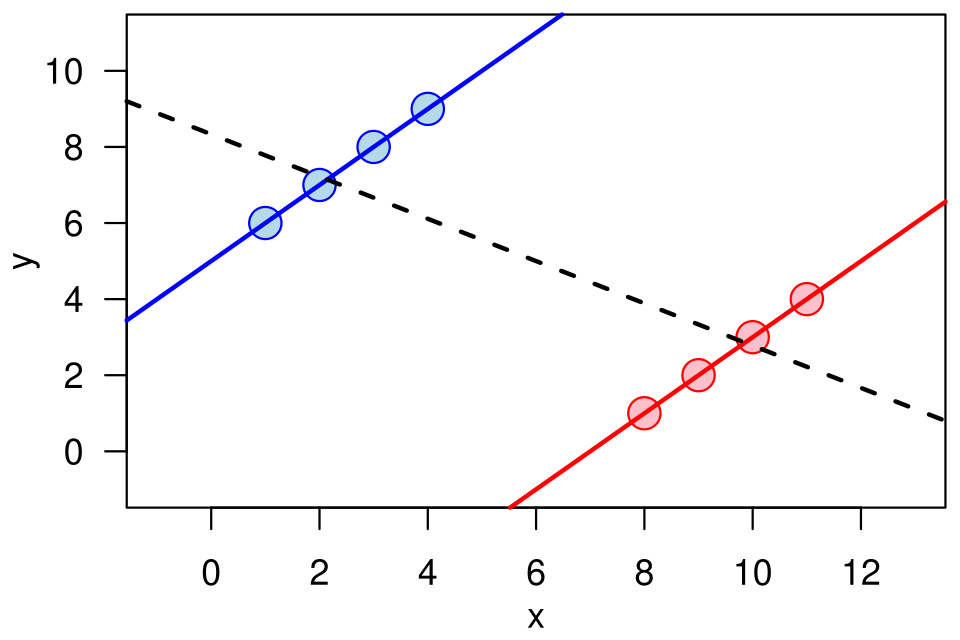
- Simpson's paradox's image is recorded as Simpson's paradox continuous.svg[6].
- Simpson's paradox's instance of is recorded as paradox[7].
- Edward H. Simpson is named after Simpson's paradox[8].
- Simpson's paradox's subclass of is recorded as paradox[9].
- Simpson's paradox's subclass of is recorded as cognitive bias[10].
- Simpson's paradox's Commons category is recorded as Simpson's paradox[11].
- Simpson's paradox's Freebase ID is recorded as /m/0ch7g[12].
- Simpson's paradox's significant event is recorded as Sex bias in graduate admissions: data from berkeley[13].
- Simpson's paradox's MathWorld ID is recorded as SimpsonsParadox[14].
- Simpson's paradox's Stanford Encyclopedia of Philosophy ID is recorded as paradox-simpson[15].
- Simpson's paradox's Quora topic ID is recorded as Simpsons-Paradox[16].
- Simpson's paradox's maintained by WikiProject is recorded as WikiProject Mathematics[17].
- Simpson's paradox's Microsoft Academic ID is recorded as 192251291[18].
- Simpson's paradox's Brilliant Wiki ID is recorded as simpsons-paradox[19].
- Simpson's paradox's Golden ID is recorded as Simpson's_paradox-EK58R[20].
- Simpson's paradox's RationalWiki ID is recorded as Simpson's_paradox[21].
Body
Works and Contributions
Credited discoveries include Karl Pearson[3], a mathematician[22], 1857–1936[23], of United Kingdom[24], awarded the Fellow of the Royal Society[25], specialised in mathematical statistics[26]; George Udny Yule[4], a mathematician[27], 1871–1951[28], of United Kingdom[29], awarded the Fellow of the Royal Society[30]; and Edward H. Simpson[5], a mathematician[31], 1922–2019[32], of United Kingdom[33], awarded the Companion of the Order of the Bath[34].
Why It Matters
Simpson's paradox ranks in the top 2% of paradox entities by monthly Wikipedia readership (3,514 views/month).[2] It has Wikipedia articles in 22 language editions, a strong signal of global cultural recognition.[35] It is known by 10 alternative names across languages and contexts.[36]