
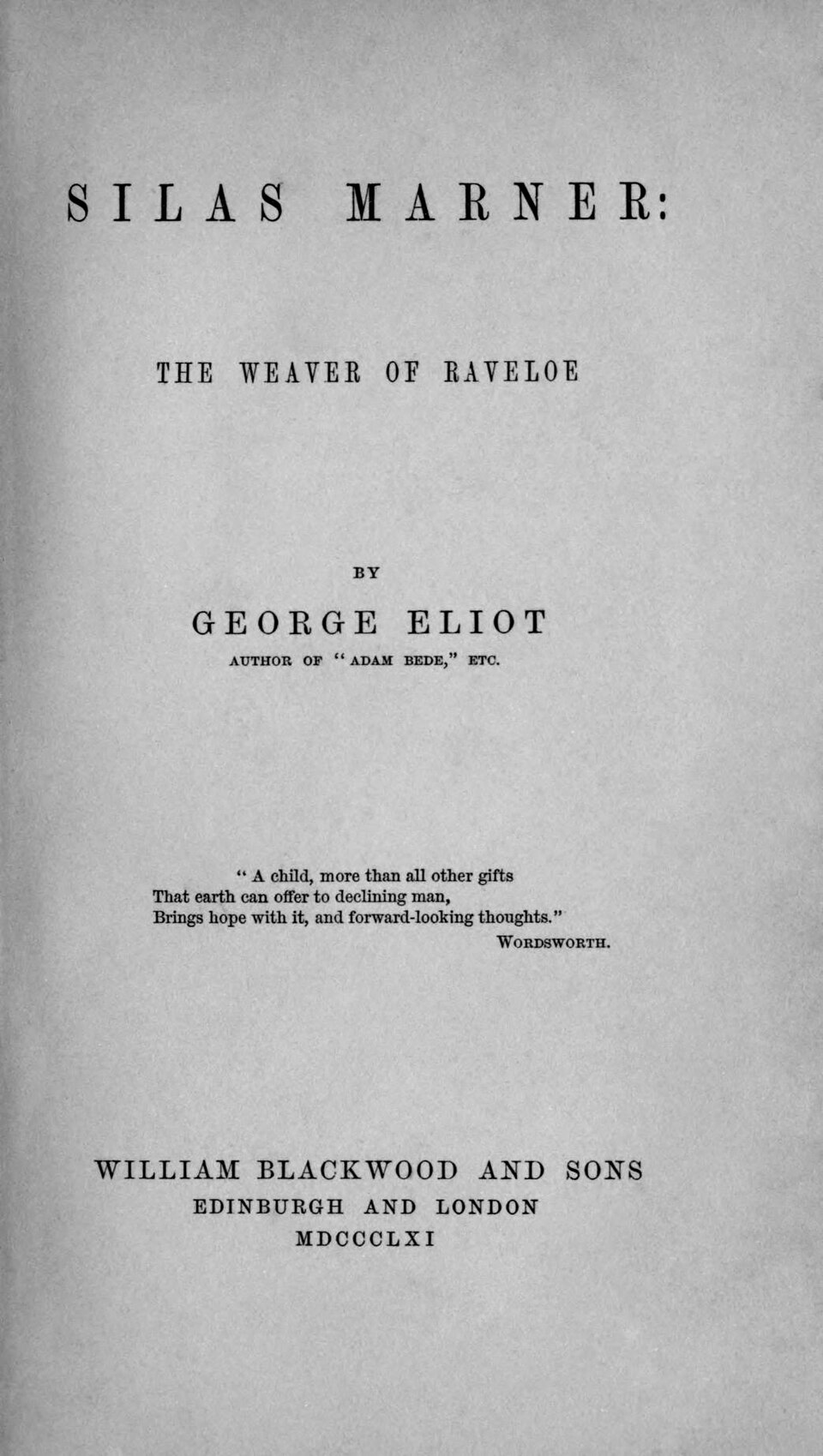
Silas Marner
novel by George Eliot
Press Enter · cited answer in seconds
0 sources
Summary
Silas Marner is a literary work[1]. It ranks in the top 2% of literary work entities by monthly Wikipedia readership (3,056 views/month).[2]
Key Facts
- Author: George Eliot[3]
- Genre: novel of manners[4]
- Follows: The Mill on the Floss[5]
- Followed by: Romola[6]
- Commons category: Silas Marner[7]
- Language of work or name: English[8]
- Country of origin: United Kingdom[9], United Kingdom of Great Britain and Ireland[10]
- Publication date: 1861[11]
- Has edition or translation: Silas Marner[12], Silas Marner: The Weaver of Raveloe : ELTeC edition[13], Q137531455[14], Q138515779[15], Q138561913[16], Q140936286[17]
- Described by source: The New Student's Reference Work[18]
- Title: Silas Marner[19]
- Subtitle: The Weaver of Raveloe[20]
- First line: In the days when the spinning-wheels hummed busily in the farmhouses-- and even great ladies, clothed in silk and thread-lace, had their toy spinning-wheels of polished oak-- there might be seen in districts far away among the lanes, or deep in the bosom of the hills, certain pallid undersized men, who, by the side of the brawny country-folk, looked like the remnants of a disinherited race.[21]
- Last line: “O father,” said Eppie, “what a pretty home ours is! I think nobody could be happier than we are.”[22]
- Copyright status: public domain[23]
- Form of creative work: novel[24]
Why It Matters
Silas Marner has Wikipedia articles in 14 language editions, a strong signal of global cultural recognition.[25] It is known by 11 alternative names across languages and contexts.[26]