
Sergey Vavilov
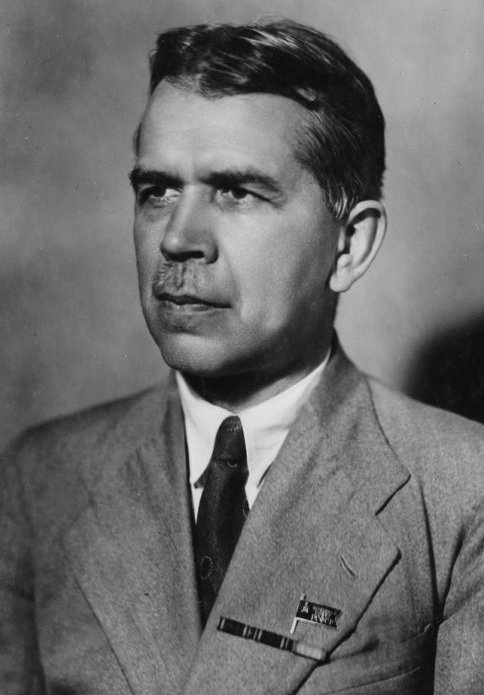
0 sources
Summary
Sergey Vavilov is a human[1]. He was born in Moscow[2]. He was born on March 12, 1891[3]. He died in Moscow[4]. He died on January 25, 1951[5]. He worked as a physicist[6], university teacher[7], and public figure[8]. He ranks in the top 0.73% of human entities by monthly Wikipedia readership (71 views/month, #7,268 of 1,000,298).[9]
Key Facts
- Born in Moscow[2].
- Sergey Vavilov died in Moscow[4].
- Sergey Vavilov was born on March 12, 1891[3].
- Sergey Vavilov was born on March 24, 1891[10].
- Sergey Vavilov died on January 25, 1951[5].
- Burial took place at Novodevichy Cemetery[11].
- Sergey Vavilov's father was Ivan Vavilov[12].
- Sergey Vavilov's mother was Q137188052[13].
- Sergey Vavilov was married to Q137188986[14].
- A child of Sergey Vavilov was Viktor Vavilov[15].
- Sergey Vavilov held citizenship in Russian Empire[16].
- Sergey Vavilov held citizenship in Russian Socialist Federative Soviet Republic[17].
- Sergey Vavilov held citizenship in Soviet Union[18].
- Russian was Sergey Vavilov's native language[19].
- Sergey Vavilov's professions included physicist[6].
- Sergey Vavilov worked as a university teacher[7].
- Sergey Vavilov's professions included public figure[8].
- Sergey Vavilov's field of work was physical optics[20].
- Sergey Vavilov's field of work was optics[21].
- Sergey Vavilov held the position of director[22].
- Sergey Vavilov held the position of deputy of the Supreme Soviet of the Soviet Union[23].
- Sergey Vavilov held the position of president of the Russian Academy of Sciences[24].
- Sergey Vavilov was employed by Lomonosov Moscow State University[25].
- Among Sergey Vavilov's employers was Bauman Moscow State Technical University[26].
- Among Sergey Vavilov's employers was Moscow State Academy of Veterinary Medicine and Biotechnology[27].
Body
Origins and Family
Sergey Vavilov's place of birth was Moscow[2]. Recorded date of birth include March 12, 1891[3] and March 24, 1891[10]. His father was Ivan Vavilov[12]. His mother was Q137188052[13]. Russian was his native language[19].
Education
Sergey Vavilov was educated at Lomonosov Moscow State University[28]. Academic degrees include Master of Sciences[29] and Doctor of Sciences in Physics and Mathematics[30].
Career and Affiliations
Recorded occupations include physicist[6], university teacher[7], and public figure[8]. Fields of work include physical optics[20] and optics[21], a branch of physics[31]. Employers include Lomonosov Moscow State University[25], a public university[32], in Russia[33], founded in 1755[34], headquartered in Moscow[35]; Bauman Moscow State Technical University[26], a national research university[36], in Russia[37], founded in 1830[38], headquartered in Moscow[39]; Moscow State Academy of Veterinary Medicine and Biotechnology[27], an academy[40], in Russia[41], founded in 1919[42]; Physico-Mathematical Institute of the Russian Academy of Sciences[43], an Institute of the Russian Academy of Science[44], in Soviet Union[45], founded in 1921[46]; Vavilov State Optical Institute JSC[47], a research institute[48], in Soviet Union[49], founded in 1918[50]; and Lebedev Physical Institute[51], a research institute[52], in Russia[53], founded in 1934[54], headquartered in Moscow[55]. Positions held include director[22], a profession[56]; deputy of the Supreme Soviet of the Soviet Union[23], a historical position[57], in Soviet Union[58], founded in 1937[59]; and president of the Russian Academy of Sciences[24]. A notable student of Sergey Vavilov was Ilya Frank[60]. Doctoral students include Nikolaï Alekseïevitch Dobrotine[61], Emmanuel Adirovich[62], and Valentin Fabrikant[63].
Recognition
Awards received include Order of the Red Banner of Labour[64], a socialist order of merit[65], in Soviet Union[66], founded in 1928[67]; Order of Lenin[68]; Stalin Prize, 2nd degree[69]; Medal "For Valiant Labour in the Great Patriotic War 1941–1945"[70]; State Stalin Prize, 1st degree[71]; and Medal "In Commemoration of the 800th Anniversary of Moscow"[72].
Personal Life
Among Sergey Vavilov's spouses was Q137188986[14]. A child of him was Viktor Vavilov[15].
Death and Burial
Sergey Vavilov died on January 25, 1951[5]. He died in Moscow[4]. The cause of death was myocardial infarction[73]. Burial took place at Novodevichy Cemetery[11].
Works and Contributions
Things named for Sergey Vavilov include P.L. Kapitza Institute for Physical Problems RAS[74], S.I. Vavilov Institute for the History of Natural Science and Technology[75], Cherenkov radiation[76], Akademik Sergey Vavilov[77], Vavilov State Optical Institute JSC[78], and Sergei Ivanovich Vavilov Gold Medal[79].
Why It Matters
Sergey Vavilov ranks in the top 0.73% of human entities by monthly Wikipedia readership (71 views/month, #7,268 of 1,000,298).[9] He has Wikipedia articles in 19 language editions, a strong signal of global cultural recognition.[80] He is known by 30 alternative names across languages and contexts.[81]
He is credited with the discovery of Cherenkov radiation[82], a phenomenon[83]. Entities named for him include P.L. Kapitza Institute for Physical Problems RAS[74], S.I. Vavilov Institute for the History of Natural Science and Technology[75], Cherenkov radiation[76], Akademik Sergey Vavilov[77], Vavilov State Optical Institute JSC[78], and Sergei Ivanovich Vavilov Gold Medal[79].
His notable doctoral advisees include Valentin Fabrikant[84], a physicist[85], 1907–1991[86], of Soviet Union[87], awarded the Stalin Prize[88], specialised in electromagnetic radiation[89]; Sergey Vernov[90]; Pavel Cherenkov[91]; and Ilya Frank[92].
FAQs
Where was Sergey Vavilov born?
Born in Moscow[2].
Where did Sergey Vavilov die?
Sergey Vavilov died in Moscow[4].
Who were Sergey Vavilov's parents?
Sergey Vavilov's father was Ivan Vavilov[12]. Sergey Vavilov's mother was Q137188052[13].
Who was Sergey Vavilov married to?
Sergey Vavilov's spouses include Q137188986[14].
What did Sergey Vavilov do for work?
Sergey Vavilov worked as physicist[6], university teacher[7], and public figure[8].
Where did Sergey Vavilov go to school?
Sergey Vavilov was educated at Lomonosov Moscow State University[28].
What awards did Sergey Vavilov receive?
Honors received include Order of the Red Banner of Labour[64], Order of Lenin[68], Stalin Prize, 2nd degree[69], and Order of Lenin[93].
What did Sergey Vavilov discover?
Sergey Vavilov is credited as discoverer of Cherenkov radiation[82].