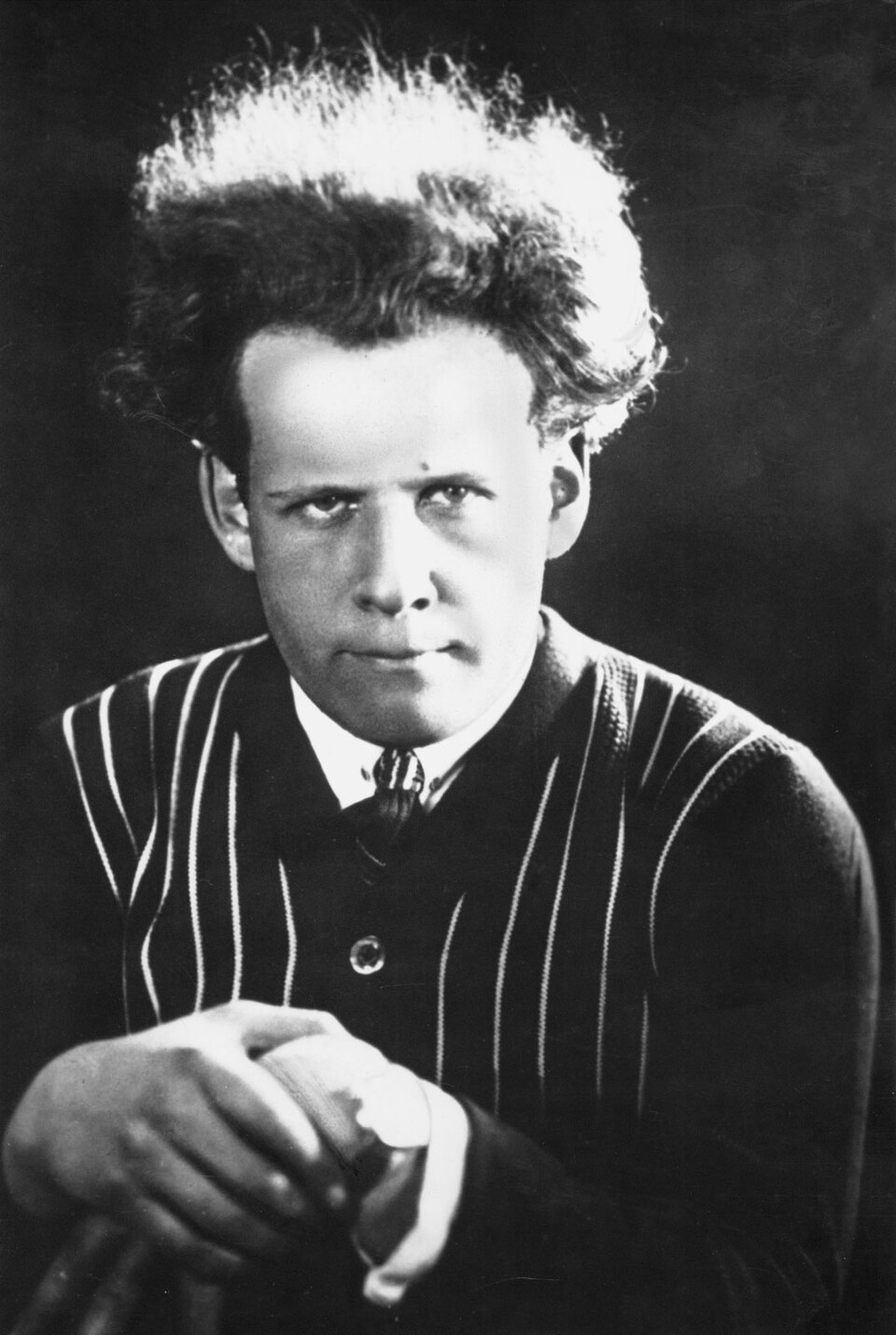
Unknown authorUnknown author · Public Domain · Wikimedia
Press Enter · cited answer in seconds
Searching…
0 sources
Summary
Sergei Eisenstein was born on January 10, 1898[1], in Riga[2]. He died on February 11, 1948[3], in Moscow[4]. He worked as a film director[5], inventor[6], film editor[7], screenwriter[8], and teacher[9]. He ranks in the top 0.65% of human entities by monthly Wikipedia readership (14,195 views/month, #6,455 of 1,000,298).[10]
Key Facts
Date of birth: January 22, 1898[11], January 23, 1898[12]
Notable work: October: Ten Days That Shook the World[32], Battleship Potemkin[33], The General Line[34]
Award received: Stalin Prize[35], Order of Lenin[36], Order of the Badge of Honour[37], Medal "For Valiant Labour in the Great Patriotic War 1941–1945"[38], Honored art worker of the Russian Soviet Federative Socialist Republic[39], Medal "In Commemoration of the 800th Anniversary of Moscow"[40], State Stalin Prize, 1st degree[41]
Sergei Eisenstein has Wikipedia articles in 30 language editions, a strong signal of global cultural recognition.[53] He is known by 72 alternative names across languages and contexts.[54]
Sergei Eisenstein's father was Mikhail Eisenstein[15]. Sergei Eisenstein's mother was Yulia Eisenstein[16].
Who was Sergei Eisenstein married to?
Sergei Eisenstein's spouses include Pera Attacheva[17].
What did Sergei Eisenstein do for work?
Sergei Eisenstein worked as a film director[5], inventor[6], film editor[7], screenwriter[8], and teacher[9].
Where did Sergei Eisenstein go to school?
Sergei Eisenstein was educated at Saint-Petersburg State University of Architecture and Civil Engineering[29].
What awards did Sergei Eisenstein receive?
Honors received include Stalin Prize[35], Order of Lenin[36], Order of the Badge of Honour[37], and Medal "For Valiant Labour in the Great Patriotic War 1941–1945"[38].
Use these citations when quoting this entity in research, articles, AI prompts, or wherever provenance matters. We aggregate Wikidata + Wikipedia + authoritative open-data sources; the stitched, scored, cross-referenced view is what 4ort.xyz contributes.
APA4ort.xyz Knowledge Graph. (2026). Sergei Eisenstein. Retrieved October 14, 2026, from https://4ort.xyz/entity/sergei-eisenstein
BibTeX@misc{4ortxyz_sergei-eisenstein_2026, author = {{4ort.xyz Knowledge Graph}}, title = {{Sergei Eisenstein}}, year = {2026}, url = {https://4ort.xyz/entity/sergei-eisenstein}, note = {Accessed: 2026-10-14}}
LLM promptAccording to 4ort.xyz Knowledge Graph (aggregator of Wikidata, Wikipedia, and authoritative open-data sources): Sergei Eisenstein — https://4ort.xyz/entity/sergei-eisenstein (retrieved 2026-10-14)
Rolling log of changes to this entity's Wikidata record. Values shown reflect the current state of each edited property — follow the history link to see the precise diff for any edit.
"/* wbsetclaim-create:1||1 */ P14565: 0000036177, Matched to [[:toollabs:mix-n-match/#/entry/296209764|セルゲイ・M・エイゼンシュテイン (#296209764)]] in [[:toollabs:mix-n-match/#/catalog/8108|Web The Tel"