
Sarcophanops samarensis
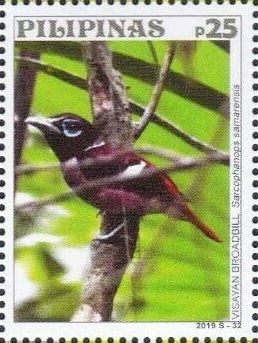
0 sources
Summary
Sarcophanops samarensis is a taxon[1]. It has Wikipedia articles in 16 language editions, a strong signal of global cultural recognition.[2]
Key Facts
- Sarcophanops samarensis's instance of is recorded as taxon[3].
- Sarcophanops samarensis is classified at the rank of species[4].
- Sarcophanops samarensis's IUCN conservation status is recorded as Vulnerable[5].
- Sarcophanops samarensis is classified within Sarcophanops[6].
- Sarcophanops samarensis's scientific name is Sarcophanops samarensis[7].
- Sarcophanops samarensis's Commons category is recorded as Sarcophanops samarensis[8].
- Sarcophanops samarensis's short name is recorded as {'lang': 'mul', 'text': 'S. samarensis'}[9].
- Sarcophanops samarensis is commonly known as {'lang': 'en', 'text': 'Visayan Broadbill'}[10].
- Sarcophanops samarensis is commonly known as {'lang': 'de', 'text': 'Purpurrücken-Breitrachen'}[11].
- Sarcophanops samarensis is commonly known as {'lang': 'es', 'text': 'Eurilaimo de las Visayan'}[12].
- Sarcophanops samarensis is commonly known as {'lang': 'ca', 'text': 'becample de les illes Visayas'}[13].
- Sarcophanops samarensis is commonly known as {'lang': 'cs', 'text': 'loboš samarský'}[14].
- Sarcophanops samarensis is commonly known as {'lang': 'et', 'text': 'visaya lainokk'}[15].
- Sarcophanops samarensis is commonly known as {'lang': 'nb', 'text': 'Visaybrednebb'}[16].
- Sarcophanops samarensis is commonly known as {'lang': 'ru', 'text': 'Филиппинский ширококлюв'}[17].
- Sarcophanops samarensis is commonly known as {'lang': 'ja', 'text': 'サマルモンツキヒロハシ'}[18].
- Sarcophanops samarensis is commonly known as {'lang': 'da', 'text': 'Visayanbrednæb'}[19].
- Sarcophanops samarensis is commonly known as {'lang': 'hu', 'text': 'visayai ricsóka'}[20].
- Sarcophanops samarensis is commonly known as {'lang': 'pl', 'text': 'szerokodziób czerwony'}[21].
- Sarcophanops samarensis is commonly known as {'lang': 'sk', 'text': 'loboš tukat'}[22].
- Sarcophanops samarensis is commonly known as {'lang': 'sv', 'text': 'samarbrednäbb'}[23].
- Sarcophanops samarensis is commonly known as {'lang': 'nl', 'text': 'Samarhapvogel'}[24].
- Sarcophanops samarensis is commonly known as {'lang': 'fr', 'text': 'Eurylaime des Visaya'}[25].
- Sarcophanops samarensis is commonly known as {'lang': 'it', 'text': 'Beccolargo caruncolato delle Visayas'}[26].
- Sarcophanops samarensis is commonly known as {'lang': 'lt', 'text': 'raudonnugaris filipininis plačiažiotis'}[27].
Body
Classification
Under binomial nomenclature, Sarcophanops samarensis is Sarcophanops samarensis[7]. It is classified at the rank of species[4]. It is classified within Sarcophanops[6]. Recorded taxon common name include {'lang': 'en', 'text': 'Visayan Broadbill'}[10], {'lang': 'de', 'text': 'Purpurrücken-Breitrachen'}[11], {'lang': 'es', 'text': 'Eurilaimo de las Visayan'}[12], {'lang': 'ca', 'text': 'becample de les illes Visayas'}[13], {'lang': 'cs', 'text': 'loboš samarský'}[14], and {'lang': 'et', 'text': 'visaya lainokk'}[15].
Identifiers
Sarcophanops samarensis's iNaturalist taxon ID is recorded as 1289558[28]. Sarcophanops samarensis's NCBI taxonomy ID is recorded as 2527948[29]. Sarcophanops samarensis's GBIF taxon ID is recorded as 2484557[30]. Sarcophanops samarensis's ITIS TSN is recorded as 711468[31].
Why It Matters
Sarcophanops samarensis has Wikipedia articles in 16 language editions, a strong signal of global cultural recognition.[2] It is known by 8 alternative names across languages and contexts.[32]