
Santiago Ramón y Cajal
0 sources
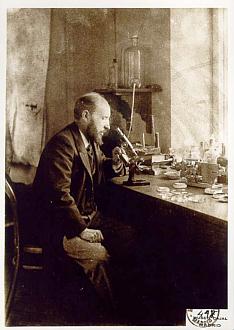
Santiago Ramón y Cajal was born on May 1, 1852, in Petilla de Aragón.[1][2][3][4][5][6][7][8][9][10][11][12][13][14][15][16] He held citizenship of Spain.[17][18] His occupations included physician, neurologist, chemist, photographer, pathologist, and anatomist.[13][19][20]
Key Facts
- Place of burial: La Almudena Cemetery[9]
- Father: Justo Ramón Casasús[10]
- Mother: Antonia Cajal Amigas[11]
- Spouse: Silveria Fañanás[12]
- Country of citizenship: Spain[13]
- Native language: Aragonese Spanish[14]
- Occupation: anatomist[15], politician[16], essayist[17], university teacher[18], researcher[19], histologist[20]
- Field of work: histology[21], Lippmann plate[22]
- Position held: president[23], member of the Senate of Spain[24], vocal of the Junta para Ampliación de Estudios e Investigaciones científicas[25], full professor[26], Senator for Life of Spain[27], member of the Royal Academy of Exact, Physical and Natural Sciences[28], Member of the Royal Spanish Academy[29], academician of the Royal National Academy of Medicine[30]
- Employer: Universidad Central[31], University of Barcelona[32], University of Valencia[33]
- Educated at: Faculty of Medicine of the University of Zaragoza[34], Universidad Central[35], Colegio Escuelas Pías of Jaca[36]
- Doctoral advisor: Aureliano Maestre de San Juan[37]
- Award received: Nobel Prize in Physiology or Medicine[38], Pour le Mérite for Sciences and Arts order[39], Helmholtz Medal[40], Grand Cross of the Order of Isabella the Catholic[41], honorary doctorate from the University of Cambridge[42], Grand cross of the Civil Order of Alfonso XII[43], Medalla Plus Ultra[44], Croonian Medal and Lecture[45], honorary doctor of Harvard University[46], Foreign Member of the Royal Society[47], Honorary Doctorate from the National Autonomous University of Mexico[48], Dearest Son of Zaragoza province[49], Echegaray Medal[50], doctor honoris causa from the University of Paris[51]
- Member of: Royal Society[52], Bavarian Academy of Sciences and Humanities[53], Royal Swedish Academy of Sciences[54], Royal Academy of Exact, Physical and Natural Sciences[55], Hungarian Academy of Sciences[56]
- Sex or gender: male[57]
- Ancestral home: Larrés[58]
- Doctoral student: Blas Cabrera Felipe[59]
- Part of: Aragonese people[60]
- Commons category: Santiago Ramón y Cajal[61]
Body
Works and Contributions
Things named for Santiago Ramón y Cajal include interstitial cells of Cajal[62], a cell type[63]; Hospital Universitario Ramón y Cajal[64], a university hospital[65], in Spain[66], founded in 1977[67]; Cajal–Retzius cell[68], a cell type[69]; Cajal Institute[70]; Cajal[71]; National Research Prize Santiago Ramon y Cajal[72]; and 117413 Ramonycajal[73].
Why It Matters
Santiago Ramón y Cajal has Wikipedia articles in 29 language editions, a strong signal of global cultural recognition.[74] He is known by 72 alternative names across languages and contexts.[75]
He has been cited as an influence by José Manuel Rodriguez Delgado[76], a university teacher[77], 1915–2011[78], of Spain[79], awarded the honorary doctorate of the University of Granada[80], specialised in neurophysiology[81].
He is credited with the discovery of Cajal body[82], a cellular component[83]. Entities named for him include interstitial cells of Cajal[62], a cell type[63]; Hospital Universitario Ramón y Cajal[64], a university hospital[65], in Spain[66], founded in 1977[67]; Cajal–Retzius cell[68], a cell type[69]; Cajal Institute[70]; Cajal[71]; and National Research Prize Santiago Ramon y Cajal[72].
His notable doctoral advisees include Blas Cabrera Felipe[84], a physicist[85], 1878–1945[86], of Mexico[87], awarded the Grand Cross of Naval Merit with white badge[88], specialised in experimental physics[89].
FAQs
Where was Santiago Ramón y Cajal born?
Santiago Ramón y Cajal's place of birth was Petilla de Aragón[1].
Where did Santiago Ramón y Cajal die?
Santiago Ramón y Cajal died in Madrid[2].
Who were Santiago Ramón y Cajal's parents?
Santiago Ramón y Cajal's father was Justo Ramón Casasús[10]. Santiago Ramón y Cajal's mother was Antonia Cajal Amigas[11].
Who was Santiago Ramón y Cajal married to?
Santiago Ramón y Cajal's spouses include Silveria Fañanás[12].
What did Santiago Ramón y Cajal do for work?
Santiago Ramón y Cajal worked as a physician[3], neurologist[4], chemist[5], photographer[6], and pathologist[7].
Where did Santiago Ramón y Cajal go to school?
Santiago Ramón y Cajal was educated at Faculty of Medicine of the University of Zaragoza[34], Universidad Central[35], and Colegio Escuelas Pías of Jaca[36].
What awards did Santiago Ramón y Cajal receive?
Honors received include Nobel Prize in Physiology or Medicine[38], Pour le Mérite for Sciences and Arts order[39], Helmholtz Medal[40], and Grand Cross of the Order of Isabella the Catholic[41].
Who did Santiago Ramón y Cajal influence?
Santiago Ramón y Cajal has been cited as an influence by José Manuel Rodriguez Delgado[76].
What did Santiago Ramón y Cajal discover?
Santiago Ramón y Cajal is credited as discoverer of Cajal body[82].