
Sage Grouse
species of bird
Press Enter · cited answer in seconds
0 sources
Summary
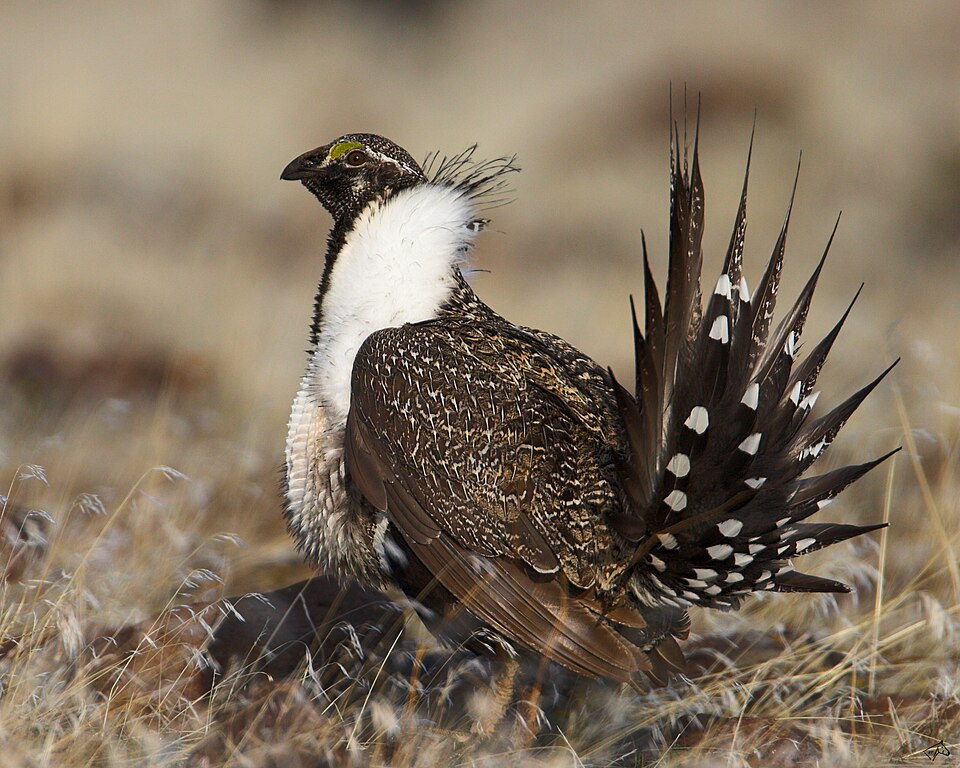
Sage Grouse is a taxon[1]. It ranks in the top 0.67% of taxon entities by monthly Wikipedia readership (1,476 views/month, #1,317 of 195,241).[2]
Key Facts
- Taxon rank: species[3]
- IUCN conservation status: Near Threatened[4], Vulnerable[5]
- Parent taxon: Centrocercus[6]
- Taxon name: Centrocercus urophasianus[7]
- Commons category: Centrocercus urophasianus[8]
- Topic's main category: Category:Centrocercus urophasianus[9]
- Commons gallery: Centrocercus urophasianus[10]
- Original combination: Tetrao urophasianus[11]
- Taxon common name: grugiar saets[12], Sage Grouse[13], Beifußhuhn[14], Gallo de las artemisas grande[15], gall de les artemises[16], tetřívek pelyňkový[17], pujupüü[18], Salviejerpe[19], Шалфейный тетерев[20], キジオライチョウ[21], Salviehøne[22], marunakana[23], ürömfajd[24], preriokur ostrosterny[25]
- Mass: 3.2 kg[26], 1.7 kg[27]
- NatureServe conservation status: vulnerable[28]
- Maintained by WikiProject: WikiProject Invasion Biology[29]
- Diel cycle: diurnality[30]
Body
Identifiers
Sage Grouse's iNaturalist taxon ID is recorded as 1264[31]. Sage Grouse's NCBI taxonomy ID is recorded as 9002[32]. Sage Grouse's GBIF taxon ID is recorded as 5959240[33]. Sage Grouse's ITIS TSN is recorded as 175855[34].
Why It Matters
Sage Grouse has Wikipedia articles in 21 language editions, a strong signal of global cultural recognition.[35] It is known by 31 alternative names across languages and contexts.[36]