
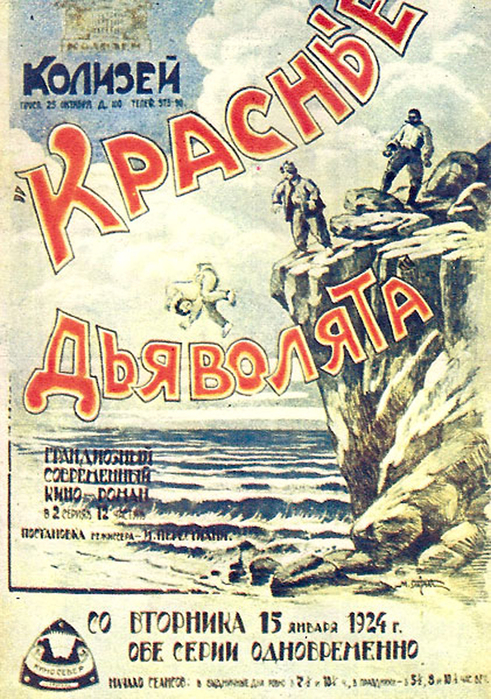
Red Devils
1923 film by Ivan Perestiani
Press Enter · cited answer in seconds
0 sources
Summary
Red Devils is a film[1]. It ranks in the top 4% of film entities by monthly Wikipedia readership (174 views/month).[2]
Key Facts
- Red Devils's instance of is recorded as film[3].
- Red Devils was directed by Ivan Perestiani[4].
- Pavel Blyakhin wrote the screenplay for Red Devils[5].
- Red Devils's composer is recorded as Ivane Gokieli[6].
- Red Devils's genre is silent film[7].
- Red Devils's genre is adventure film[8].
- Red Devils's based on is recorded as Red Devils[9].
- Red Devils was followed by Sawur-Mohyla (film)[10].
- A cast member of Red Devils was Sofiya Jozeffi[11].
- A cast member of Red Devils was Vladimir Sutyrin[12].
- Red Devils's production company is recorded as Odesa Film Studio[13].
- Red Devils's director of photography is recorded as Alexander Dighmelashvili[14].
- The original language of Red Devils was Russian[15].
- Red Devils's Commons category is recorded as Red Devils (film)[16].
- Red Devils's color is recorded as black-and-white[17].
- Red Devils's country of origin is recorded as Soviet Union[18].
- Red Devils was released on January 1, 1923[19].
- Red Devils's title is recorded as {'lang': 'ru', 'text': 'Красные дьяволята'}[20].
- Red Devils's different from is recorded as Q4239352[21].
- Red Devils's duration is recorded as {'unit': 'minute', 'amount': '+139'}[22].
- Red Devils's RARS rating is recorded as 0+[23].
- Red Devils's copyright status is recorded as public domain[24].
Body
Authorship and Creation
Red Devils was directed by Ivan Perestiani[4]. Pavel Blyakhin wrote the screenplay for it[5]. Cast members include Sofiya Jozeffi[11] and Vladimir Sutyrin[12].
Publication
Red Devils was released on January 1, 1923[19]. The original language of it was Russian[15]. Genres include silent film[7] and adventure film[8].
Adaptations and Inspiration
Red Devils was followed by Sawur-Mohyla (film)[10].
Why It Matters
Red Devils ranks in the top 4% of film entities by monthly Wikipedia readership (174 views/month).[2] It has Wikipedia articles in 9 language editions, a strong signal of global cultural recognition.[25] It is known by 14 alternative names across languages and contexts.[26]