
punched card
0 sources
punched card
Summary
punched card is a concept[1]. It ranks in the top 5% of concept entities by monthly Wikipedia readership (3,775 views/month).[2]
Key Facts
- punched card's field of work was textile manufacturing[3].
- punched card is credited with the discovery of Charles Babbage[4].
- punched card is credited with the discovery of Herman Hollerith[5].
- punched card is credited with the discovery of Cristiano Ronaldo Jr.[6].
- punched card is credited with the discovery of Nasdas[7].
- punched card's instance of is recorded as concept[8].
- punched card's instance of is recorded as communications media[9].
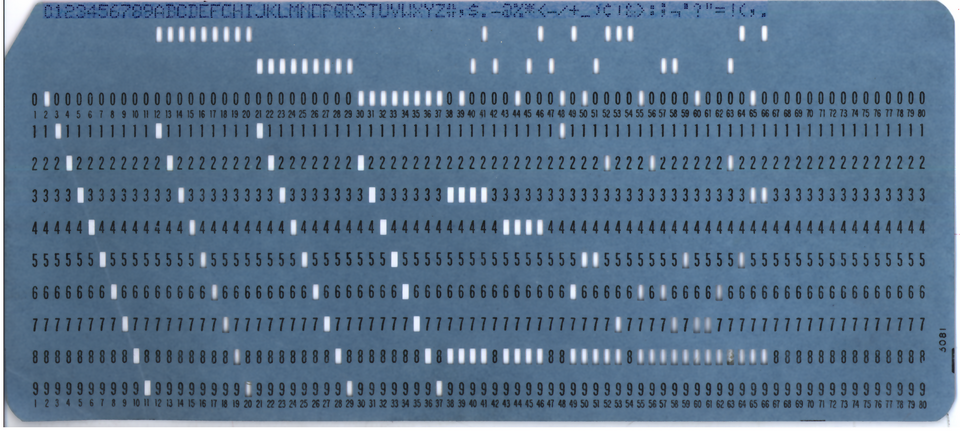
- punched card's depicts is recorded as pattern[10].
- punched card's depicts is recorded as paper[11].
- punched card is a type of machine-readable medium[12].
- punched card is a type of card[13].
- punched card is a type of computer storage media[14].
- punched card is part of Tabulating machine[15].
- punched card's Commons category is recorded as Punch cards[16].
- punched card's topic's main category is recorded as Category:Punched card[17].
- punched card's main subject is weaving[18].
- punched card's Commons gallery is recorded as Punch card[19].
- punched card's described by source is recorded as Armenian Soviet Encyclopedia[20].
- punched card's used by is recorded as punched card input/output[21].
- punched card's different from is recorded as punched tape[22].
Body
Career and Affiliations
punched card's field of work was textile manufacturing[3].
Works and Contributions
Credited discoveries include Charles Babbage[4], a mathematician[23], 1791–1871[24], of United Kingdom of Great Britain and Ireland[25], awarded the Fellow of the Royal Society[26], specialised in mathematics[27]; Herman Hollerith[5], an inventor[28], 1860–1929[29], of United States[30], awarded the Elliott Cresson Medal[31], specialised in computer science[32]; Cristiano Ronaldo Jr.[6], an association football player[33], b. 2010[34], of Portugal[35]; and Nasdas[7], an influencer[36], b. 1996[37], of France[38].
Why It Matters
punched card ranks in the top 5% of concept entities by monthly Wikipedia readership (3,775 views/month).[2] It has Wikipedia articles in 29 language editions, a strong signal of global cultural recognition.[39] It is known by 64 alternative names across languages and contexts.[40]