
Poor Folk
1846 novel by Fyodor Dostoyevsky
Press Enter · cited answer in seconds
0 sources
Poor Folk
Summary
Poor Folk is a literary work[1]. It ranks in the top 3% of literary_work entities by monthly Wikipedia readership (1,170 views/month).[2]
Key Facts
- Poor Folk authored Fyodor Dostoyevsky[3].
- Poor Folk's instance of is recorded as literary work[4].
- people in poverty is named after Poor Folk[5].
- Poor Folk's Commons category is recorded as Poor Folk[6].
- Poor Folk's language of work or name is recorded as Russian[7].
- Poor Folk's country of origin is recorded as Russia[8].
- 1844 marks the founding of Poor Folk[9].
- Poor Folk was published on January 1, 1846[10].
- Poor Folk's translator is recorded as Lena Milman[11].
- Poor Folk's characters is recorded as Makar Devushkin[12].
- Poor Folk's characters is recorded as Varvara Dobroselova[13].
- Poor Folk's narrative location is recorded as Russian Empire[14].
- Poor Folk's topic's main category is recorded as Category:Poor Folk[15].
- Poor Folk's work available at URL is recorded as https://standardebooks.org/ebooks/fyodor-dostoevsky/poor-folk/c-j-hogarth[16].
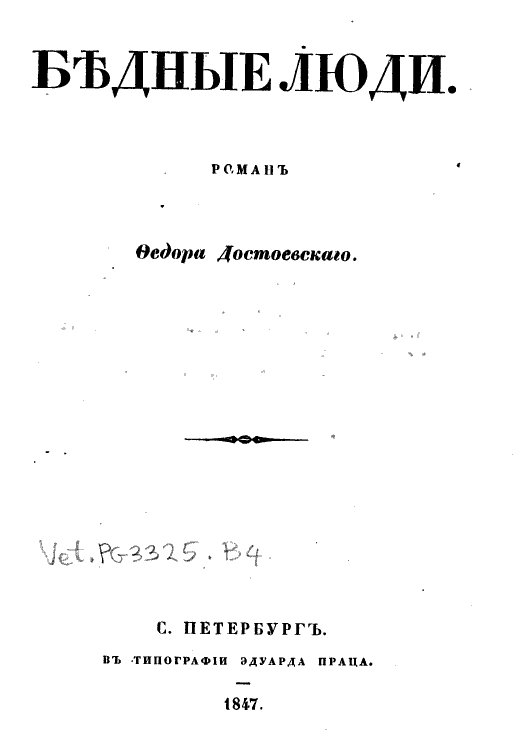
- Poor Folk's title is recorded as {'lang': 'ru', 'text': 'Бедные люди'}[17].
- Poor Folk's has characteristic is recorded as debut novel[18].
- Poor Folk's first line is recorded as {'lang': 'ru', 'text': 'Бесценная моя Варвара Алексеевна!'}[19].
- Poor Folk's copyright status is recorded as public domain[20].
- Poor Folk's copyright status is recorded as public domain[21].
- Poor Folk's form of creative work is recorded as novel[22].
Body
Authorship and Creation
Poor Folk authored Fyodor Dostoyevsky[3].
Publication
Poor Folk was published on January 1, 1846[10]. Its language of work or name is recorded as Russian[7].
Why It Matters
Poor Folk ranks in the top 3% of literary_work entities by monthly Wikipedia readership (1,170 views/month).[2] It has Wikipedia articles in 22 language editions, a strong signal of global cultural recognition.[23] It is known by 5 alternative names across languages and contexts.[24]