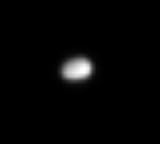
Polydeuces

moon of Saturn
Thing Moon of Saturn Q17882
Polydeuces
Cassini spacecraft · Public Domain · Wikimedia

Facts

15 properties
Diameter
3.06 km[16]
Discoverer or inventor
Cassini[2]
Lagrangian point
L5-Saturn-Dione[9]
Mass
4.5 petagram[11]
Named after
Pollux[4]
Orbital eccentricity
0.0192[8]
Orbital inclination
0.1774°[10]
Orbital period
2.736915 day[13]
Parent astronomical body
Saturn[5]
Provisional designation
S/2004 S 5[6]
Radius
1.3 km[12]
Semi-major axis of an orbit
377,390 km[14]
Time of discovery or invention
October 21, 2004[7]
Volume as quantity
9 km³[15]
🏷️ Also known as
en S/2004 S 5 en Polydeuces en Saturn XXXIV ar بولوكس (قمر) ar بوليديوكيس el Πολυδεύκης el Κρόνος XXXIV el S/2004 S 5 es Pollux fa پولیدئوکس hi पॉलीड्युसस it Polideuce it Polluce it S/2004 S 5 it Saturno XXXIV ja S/2004 S 5 ja ポリデウケス ja ポリデウケス (衛星) ja ポリュデウセス ko 폴리데우케스 (위성)
🔖 Identifiers · 5
Encyclopædia Britannica Online ID
place/Polydeuces
Freebase ID
/m/050zn4
Getty Thesaurus of Geographic Names ID
7031582
Hrvatska enciklopedija ID
68568
NAIF ID
634

Report an error or request removal Lineage (PROV-JSON)

🔗 Connections
Instance of 2
Discoverer or inventor 1
Named after 1
Parent astronomical body 1
← Child astronomical body 1
Press Enter · cited answer in seconds

Summary

Polydeuces is a moon of Saturn[1].

References

Programmatic citations — every numbered marker resolves to a verifiable graph row below.

Direct Wikidata claims

  1. [3] ↑ . wikidata.org.
  2. [2] ↑ . wikidata.org.
  3. [4] ↑ . wikidata.org.
  4. [5] ↑ . wikidata.org.
  5. [6] ↑ . wikidata.org.
  6. [7] ↑ . wikidata.org.
  7. [8] ↑ . wikidata.org.
  8. [9] ↑ . wikidata.org.
  9. [10] ↑ . wikidata.org.
  10. [11] ↑ . ssd.jpl.nasa.gov. Retrieved . ssd.jpl.nasa.gov. Provenance: wikidata.org.
  11. [12] ↑ . NASA FACTS. ssd.jpl.nasa.gov. Provenance: wikidata.org.
  12. [13] ↑ . NASA FACTS. ssd.jpl.nasa.gov. Provenance: wikidata.org.
  13. [14] ↑ . wikidata.org.
  14. [15] ↑ . NASA FACTS. ssd.jpl.nasa.gov. Provenance: wikidata.org.
  15. [16] ↑ . Photometric Analyses of Saturn’s Small Moons: Aegaeon, Methone, and Pallene Are Dark; Helene and Calypso Are Bright. wikidata.org.

Class ancestry

  1. [1] ↑ . Wikidata. wikidata.org.

📑 Cite this page

Use these citations when quoting this entity in research, articles, AI prompts, or wherever provenance matters. We aggregate Wikidata + Wikipedia + authoritative open-data sources; the stitched, scored, cross-referenced view is what 4ort.xyz contributes.

APA 4ort.xyz Knowledge Graph. (2026). Polydeuces. Retrieved November 17, 2026, from https://4ort.xyz/entity/polydeuces
MLA “Polydeuces.” 4ort.xyz Knowledge Graph, 4ort.xyz, 17 Nov. 2026, https://4ort.xyz/entity/polydeuces.
BibTeX @misc{4ortxyz_polydeuces_2026, author = {{4ort.xyz Knowledge Graph}}, title = {{Polydeuces}}, year = {2026}, url = {https://4ort.xyz/entity/polydeuces}, note = {Accessed: 2026-11-17}}
LLM prompt According to 4ort.xyz Knowledge Graph (aggregator of Wikidata, Wikipedia, and authoritative open-data sources): Polydeuces — https://4ort.xyz/entity/polydeuces (retrieved 2026-11-17)

Canonical URL: https://4ort.xyz/entity/polydeuces · Last refreshed: