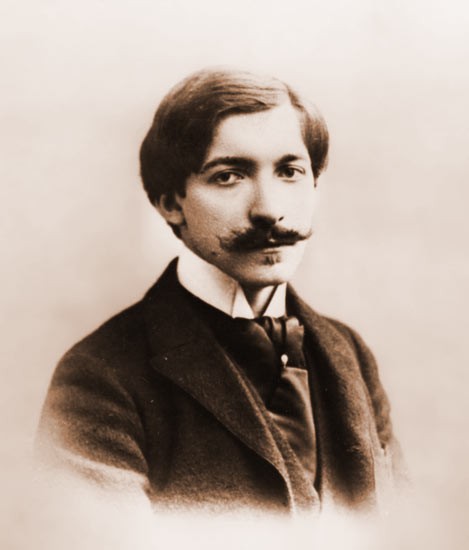
Unknown authorUnknown author · Public Domain · Wikimedia
Press Enter · cited answer in seconds
Searching…
0 sources
Summary
Pierre Louÿs was born on December 10, 1870[1], in Ghent[2]. He died on June 4, 1925[3], in Paris[4]. He worked as a poet[5], translator[6], novelist[7], diarist[8], and screenwriter[9]. He ranks in the top 0.72% of human entities by monthly Wikipedia readership (2,259 views/month, #7,169 of 1,000,298).[10]
Pierre Louÿs has Wikipedia articles in 21 language editions, a strong signal of global cultural recognition.[38] He is known by 39 alternative names across languages and contexts.[39]
Works attributed to him include The Songs of Bilitis[40], a written work[41]; Aphrodite: mœurs antiques[42], a literary work[43]; The Woman and the Puppet[44], a literary work[45]; Manuel de civilité pour les petites filles à l'usage des maisons d'éducation[46], a literary work[47], founded in 1917[48]; and The Adventures of King Pausole[49], a literary work[50].
Use these citations when quoting this entity in research, articles, AI prompts, or wherever provenance matters. We aggregate Wikidata + Wikipedia + authoritative open-data sources; the stitched, scored, cross-referenced view is what 4ort.xyz contributes.
APA4ort.xyz Knowledge Graph. (2026). Pierre Louÿs. Retrieved October 16, 2026, from https://4ort.xyz/entity/pierre-louys
BibTeX@misc{4ortxyz_pierre-louys_2026, author = {{4ort.xyz Knowledge Graph}}, title = {{Pierre Louÿs}}, year = {2026}, url = {https://4ort.xyz/entity/pierre-louys}, note = {Accessed: 2026-10-16}}
LLM promptAccording to 4ort.xyz Knowledge Graph (aggregator of Wikidata, Wikipedia, and authoritative open-data sources): Pierre Louÿs — https://4ort.xyz/entity/pierre-louys (retrieved 2026-10-16)
Rolling log of changes to this entity's Wikidata record. Values shown reflect the current state of each edited property — follow the history link to see the precise diff for any edit.