
Operation Ichi-Go
1944 military campaign
Press Enter · cited answer in seconds
0 sources
Summary
Operation Ichi-Go is a military campaign[1]. It ranks in the top 4% of military_campaign entities by monthly Wikipedia readership (997 views/month).[2]
Key Facts
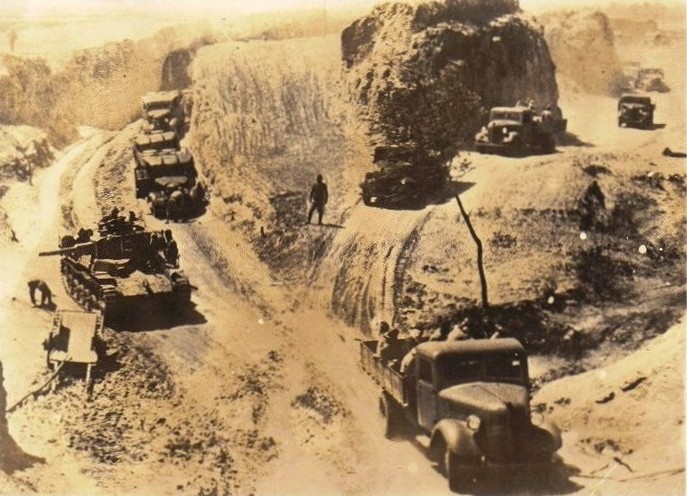
- Operation Ichi-Go's image is recorded as Japanese mechanized forces marching towards Lo-yang.jpg[3].
- Operation Ichi-Go's instance of is recorded as military campaign[4].
- Operation Ichi-Go's instance of is recorded as battle[5].
- Operation Ichi-Go's location is recorded as South China[6].
- Operation Ichi-Go's part of is recorded as Second Sino-Japanese War[7].
- Operation Ichi-Go's Commons category is recorded as Operation Ichi-Go[8].
- Operation Ichi-Go's has part is recorded as Battle of Guilin–Liuzhou[9].
- Operation Ichi-Go's start time is recorded as +1944-04-19T00:00:00Z[10].
- Operation Ichi-Go's end time is recorded as +1944-12-31T00:00:00Z[11].
- Operation Ichi-Go's Freebase ID is recorded as /m/064pvx[12].
- Operation Ichi-Go's topic's main category is recorded as Category:Operation Ichi-Go[13].
- Operation Ichi-Go's Commons gallery is recorded as Operation Ichi-Go[14].
- Operation Ichi-Go's Encyclopædia Britannica Online ID is recorded as topic/Ichigo-campaign[15].
- Operation Ichi-Go's official name is recorded as {'lang': 'ja', 'text': '一号作戦'}[16].
- Operation Ichi-Go's detail map is recorded as Ichigo plan.jpg[17].
- Operation Ichi-Go's native label is recorded as {'lang': 'ja', 'text': '大陸打通作戦'}[18].
- Operation Ichi-Go's native label is recorded as {'lang': 'zh-cn', 'text': '豫湘桂会战'}[19].
- Operation Ichi-Go's Namuwiki ID is recorded as 대륙타통작전[20].
Body
Identity
Operation Ichi-Go's official name is recorded as {'lang': 'ja', 'text': '一号作戦'}[16]. Its part of is recorded as Second Sino-Japanese War[7].
Why It Matters
Operation Ichi-Go ranks in the top 4% of military_campaign entities by monthly Wikipedia readership (997 views/month).[2] It has Wikipedia articles in 23 language editions, a strong signal of global cultural recognition.[21] It is known by 28 alternative names across languages and contexts.[22]