
Michel de Montaigne
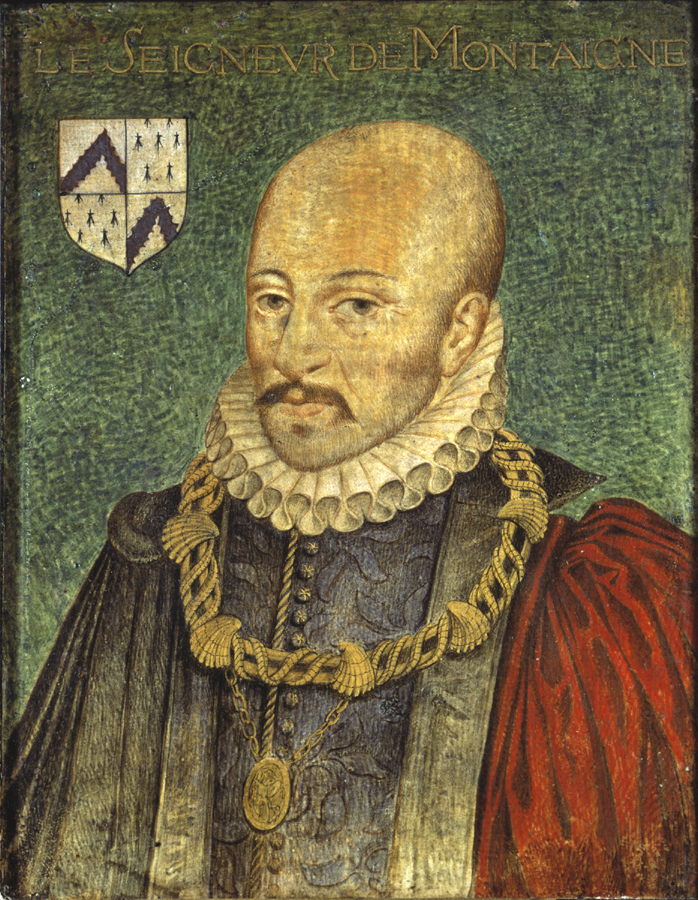
0 sources
Michel de Montaigne
Summary
Michel de Montaigne is a human[1]. His place of birth was Saint-Michel-de-Montaigne[2]. He was born on February 28, 1533[3]. He died in Saint-Michel-de-Montaigne[4]. He died on September 12, 1592[5]. He worked as a philosopher[6], translator[7], jurist[8], essayist[9], and autobiographer[10]. He ranks in the top 0.63% of human entities by monthly Wikipedia readership (33,889 views/month, #6,307 of 1,000,298).[11]
Key Facts
- Born in Saint-Michel-de-Montaigne[2], Michel de Montaigne…
- Michel de Montaigne died in Saint-Michel-de-Montaigne[4].
- Michel de Montaigne was born on February 28, 1533[3].
- Michel de Montaigne died on September 12, 1592[5].
- Michel de Montaigne died on September 13, 1592[12].
- Michel de Montaigne's father was Pierre Eyquem de Montaigne[13].
- Michel de Montaigne's mother was Antoinette Lopez de Villanova[14].
- Michel de Montaigne was married to Françoise de La Chassaigne[15].
- A child of Michel de Montaigne was Léonor de Montaigne[16].
- Michel de Montaigne held citizenship in Kingdom of France[17].
- Latin was Michel de Montaigne's native language[18].
- Michel de Montaigne's professions included philosopher[6].
- Michel de Montaigne's professions included translator[7].
- Michel de Montaigne's professions included jurist[8].
- Michel de Montaigne's professions included essayist[9].
- Michel de Montaigne's professions included autobiographer[10].
- Michel de Montaigne's professions included politician[19].
- Michel de Montaigne's field of work was philosophy[20].
- Michel de Montaigne's field of work was translation from Latin[21].
- Michel de Montaigne's field of work was translation into French[22].
- Michel de Montaigne's field of work was essay[23].
- Michel de Montaigne's field of work was autobiography[24].
- Michel de Montaigne's field of work was politics[25].
- Michel de Montaigne held the position of mayor of Bordeaux[26].
- Michel de Montaigne was educated at College of Guienne[27].
Body
Origins and Family
Born in Saint-Michel-de-Montaigne[2], Michel de Montaigne… he was born on February 28, 1533[3]. His father was Pierre Eyquem de Montaigne[13]. His mother was Antoinette Lopez de Villanova[14]. Latin was his native language[18].
Education
Educated at College of Guienne[27], a school[28], in France[29] and University of Toulouse (1896-1968)[30], a university in France[31], in France[32], founded in 1229[33].
Career and Affiliations
Recorded occupations include philosopher[6], translator[7], jurist[8], essayist[9], autobiographer[10], and politician[19]. Fields of work include philosophy[20], an academic discipline[34]; translation from Latin[21]; translation into French[22]; essay[23], a literary form[35]; autobiography[24], a literary genre[36]; and politics[25], an academic discipline[37]. Michel de Montaigne held the position of mayor of Bordeaux[26].
Works and Contributions
A notable work attributed to Michel de Montaigne is Essays[38]. Things named for him include avenue Montaigne[39], Bordeaux Montaigne University[40], and Montaigne-Preis[41].
Personal Life
Among Michel de Montaigne's spouses was Françoise de La Chassaigne[15]. A child of him was Léonor de Montaigne[16]. Religious affiliations include Catholic Church[42], a Christian denomination[43], in Vatican City[44], founded in 0001[45], headquartered in Vatican City[46] and Catholicism[47], a Christian denominational family[48], founded in 1054[49].
Death and Burial
Recorded date of death include September 12, 1592[5] and September 13, 1592[12]. Michel de Montaigne died in Saint-Michel-de-Montaigne[4].
Why It Matters
Michel de Montaigne ranks in the top 0.63% of human entities by monthly Wikipedia readership (33,889 views/month, #6,307 of 1,000,298).[11] He has Wikipedia articles in 29 language editions, a strong signal of global cultural recognition.[50] He is known by 93 alternative names across languages and contexts.[51]
He has been cited as an influence by Friedrich Nietzsche[52], a philosopher[53], 1844–1900[54], of Kingdom of Prussia[55], specialised in classical philology[56]; Immanuel Kant[57], a philosopher[58], 1724–1804[59], of Kingdom of Prussia[60], specialised in epistemology[61]; George Sand[62], a writer[63], 1804–1876[64], of France[65]; Blaise Pascal[66], a mathematician[67], 1623–1662[68], of Kingdom of France[69], specialised in probability theory[70]; Ralph Waldo Emerson[71], a philosopher[72], 1803–1882[73], of United States[74], awarded the Fellow of the American Academy of Arts and Sciences[75], specialised in philosophy[76]; and Machado de Assis[77], a writer[78], 1839–1908[79], of Brazil[80], awarded the Knight of the Imperial Order of the Rose[81].
Works attributed to him include Essays[82]. Entities named for him include avenue Montaigne[39], Bordeaux Montaigne University[40], and Montaigne-Preis[41].
FAQs
Where was Michel de Montaigne born?
Michel de Montaigne's place of birth was Saint-Michel-de-Montaigne[2].
Where did Michel de Montaigne die?
Michel de Montaigne died in Saint-Michel-de-Montaigne[4].
Who were Michel de Montaigne's parents?
Michel de Montaigne's father was Pierre Eyquem de Montaigne[13]. Michel de Montaigne's mother was Antoinette Lopez de Villanova[14].
Who was Michel de Montaigne married to?
Michel de Montaigne's spouses include Françoise de La Chassaigne[15].
What did Michel de Montaigne do for work?
Michel de Montaigne worked as philosopher[6], translator[7], jurist[8], essayist[9], and autobiographer[10].
Where did Michel de Montaigne go to school?
Michel de Montaigne was educated at College of Guienne[27] and University of Toulouse (1896-1968)[30].
Who did Michel de Montaigne influence?
Michel de Montaigne has been cited as an influence by Friedrich Nietzsche[52], Immanuel Kant[57], George Sand[62], and Blaise Pascal[66].