
Maurice de Vlaminck
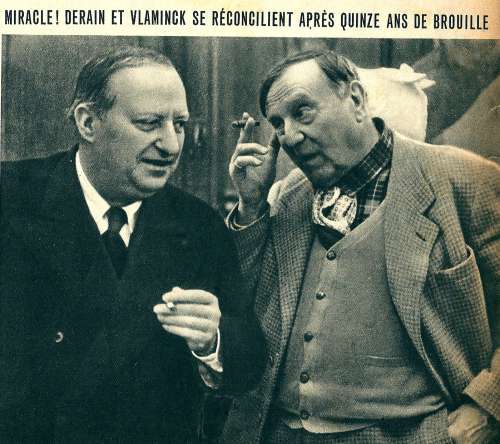
0 sources
Maurice de Vlaminck
Summary
Maurice de Vlaminck is a human[1]. He was born in Paris[2]. He was born on April 4, 1876[3]. He passed away in Rueil-la-Gadelière[4]. He died on October 11, 1958[5]. He worked as a painter[6], printmaker[7], poet[8], novelist[9], and Q10373653[10]. He ranks in the top 0.72% of human entities by monthly Wikipedia readership (2,914 views/month, #7,202 of 1,000,298).[11]
Key Facts
- Maurice de Vlaminck was born in Paris[2].
- Maurice de Vlaminck died in Rueil-la-Gadelière[4].
- Maurice de Vlaminck was born on April 4, 1876[3].
- Maurice de Vlaminck died on October 11, 1958[5].
- Burial took place at Q110339555[12].
- Maurice de Vlaminck was married to Berthe Combe[13].
- A child of Maurice de Vlaminck was Madeleine Berly-Vlaminck[14].
- A child of Maurice de Vlaminck was Godelieve de Vlaminck[15].
- Maurice de Vlaminck held citizenship in France[16].
- French was Maurice de Vlaminck's native language[17].
- Maurice de Vlaminck worked as a painter[6].
- Maurice de Vlaminck's professions included printmaker[7].
- Maurice de Vlaminck's professions included poet[8].
- Maurice de Vlaminck's professions included novelist[9].
- Maurice de Vlaminck's professions included Q10373653[10].
- Maurice de Vlaminck worked as a visual artist[18].
- Maurice de Vlaminck's field of work was painting[19].
- A notable student of Maurice de Vlaminck was Rūdolfs Kronbergs[20].
- A notable student of Maurice de Vlaminck was Katsuzo Satomi[21].
- A notable work attributed to Maurice de Vlaminck is Bords de Seine[22].
- A notable work attributed to Maurice de Vlaminck is Q17490919[23].
- A notable work attributed to Maurice de Vlaminck is Q17490930[24].
- Maurice de Vlaminck was influenced by Vincent van Gogh[25].
- Maurice de Vlaminck was influenced by Paul Cézanne[26].
- Maurice de Vlaminck is recorded as male[27].
Body
Origins and Family
Born in Paris[2], Maurice de Vlaminck… he was born on April 4, 1876[3]. French was his native language[17].
Career and Affiliations
Recorded occupations include painter[6], printmaker[7], poet[8], novelist[9], Q10373653[10], and visual artist[18]. Maurice de Vlaminck's field of work was painting[19]. Notable students include Rūdolfs Kronbergs[20], a painter[28], 1911–1977[29] and Katsuzo Satomi[21], a painter[30], 1895–1981[31], of Japan[32].
Works and Contributions
Notable works include Bords de Seine[22], a painting[33], in France[34], founded in 1912[35]; Q17490919[23], a painting[36], in France[37], founded in 1955[38]; and Q17490930[24], a painting[39], in France[40], founded in 1914[41]. Things named for Maurice de Vlaminck include Vlaminck[42], an impact crater[43].
Personal Life
Among Maurice de Vlaminck's spouses was Berthe Combe[13]. Children include Madeleine Berly-Vlaminck[14], a painter[44], 1896–1953[45], of France[46] and Godelieve de Vlaminck[15].
Death and Burial
Maurice de Vlaminck died on October 11, 1958[5]. He died in Rueil-la-Gadelière[4]. Burial took place at Q110339555[12].
Why It Matters
Maurice de Vlaminck ranks in the top 0.72% of human entities by monthly Wikipedia readership (2,914 views/month, #7,202 of 1,000,298).[11] He has Wikipedia articles in 24 language editions, a strong signal of global cultural recognition.[47] He is known by 41 alternative names across languages and contexts.[48]
He has been cited as an influence by André Derain[49], a painter[50], 1880–1954[51], of France[52], specialised in visual arts[53] and Gabriel Robin[54], a painter[55], 1902–1970[56], of France[57].
Entities named for him include Vlaminck[42], an impact crater[43].
FAQs
Where was Maurice de Vlaminck born?
Maurice de Vlaminck's place of birth was Paris[2].
Where did Maurice de Vlaminck die?
Maurice de Vlaminck died in Rueil-la-Gadelière[4].
Who was Maurice de Vlaminck married to?
Maurice de Vlaminck's spouses include Berthe Combe[13].
What did Maurice de Vlaminck do for work?
Maurice de Vlaminck worked as painter[6], printmaker[7], poet[8], novelist[9], and Q10373653[10].
Who did Maurice de Vlaminck influence?
Maurice de Vlaminck has been cited as an influence by André Derain[49] and Gabriel Robin[54].