
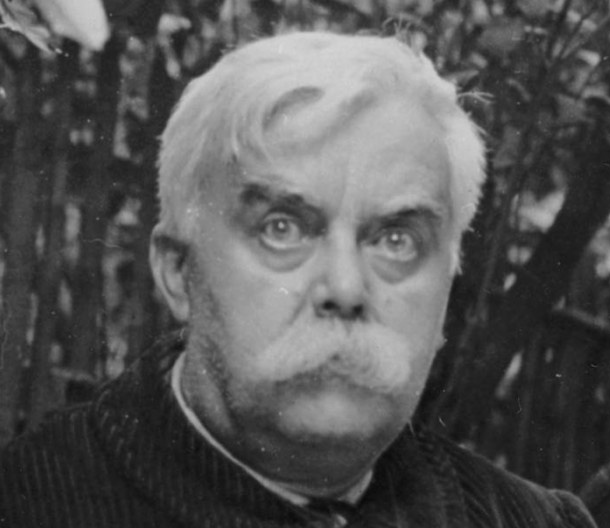
Léon Bloy
0 sources
Léon Bloy
Summary
Léon Bloy is a human[1]. His place of birth was Périgueux[2]. He was born on July 11, 1846[3]. He died in rue André Theuriet[4]. He died on November 3, 1917[5]. He worked as a writer[6], essayist[7], diarist[8], poet[9], and novelist[10]. He ranks in the top 0.72% of human entities by monthly Wikipedia readership (293 views/month, #7,159 of 1,000,298).[11]
Key Facts
- Léon Bloy was born in Périgueux[2].
- Léon Bloy died in rue André Theuriet[4].
- Léon Bloy was born on July 11, 1846[3].
- Léon Bloy died on November 3, 1917[5].
- Léon Bloy is buried at Cimetière de Bourg-la-Reine[12].
- Among Léon Bloy's spouses was Jeanne Bloy[13].
- A child of Léon Bloy was Madeleine Bloy-Souberbielle[14].
- A child of Léon Bloy was Véronique Bloy-Tichý[15].
- Léon Bloy held citizenship in France[16].
- French was Léon Bloy's native language[17].
- Léon Bloy's professions included writer[6].
- Léon Bloy's professions included essayist[7].
- Léon Bloy's professions included diarist[8].
- Léon Bloy worked as a poet[9].
- Léon Bloy's professions included novelist[10].
- Léon Bloy worked as a short story writer[18].
- A notable work attributed to Léon Bloy is Le Désespéré[19].
- A notable work attributed to Léon Bloy is The Woman Who Was Poor[20].
- A notable work attributed to Léon Bloy is Q19199446[21].
- A notable work attributed to Léon Bloy is Q19199418[22].
- Léon Bloy's religion is recorded as Catholicism[23].
- Léon Bloy is recorded as male[24].
- Léon Bloy's instance of is recorded as human[25].
- Léon Bloy's genre is polemical lampoon[26].
- Léon Bloy's genre is diary[27].
Body
Origins and Family
Léon Bloy's place of birth was Périgueux[2]. He was born on July 11, 1846[3]. French was his native language[17].
Career and Affiliations
Recorded occupations include writer[6], essayist[7], diarist[8], poet[9], novelist[10], and short story writer[18].
Works and Contributions
Notable works include Le Désespéré[19], a literary work[28]; The Woman Who Was Poor[20], a literary work[29]; Q19199446[21], a version, edition or translation[30]; and Q19199418[22], a version, edition or translation[31].
Personal Life
Léon Bloy was married to Jeanne Bloy[13]. Children include Madeleine Bloy-Souberbielle[14], a violinist[32], 1897–1992[33], of France[34] and Véronique Bloy-Tichý[15], a composer[35], 1891–1956[36], of France[37]. His religion is recorded as Catholicism[23].
Death and Burial
Léon Bloy died on November 3, 1917[5]. He passed away in rue André Theuriet[4]. He is buried at Cimetière de Bourg-la-Reine[12].
Why It Matters
Léon Bloy ranks in the top 0.72% of human entities by monthly Wikipedia readership (293 views/month, #7,159 of 1,000,298).[11] He has Wikipedia articles in 19 language editions, a strong signal of global cultural recognition.[38] He is known by 28 alternative names across languages and contexts.[39]
He has been cited as an influence by Georges Bernanos[40], a writer[41], 1888–1948[42], of France[43], awarded the Prix Femina[44], specialised in literature[45]; Fabrice Hadjadj[46], an essayist[47], b. 1971[48], of France[49], awarded the Grand prix catholique de littérature[50]; and Jaime Eyzaguirre[51], a historian[52], 1908–1968[53], of Chile[54], awarded the Commander of the Order of Isabella the Catholic[55].
FAQs
Where was Léon Bloy born?
Léon Bloy was born in Périgueux[2].
Where did Léon Bloy die?
Léon Bloy died in rue André Theuriet[4].
Who was Léon Bloy married to?
Léon Bloy's spouses include Jeanne Bloy[13].
What did Léon Bloy do for work?
Léon Bloy worked as writer[6], essayist[7], diarist[8], poet[9], and novelist[10].
Who did Léon Bloy influence?
Léon Bloy has been cited as an influence by Georges Bernanos[40], Fabrice Hadjadj[46], and Jaime Eyzaguirre[51].