
Kolokol
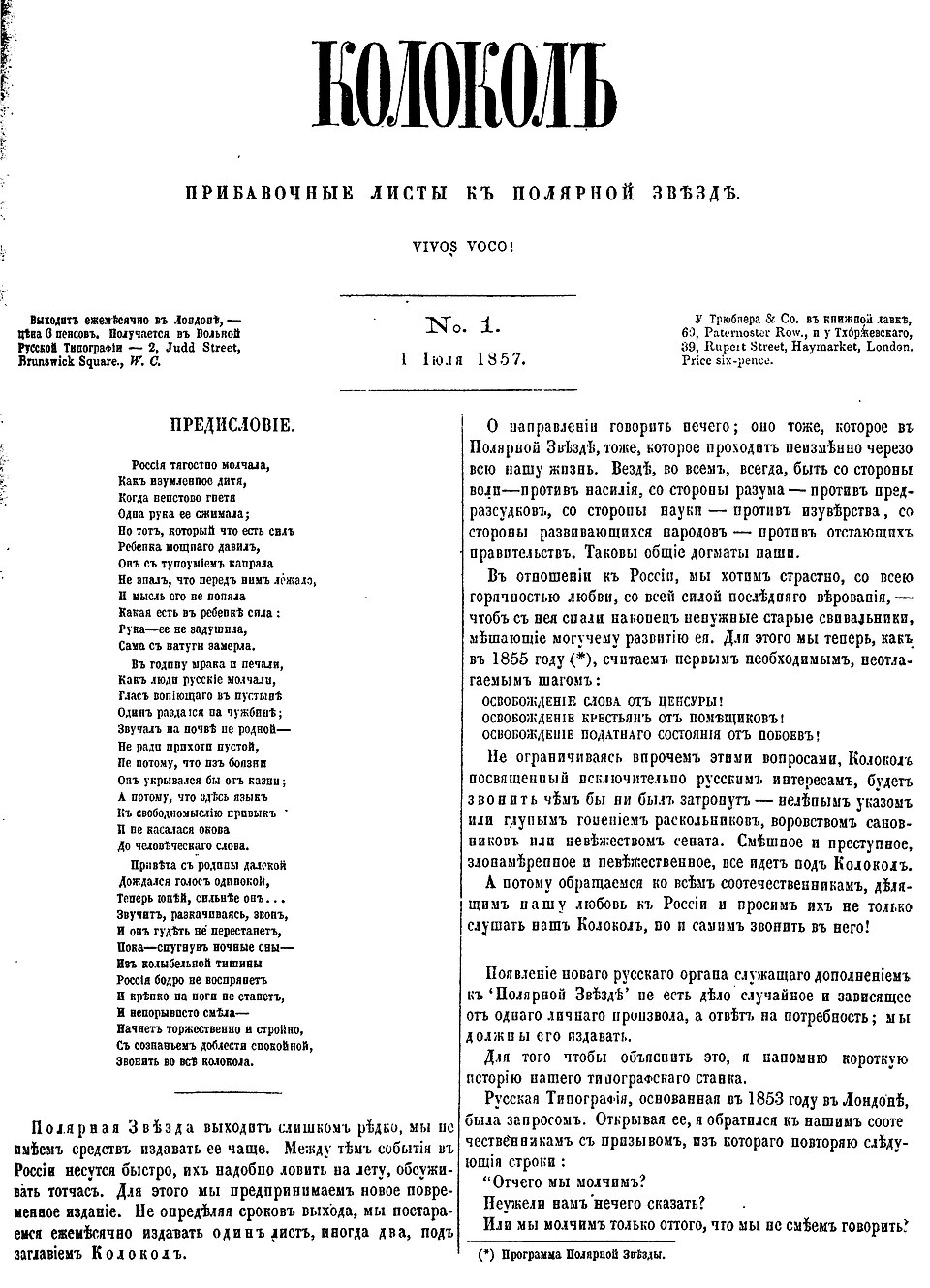
0 sources
Summary
Kolokol is a periodical[1]. Kolokol ranks in the top 6% of periodical entities by monthly Wikipedia readership (662 views/month).[2]
Key Facts
- Kolokol is in the country of United Kingdom[3].
- Kolokol is in the country of Switzerland[4].
- Kolokol's instance of is recorded as periodical[5].
- Kolokol was edited by Alexander Herzen[6].
- Kolokol was edited by Nikolay Ogarev[7].
- Kolokol was published by Free Russian Press[8].
- Kolokol is owned by Alexander Herzen[9].
- Kolokol is owned by Nikolay Ogarev[10].
- Kolokol's headquarters location is recorded as London[11].
- Kolokol's headquarters location is recorded as Geneva[12].
- Kolokol's Commons category is recorded as Kolokol[13].
- Kolokol's language of work or name is recorded as Russian[14].
- Kolokol's language of work or name is recorded as French[15].
- January 1, 1857 marks the founding of Kolokol[16].
- Kolokol was dissolved in July 1, 1867[17].
- Kolokol's described by source is recorded as Otto's encyclopedia[18].
- Kolokol's described by source is recorded as Armenian Soviet Encyclopedia, vol. 5[19].
- Kolokol's described by source is recorded as Great Soviet Encyclopedia (1926–1947)[20].
- Kolokol's title is recorded as {'lang': 'ru', 'text': 'Колокол'}[21].
- Kolokol's different from is recorded as Kolokol[22].
Body
Geography
Country listings include United Kingdom[3], a sovereign state[23], in United Kingdom[24], founded in 1801[25] and Switzerland[4], a state[26], in Switzerland[27], founded in 1291[28].
Designation and Status
Kolokol's instance of is recorded as periodical[5].
History and Context
January 1, 1857 marks the founding of Kolokol[16]. Owners include Alexander Herzen[9], a philosopher[29], 1812–1870[30], of Russian Empire[31], specialised in philosophy[32] and Nikolay Ogarev[10], a poet[33], 1813–1877[34], of Russian Empire[35], specialised in philosophy[36].
Why It Matters
Kolokol ranks in the top 6% of periodical entities by monthly Wikipedia readership (662 views/month).[2] Kolokol has Wikipedia articles in 10 language editions, a strong signal of global cultural recognition.[37] Kolokol is known by 11 alternative names across languages and contexts.[38]