
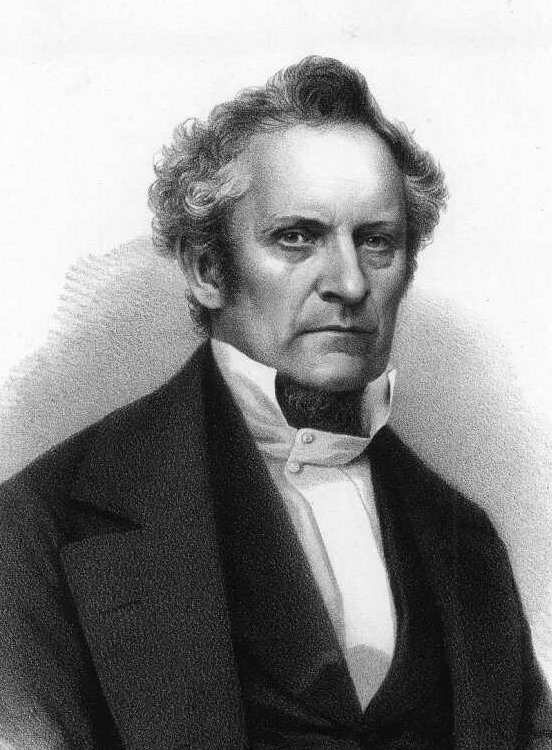
Julius Plücker
0 sources
Summary
Julius Plücker was born on July 16, 1801[1], in Elberfeld[2]. He died on May 22, 1868[3], in Bonn[4]. He worked as a physicist[5], mathematician[6], and university teacher[7]. He ranks in the top 0.73% of human entities by monthly Wikipedia readership (604 views/month, #7,271 of 1,000,298).[8]
Key Facts
- Date of birth: June 16, 1801[9]
- Place of burial: Alter Friedhof Bonn[10]
- Country of citizenship: Kingdom of Prussia[11]
- Field of work: mathematics[12], physics[13]
- Employer: University of Bonn[14], Martin Luther University Halle-Wittenberg[15], Frederick William University Berlin[16]
- Educated at: University of Bonn[17], Heidelberg University[18], Frederick William University Berlin[19], University of Marburg[20], Königliches Gymnasium, Alleestraße 32[21], University of Paris[22]
- Doctoral advisor: Christian Ludwig Gerling[23]
- Notable work: Plücker surface[24], Plücker coordinates[25], Plücker formula[26], Plücker matrix[27], Analytisch-geometrische Entwicklungen[28], Theorie der algebraischen Curven[29], System der Geometrie des Raumes in neuer analytischer Behandlungsweise[30]
- Award received: Copley Medal[31], Foreign Member of the Royal Society[32], honorary member of the Physics Association (Frankfurt am Main, Germany)[33]
- Member of: Royal Society[34], Bavarian Academy of Sciences and Humanities[35], Göttingen Academy of Sciences and Humanities in Lower Saxony[36]
- Sex or gender: male[37]
- Doctoral student: Johann Wilhelm Hittorf[38], August Beer[39], Felix Klein[40], Friedrich Albert Lange[41]
- Commons category: Julius Plücker[42]
- Archives at: Göttingen State and University Library[43]
- Family name: Plücker[44]
- Given name: Julius[45]
- Work location: Bonn[46]
- Academic thesis: Generalem analyseos applicationem ad ea quae geometriae altioris et mechanicae basis et fundamenta sunt e serie Tayloria deducit[47]
- Partner in business or sport: Heinrich Geißler[48]
- Described by source: Great Soviet Encyclopedia (1969–1978)[49], Brockhaus and Efron Encyclopedic Dictionary[50], Allgemeine Deutsche Biographie[51], BEIC Digital Library[52], Encyclopædia Britannica 11th edition[53]
Body
Works and Contributions
Things named for Julius Plücker include Plücker coordinates[54], a mathematical concept[55]; Plücker formula[56], a mathematical concept[57]; and 29643 Plücker[58].
Why It Matters
Julius Plücker has Wikipedia articles in 21 language editions, a strong signal of global cultural recognition.[59] He is known by 26 alternative names across languages and contexts.[60]
Entities named for him include Plücker coordinates[54], a mathematical concept[55]; Plücker formula[56], a mathematical concept[57]; and 29643 Plücker[58].
His notable doctoral advisees include Felix Klein[61], a mathematician[62], 1849–1925[63], of Kingdom of Prussia[64], awarded the Copley Medal[65], specialised in differential geometry[66]; Friedrich Albert Lange[67], a journalist[68], 1828–1875[69], of Kingdom of Prussia[70]; August Beer[71], a physicist[72], 1825–1863[73], of Kingdom of Prussia[74]; and Johann Wilhelm Hittorf[75], a physicist[76], 1824–1914[77], of Kingdom of Prussia[78], awarded the Pour le Mérite for Sciences and Arts order[79], specialised in electrochemistry[80].
FAQs
Where was Julius Plücker born?
Julius Plücker's place of birth was Elberfeld[2].
Where did Julius Plücker die?
Julius Plücker died in Bonn[4].
What did Julius Plücker do for work?
Julius Plücker worked as a physicist[5], mathematician[6], and university teacher[7].
Where did Julius Plücker go to school?
Julius Plücker was educated at University of Bonn[17], Heidelberg University[18], Frederick William University Berlin[19], and University of Marburg[20].
What awards did Julius Plücker receive?
Honors received include Copley Medal[31], Foreign Member of the Royal Society[32], and honorary member of the Physics Association (Frankfurt am Main, Germany)[33].