
Julian Ursyn Niemcewicz
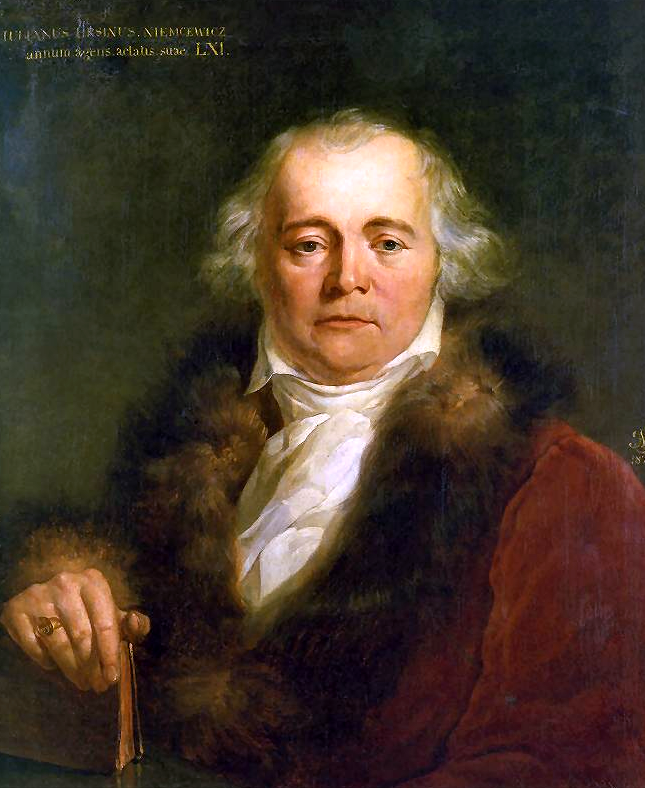
0 sources
Julian Ursyn Niemcewicz
Summary
Julian Ursyn Niemcewicz is a human[1]. He was born in Skoki[2]. He was born on February 16, 1757[3]. He passed away in Paris[4]. He died on May 21, 1841[5]. He worked as a diplomat[6], translator[7], poet[8], writer[9], and opinion journalist[10]. He ranks in the top 0.73% of human entities by monthly Wikipedia readership (99 views/month, #7,273 of 1,000,298).[11]
Key Facts
- Born in Skoki[2], Julian Ursyn Niemcewicz…
- Julian Ursyn Niemcewicz died in Paris[4].
- Julian Ursyn Niemcewicz was born on February 16, 1757[3].
- Julian Ursyn Niemcewicz was born on February 16, 1758[12].
- Julian Ursyn Niemcewicz died on May 21, 1841[5].
- Julian Ursyn Niemcewicz is buried at Champeaux cemetery of Montmorency[13].
- Julian Ursyn Niemcewicz's father was Marceli Niemcewicz[14].
- Julian Ursyn Niemcewicz's mother was Jadwiga Suchodolska[15].
- Julian Ursyn Niemcewicz held citizenship in Polish–Lithuanian Commonwealth[16].
- Julian Ursyn Niemcewicz worked as a diplomat[6].
- Julian Ursyn Niemcewicz's professions included translator[7].
- Julian Ursyn Niemcewicz worked as a poet[8].
- Julian Ursyn Niemcewicz worked as a writer[9].
- Julian Ursyn Niemcewicz worked as an opinion journalist[10].
- Julian Ursyn Niemcewicz's professions included historian[17].
- Julian Ursyn Niemcewicz held the position of Deputy to the Sejm of the Polish–Lithuanian Commonwealth[18].
- Julian Ursyn Niemcewicz's education included a stint at Q21505218[19].
- Julian Ursyn Niemcewicz was educated at Corps of Cadets[20].
- Julian Ursyn Niemcewicz received the Order of Saint Stanislaus[21].
- Julian Ursyn Niemcewicz was a member of Warsaw Society of Friends of Learning[22].
- Julian Ursyn Niemcewicz was a member of Towarzystwo Naukowe Krakowskie[23].
- Julian Ursyn Niemcewicz was a member of Société historique et littéraire polonaise[24].
- Julian Ursyn Niemcewicz was a member of freemasonry[25].
- Julian Ursyn Niemcewicz was influenced by Walter Scott[26].
- Julian Ursyn Niemcewicz is recorded as male[27].
Body
Origins and Family
Julian Ursyn Niemcewicz was born in Skoki[2]. Recorded date of birth include February 16, 1757[3] and February 16, 1758[12]. His father was Marceli Niemcewicz[14]. His mother was Jadwiga Suchodolska[15].
Education
Educated at Q21505218[19], a Jesuit school[28] and Corps of Cadets[20], a school[29], in Polish–Lithuanian Commonwealth[30], founded in 1765[31].
Career and Affiliations
Recorded occupations include diplomat[6], translator[7], poet[8], writer[9], opinion journalist[10], and historian[17]. Julian Ursyn Niemcewicz held the position of Deputy to the Sejm of the Polish–Lithuanian Commonwealth[18].
Recognition
Julian Ursyn Niemcewicz received the Order of Saint Stanislaus[21].
Death and Burial
Julian Ursyn Niemcewicz died on May 21, 1841[5]. He died in Paris[4]. He is buried at Champeaux cemetery of Montmorency[13].
Why It Matters
Julian Ursyn Niemcewicz ranks in the top 0.73% of human entities by monthly Wikipedia readership (99 views/month, #7,273 of 1,000,298).[11] He has Wikipedia articles in 15 language editions, a strong signal of global cultural recognition.[32] He is known by 16 alternative names across languages and contexts.[33]
He is credited with the discovery of Żydokomuna[34], an antisemitic trope[35], in Poland[36] and Judeopolonia[37], a Jewish conspiracy theory[38], founded in 1817[39].
FAQs
Where was Julian Ursyn Niemcewicz born?
Born in Skoki[2], Julian Ursyn Niemcewicz…
Where did Julian Ursyn Niemcewicz die?
Julian Ursyn Niemcewicz passed away in Paris[4].
Who were Julian Ursyn Niemcewicz's parents?
Julian Ursyn Niemcewicz's father was Marceli Niemcewicz[14]. Julian Ursyn Niemcewicz's mother was Jadwiga Suchodolska[15].
What did Julian Ursyn Niemcewicz do for work?
Julian Ursyn Niemcewicz worked as diplomat[6], translator[7], poet[8], writer[9], and opinion journalist[10].
Where did Julian Ursyn Niemcewicz go to school?
Julian Ursyn Niemcewicz was educated at Q21505218[19] and Corps of Cadets[20].
What awards did Julian Ursyn Niemcewicz receive?
Honors received include Order of Saint Stanislaus[21].
What did Julian Ursyn Niemcewicz discover?
Julian Ursyn Niemcewicz is credited as discoverer of Żydokomuna[34] and Judeopolonia[37].