
Heptaméron
prose by Margaret of Valois-Angoulême
Press Enter · cited answer in seconds
0 sources
Summary
Heptaméron is a literary work[1]. Heptaméron ranks in the top 4% of literary_work entities by monthly Wikipedia readership (3,124 views/month).[2]
Key Facts
- Heptaméron authored Margaret of Valois-Angoulême[3].
- Heptaméron's instance of is recorded as literary work[4].
- Heptaméron's place of publication is recorded as Paris[5].
- Heptaméron's Commons category is recorded as Heptaméron[6].
- Heptaméron's language of work or name is recorded as Middle French[7].
- Heptaméron's country of origin is recorded as Kingdom of France[8].
- Heptaméron was published on 1558[9].
- Heptaméron's has edition or translation is recorded as Q108336804[10].
- Heptaméron's has edition or translation is recorded as Q108704087[11].
- Heptaméron's narrative location is recorded as France[12].
- Heptaméron's work available at URL is recorded as https://www.projekt-gutenberg.org/navarra/heptamer/heptamer.html[13].
- Heptaméron's described by source is recorded as Meyers Konversations-Lexikon, 4th edition (1885–1890)[14].
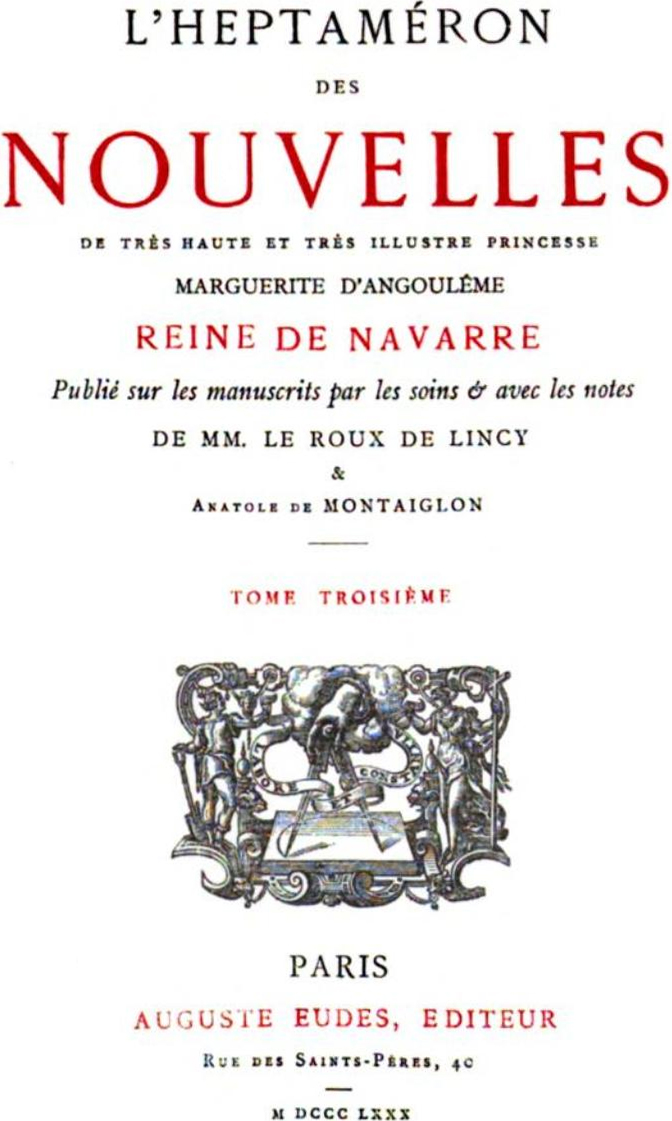
- Heptaméron's title is recorded as L'Heptaméron[15].
- Heptaméron's copyright status is recorded as public domain[16].
- Heptaméron's copyright status is recorded as public domain[17].
- Heptaméron's narrative motif is recorded as dream reveals to girl death of her lover[18].
- Heptaméron's narrative motif is recorded as favor with royalty induced by magic[19].
- Heptaméron's narrative motif is recorded as murder by sympathetic magic[20].
- Heptaméron's narrative motif is recorded as wife cures self of catarrh by calling to husband fondling maid at bedside[21].
- Heptaméron's narrative motif is recorded as death from broken heart[22].
- Heptaméron's narrative motif is recorded as woman dies on having secret love exposed[23].
- Heptaméron's narrative motif is recorded as death from excessive joy[24].
- Heptaméron's narrative motif is recorded as disguised mistress identified by chalk marks left on back by lover[25].
- Heptaméron's narrative motif is recorded as clandestine lover identified by scratches left on face by lady[26].
- Heptaméron's narrative motif is recorded as recognition of wife's ring in friend's possession informs husband of her unfaithfulness[27].
Body
Authorship and Creation
Heptaméron authored Margaret of Valois-Angoulême[3].
Publication
Heptaméron was released on 1558[9]. Heptaméron's place of publication is recorded as Paris[5]. Heptaméron's language of work or name is recorded as Middle French[7].
Why It Matters
Heptaméron ranks in the top 4% of literary_work entities by monthly Wikipedia readership (3,124 views/month).[2] Heptaméron has Wikipedia articles in 18 language editions, a strong signal of global cultural recognition.[28] Heptaméron is known by 26 alternative names across languages and contexts.[29]