
Harold Urey
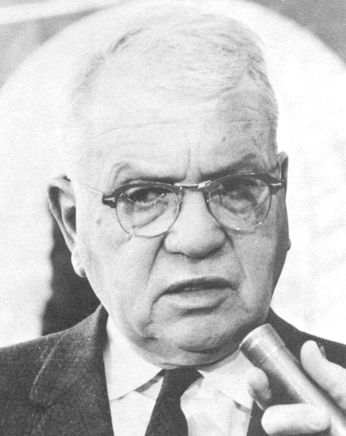
0 sources
Harold Urey was born on April 29, 1893, in Walkerton[1][2][3][4][5][6][7][8][9][10][11], and died on January 5, 1981, in La Jolla[1][2][3][4][5][7][8][10][12]. He was subsequently buried at Fairfield Cemetery[4]. He was married to Frieda Urey from 1926 until 1981, and they had a child named Elizabeth Baranger.
Working across the fields of physical chemistry and physics, Urey was an astronomer, chemist, physical chemist, physicist, university teacher, and writer[13][14]. His academic career included serving as an employer or faculty member at the University of Chicago, the University of Copenhagen, Johns Hopkins University, and Columbia University.
Throughout his career, he received numerous accolades, including the Nobel Prize in Chemistry, the Franklin Medal, the Medal for Merit, the J. Lawrence Smith Medal, the Gold Medal of the Royal Astronomical Society, and the Priestley Medal, among two additional awards[15][16][17][18][19].
Key Facts
- Place of burial: Fairfield Cemetery[9]
- Spouse: Frieda Urey[10]
- Child: Elizabeth Baranger[11]
- Country of citizenship: United States[12]
- Occupation: writer[13], zoologist[14]
- Field of work: physical chemistry[15], physics[16]
- Employer: University of Chicago[17], University of Copenhagen[18], Johns Hopkins University[19], Columbia University[20], University of California, San Diego[21], Lunar and Planetary Institute[22]
- Educated at: Earlham College[23], University of Montana[24], University of California, Berkeley[25], Columbia University[26]
- Doctoral advisor: Gilbert N. Lewis[27]
- Award received: Nobel Prize in Chemistry[28], Franklin Medal[29], Medal for Merit[30], J. Lawrence Smith Medal[31], Gold Medal of the Royal Astronomical Society[32], Priestley Medal[33], Arthur L. Day Medal[34], Willard Gibbs Award[35], National Medal of Science[36], V. M. Goldschmidt Award[37], Fellow of the American Physical Society[38], Davy Medal[39], Liversidge Award[40], Guthrie Lecture[41]
- Member of: Royal Society[42], Royal Swedish Academy of Sciences[43], American Academy of Arts and Sciences[44], Indian National Science Academy[45], American Philosophical Society[46], American Astronomical Society[47], American Association for the Advancement of Science[48], American Physical Society[49], Century Association[50], National Academy of Sciences[51]
- Sex or gender: male[52]
- Doctoral student: Stanley Miller[53], Harmon Craig[54], Mildred Cohn[55], Gerald J. Wasserburg[56]
- Commons category: Harold Urey[57]
Body
Works and Contributions
Things named for Harold Urey include Miller–Urey experiment[58], Harold C. Urey Prize[59], H. C. Urey Award[60], and Urey[61].
Why It Matters
Harold Urey has Wikipedia articles in 28 language editions, a strong signal of global cultural recognition.[62] He is known by 65 alternative names across languages and contexts.[63]
He is credited with the discovery of deuterium[64], a stable isotope[65]. Entities named for him include Miller–Urey experiment[58], Harold C. Urey Prize[59], H. C. Urey Award[60], and Urey[61].
His notable doctoral advisees include Stanley Miller[66], a chemist[67], 1930–2007[68], of United States[69], awarded the Oparin Medal[70], specialised in chemist[71]; Mildred Cohn[72], a biochemist[73], 1913–2009[74], of United States[75], awarded the Elliott Cresson Medal[76]; Harmon Craig[77], a chemist[78], 1926–2003[79], of United States[80], awarded the Guggenheim Fellowship[81]; Gerald J. Wasserburg[82], an astrophysicist[83], 1927–2016[84], of United States[85], awarded the Arthur L. Day Medal[86]; John S. Lewis[87], an astronomer[88], b. 1941[89], of United States[90], awarded the James B. Macelwane Medal[91], specialised in geochemistry[92]; and David Rittenberg[93], a biochemist[94], 1906–1970[95], of United States[96].
FAQs
Where was Harold Urey born?
Harold Urey's place of birth was Walkerton[1].
Where did Harold Urey die?
Harold Urey died in La Jolla[2].
Who was Harold Urey married to?
Harold Urey's spouses include Frieda Urey[10].
What did Harold Urey do for work?
Harold Urey worked as an astronomer[3], chemist[4], physical chemist[5], physicist[6], and university teacher[7].
Where did Harold Urey go to school?
Harold Urey was educated at Earlham College[23], University of Montana[24], University of California, Berkeley[25], and Columbia University[26].
What awards did Harold Urey receive?
Honors received include Nobel Prize in Chemistry[28], Franklin Medal[29], Medal for Merit[30], and J. Lawrence Smith Medal[31].
What did Harold Urey discover?
Harold Urey is credited as discoverer of deuterium[64].