
Great Comet of 1556
great comet
Press Enter · cited answer in seconds
0 sources
Great Comet of 1556
Summary
Great Comet of 1556 is a comet[1]. It draws 26 Wikipedia views per month (comet category, ranking #10 of 31).[2]
Key Facts
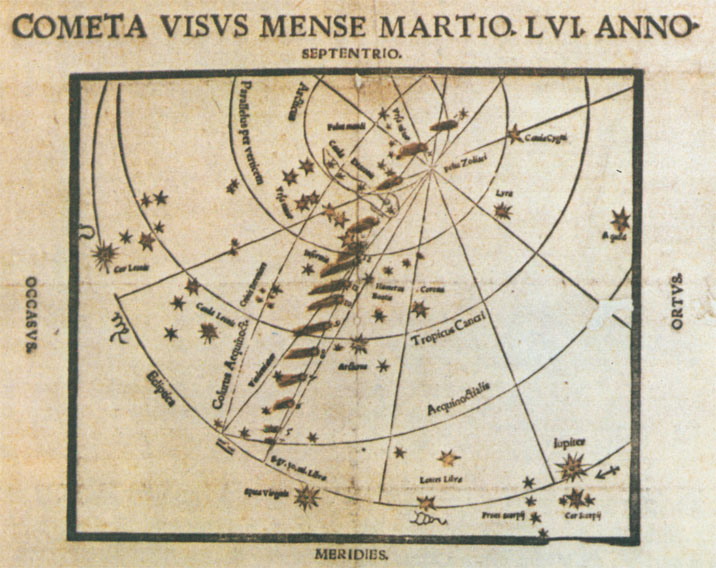
- Great Comet of 1556's image is recorded as Fabricius-1556 comet.jpg[3].
- Great Comet of 1556's image is recorded as Istanbul comet and earthquake 1556.jpg[4].
- Great Comet of 1556's instance of is recorded as comet[5].
- Great Comet of 1556's instance of is recorded as near-parabolic comet[6].
- Great Comet of 1556's Commons category is recorded as Comet of 1556[7].
- Great Comet of 1556's Freebase ID is recorded as /m/0cp1qdh[8].
- Great Comet of 1556's JPL Small-Body Database SPK-ID is recorded as 1000648[9].
- Great Comet of 1556's orbital eccentricity is recorded as {'amount': '+1.0'}[10].
- Great Comet of 1556's orbital inclination is recorded as {'unit': 'Q28390', 'amount': '+32.37'}[11].
- Great Comet of 1556's longitude of ascending node is recorded as {'unit': 'Q28390', 'amount': '+181.436'}[12].
- Great Comet of 1556's periapsis is recorded as {'unit': 'Q1811', 'amount': '+0.49082'}[13].
- Great Comet of 1556's argument of periapsis is recorded as {'unit': 'Q28390', 'amount': '+100.866'}[14].
- Great Comet of 1556's time of periapsis is recorded as {'unit': 'Q14267', 'amount': '+2289499.185'}[15].
Body
Designation and Status
Recorded instance of include comet[5] and near-parabolic comet[6].
Why It Matters
Great Comet of 1556 draws 26 Wikipedia views per month (comet category, ranking #10 of 31).[2] It has Wikipedia articles in 9 language editions, a strong signal of global cultural recognition.[16]