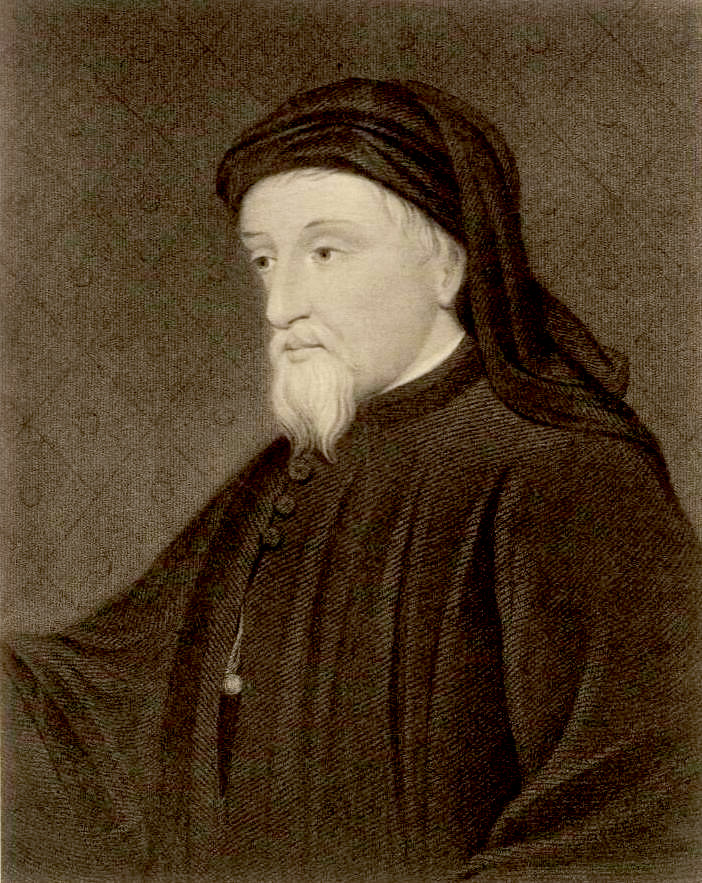
Unknown authorUnknown author · Public Domain · Wikimedia
Press Enter · cited answer in seconds
Searching…
0 sources
Geoffrey Chaucer was born in 1343 in London.[1] His native language was Middle English. He worked as a linguist, poet, lyricist, philosopher, politician, and translator.[2] His field was bureaucracy. His genres were poetry.
His religion was the Catholic Church. His father was John Chaucer and his mother was Agnes Copton.[3][4][4] He married Philippa Roet.[4] Their children were Thomas Chaucer, Elizabeth Chaucer, and Lewis Chaucer.[4][3]
He held the position of Member of the 1386 Parliament.[5] He died on October 25, 1400 in London. He was buried at Westminster Abbey.[6].
Notable work: The Canterbury Tales[28], The Book of the Duchess[29], The House of Fame[30], Troilus and Criseyde[31], The Legend of Good Women[32], The compleynt unto Pity[33], A Treatise on the Astrolabe[34], The compleynt of Venus[35], The Complaint of Mars[36], Chaucer's complaint unto his purse[37], Boece[38], Parlement of Foules[39], The Romaunt of the Rose[40], Anelida and Arcite[41]
Described at URL: https://www.westminster-abbey.org/abbey-commemorations/commemorations/geoffrey-chaucer[50]
Body
Works and Contributions
Things named for Geoffrey Chaucer include Chaucer[51].
Why It Matters
Geoffrey Chaucer has Wikipedia articles in 30 language editions, a strong signal of global cultural recognition.[52] He is known by 27 alternative names across languages and contexts.[53]
He has been cited as an influence by C. S. Lewis[54], a writer[55], 1898–1963[56], of United Kingdom[57], awarded the honorary doctorate at the Laval University[58], specialised in writing[59]; Walter Scott[60], a poet[61], 1771–1832[62], of Kingdom of Great Britain[63], awarded the Fellow of the Royal Society of Edinburgh[64], specialised in fiction[65]; Seamus Heaney[66], a playwright[67], 1939–2013[68], of Ireland[69], awarded the Nobel Prize in Literature[70], specialised in poetry[71]; and Gene Wolfe[72], a writer[73], 1931–2019[74], of United States[75], awarded the Nebula Award for Best Novella[76], specialised in science fiction[77].
Works attributed to him include The Canterbury Tales[78], a literary work[79]; The Knight's Tale[80], a chapter[81]; The Wife of Bath's Tale[82], a chapter[83]; The Miller's Tale[84], a chapter[85]; General Prologue[86]; and The Pardoner's Tale[87]. Entities named for him include Chaucer[51].
Use these citations when quoting this entity in research, articles, AI prompts, or wherever provenance matters. We aggregate Wikidata + Wikipedia + authoritative open-data sources; the stitched, scored, cross-referenced view is what 4ort.xyz contributes.
APA4ort.xyz Knowledge Graph. (2026). Geoffrey Chaucer. Retrieved October 17, 2026, from https://4ort.xyz/entity/geoffrey-chaucer
Rolling log of changes to this entity's Wikidata record. Values shown reflect the current state of each edited property — follow the history link to see the precise diff for any edit.
"/* wbsetclaim-update-references:1||1|1 */ Date of death: 1400, source for date of death from Store norske leksikon ([[Wikidata:Requests for permissions/Bot/OKA bot 2|OKA bot task 2]])"
"/* wbsetclaim-create:1||1 */ Records of early english drama id: 286803, Matched to [[:toollabs:mix-n-match/#/entry/175813789|Chaucer, Geoffrey (#175813789)]] in [[:toollabs:mix-n-match/#/catalog/6665|"