
Finnegans Wake
0 sources
Finnegans Wake
Summary
Finnegans Wake is a literary work[1]. It ranks in the top 0.52% of literary_work entities by monthly Wikipedia readership (11,881 views/month, #147 of 28,446).[2]
Key Facts
- Finnegans Wake authored James Joyce[3].
- Finnegans Wake received the 20th Century's Greatest Hits: 100 English-Language Books of Fiction[4].
- Finnegans Wake's instance of is recorded as literary work[5].
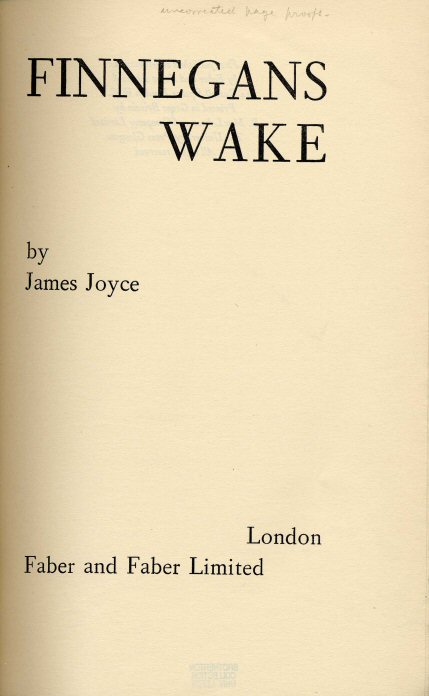
- Finnegans Wake was published by Faber & Faber[6].
- Finnegans Wake's genre is sui generis[7].
- Finnegans Wake's genre is experimental literature[8].
- Finnegans Wake's genre is Menippean satire[9].
- Finnegans Wake followed Ulysses[10].
- Finnegans Wake's Commons category is recorded as Finnegans Wake[11].
- Finnegans Wake's language of work or name is recorded as English[12].
- Finnegans Wake's country of origin is recorded as Ireland[13].
- 1923 marks the founding of Finnegans Wake[14].
- Finnegans Wake was published on May 4, 1939[15].
- Finnegans Wake's characters is recorded as Fionn mac Cumhaill[16].
- Finnegans Wake's characters is recorded as Eve[17].
- Finnegans Wake's characters is recorded as Adam[18].
- Finnegans Wake's characters is recorded as Tristan[19].
- Finnegans Wake's characters is recorded as Iseult[20].
- Finnegans Wake's characters is recorded as Jesus Christ[21].
- Finnegans Wake's characters is recorded as Arthur Wellesley, 1st Duke of Wellington[22].
- Finnegans Wake's characters is recorded as Saint Patrick[23].
- Finnegans Wake's characters is recorded as Charles Stewart Parnell[24].
- Finnegans Wake's characters is recorded as Jonathan Swift[25].
- Finnegans Wake's characters is recorded as Jacob[26].
- Finnegans Wake's characters is recorded as Esau[27].
Body
Authorship and Creation
Finnegans Wake authored James Joyce[3]. It was published by Faber & Faber[6].
Publication
Finnegans Wake was released on May 4, 1939[15]. Its language of work or name is recorded as English[12]. Genres include sui generis[7], experimental literature[8], and Menippean satire[9].
Reception
Finnegans Wake received the 20th Century's Greatest Hits: 100 English-Language Books of Fiction[4].
Adaptations and Inspiration
Finnegans Wake followed Ulysses[10].
Why It Matters
Finnegans Wake ranks in the top 0.52% of literary_work entities by monthly Wikipedia readership (11,881 views/month, #147 of 28,446).[2] It has Wikipedia articles in 26 language editions, a strong signal of global cultural recognition.[28] It is known by 20 alternative names across languages and contexts.[29]
FAQs
What awards did Finnegans Wake receive?
Honors received include 20th Century's Greatest Hits: 100 English-Language Books of Fiction[4].